

I realized something slightly uncomfortable today I couldn’t explain a transaction I had just watched complete. Not because it was complex, but because there was nothing to point at. Midnight Network gave me the result, the confirmation, the proof… but none of the usual visibility I rely on to make sense of things.
That absence keeps pulling me back.
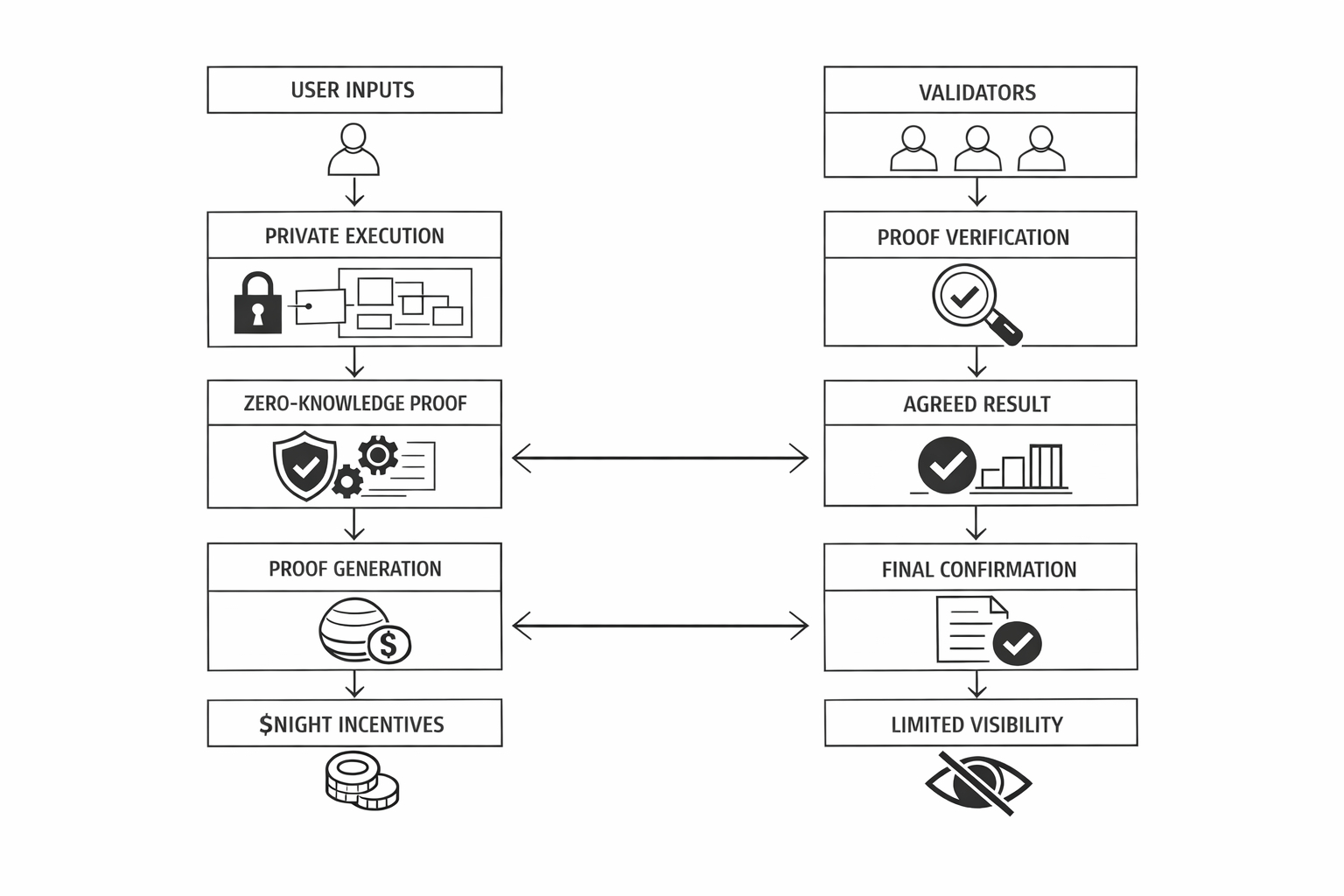
Most systems I’ve used assume that trust comes from exposure. You see the inputs, you follow execution, you verify the outcome. Midnight flips that. It uses zero-knowledge proofs so validators confirm correctness without accessing the underlying data. Execution stays private, while the network agrees on the result through proofs. It’s a clean separation—almost too clean.
I can see the motivation. A lot of real-world processes don’t need to be public to be valid. Identity checks, internal financial logic, compliance layers—these often require confidentiality. Midnight seems built for that gap, where revealing data is a liability, not a feature. So instead of sharing everything, it shares just enough to prove something happened correctly.
But I keep circling the same tension. If you remove visibility, you also remove a layer of intuitive trust. People like to check things—even if they don’t fully understand what they’re looking at. Midnight replaces that with mathematical assurance, which is stronger in theory, but less tangible in practice.
Then there’s the coordination layer. Validators operate without full context, so incentives—structured through $NIGHT—have to keep behavior aligned. That works structurally, but systems under real-world pressure don’t always behave as designed. What happens when interactions become complex? Or when something fails and there’s no clear way to inspect it?
if something breaks, you can’t debug what you can’t see.
There’s also the question of adoption. Developers might struggle to design around invisible execution, and users might hesitate to rely on outcomes they can’t verify themselves. Under load, proof generation could introduce latency, and that friction won’t go unnoticed.

Still, I keep coming back to the core idea. Midnight isn’t just improving privacy—it’s redefining what needs to be visible at all. I’m not fully convinced yet, but I’m paying attention. There’s a gap here between conceptual clarity and practical trust, and it hasn’t closed yet. That unresolved tension might be the most important part.
@MidnightNetwork #Night #night $NIGHT
