
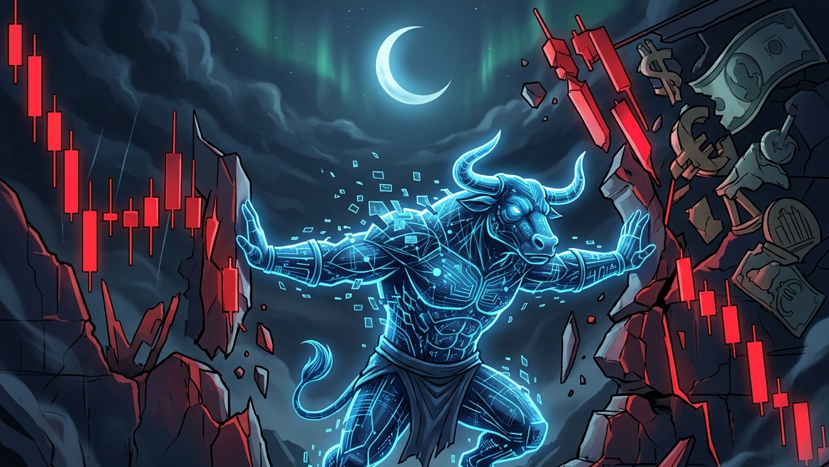
Family, today's market is truly incredible.☠️
When I opened my eyes in the morning, I habitually took a glance at the options market. Goodness, the protective premium for put options has directly broken through the ceiling. Those guys in the group who usually shout 'Wealth is found in danger' and want to catch flying knives with bare hands are as quiet as if they were attending a memorial service today.
The pancake is oscillating in an ECG-like manner near 68,900, and Ethereum is even worse, with the support level of 2100 as fragile as paper, directly smashed through. The trigger is well understood by everyone; once the geopolitical situation in the Hormuz Strait escalates, macro funds immediately enter 'escape mode'.🌍
In Xiaoxi's view, this extreme panic at the macro level is most likely to expose the soft underbelly of the underlying systems in the crypto world. Everyone is focused on how much the coin price has dropped, but I'm more worried about whether the network itself is still secure when the price plummets.
Breaking the deadlock: The unconventional Minotaur approach.
Anyway, I had no bullets to bottom fish, so I spent a whole morning, braving English dizziness, to tackle the recently released academic paper on the Minotaur consensus mechanism.
To be honest, I used to think that starting a new public chain now is simply a dead end. Cold starts are too difficult!
Look at most of the new L1s; when they just launched, to boast about security, they basically gathered a few big VCs to set up a few supernodes to control the network. This thing is euphemistically called Proof of Stake (PoS), but in Xiaoxi's eyes, it is essentially oligarchic politics based on capital hierarchy.
This model is most afraid of encountering extreme crashes like today. If large holders withdraw staked funds to hedge or are forcibly liquidated, the entire network's security will instantly face huge exposure, like a warrior without armor.
But the Minotaur protocol from IOG that Midnight is working on has an extremely 'clever' approach.
It completely shatters the single model of maintaining security relying solely on 'money (Token)' or solely on 'mining machines (computing power)'. It allows PoS (staking) and Proof of Useful Work (PoUW, such as providing useful storage and computational workload) to occur simultaneously, jointly providing security guarantees for the network. 🤝
Just think about how 'abnormal' this logic's defensive capability is under extreme market conditions.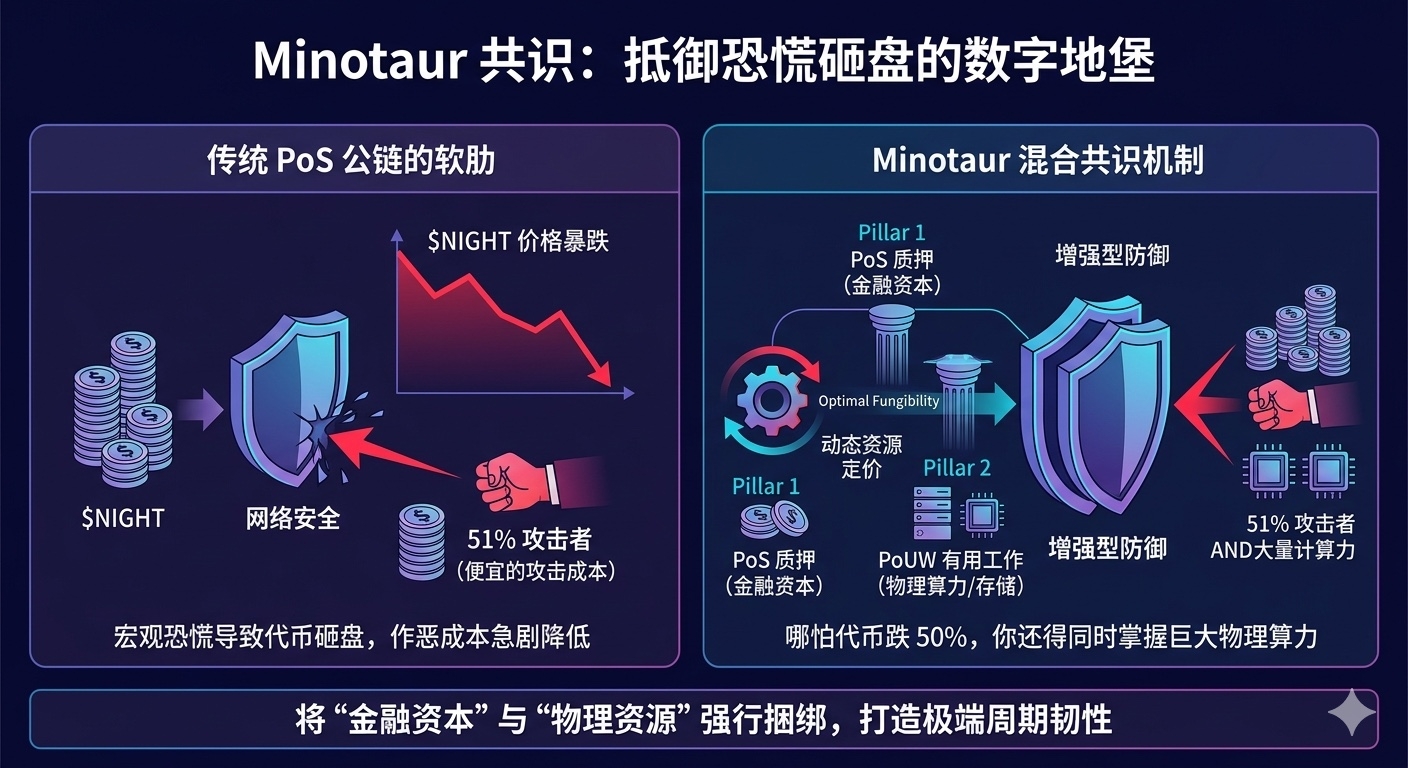
Suppose there is a macro explosion today, and the price of $NIGHT has been smashed down by half due to panic selling.
If this were on a traditional PoS chain, it would mean the cost of malicious actions is directly halved, putting the network in jeopardy.
But in the architecture of Minotaur, if you want to initiate a 51% attack, having money to buy cheap chips at the bottom is useless; you also need to control a sufficiently large amount of physically existing storage and computing resources. 💻
This mechanism that forcibly ties 'financial capital' and 'physical resources' directly raises the threshold for malicious attacks to an almost impossible height.
Situation: An enticing yet dangerous game.
There is a concept in the white paper called 'Optimal Fungibility', which means that different types of resources can be fairly converted and priced within the system.
This is the most enticing part of the entire agreement and also the part that makes me sweat the most. 😅
It does not allow any single resource to form a monopoly. If you have money, you cannot be a dictator in the network; if you have machines, you cannot dominate unilaterally.
An internal network has formed a self-competitive, dynamically balanced equilibrium mechanism, which completely inherits the paranoid gene of Cardano's Ouroboros model.
Rational observation: Implementation is the ultimate test.
Of course, talking about it on paper is always perfect.
As a trader, I, Xiaoxi, don't look at the formulas in the white paper; I only look at the real games after the implementation.
Putting staked tokens, CPU computing power, and hard disk storage in the same consensus pool for dynamic pricing is definitely 'hellish' in terms of engineering implementation. 🤯
After the mainnet goes live, if there is even a slight delay or calculation deviation in this multi-resource pricing mechanism under high concurrency and today's extreme panic sell-off, it will be immediately exploited by arbitrage scientists monitoring the underlying vulnerabilities.
So, this is definitely not an asset that can be propelled simply through marketing and hype.
Midnight is attempting to solve the inherent resilience problem of privacy public chains during cold starts and extreme cycles in an extremely heavy and hardcore academic way. It is building a bunker that can operate with multiple resources even when the external environment has crashed down to ruins.
On this Sunday, when everyone is watching the news in panic and cutting losses, studying the underlying logic designed to resist extreme risks is much more solid than guessing whether Bitcoin can recover to 70,000 tomorrow.
This type of asset is worth putting in a long-term observation pool, waiting for the real stress test data from its mainnet to come out before making a decision. 👀
What do you think, folks? Is this hybrid consensus the future or just an engineer's fantasy? Feel free to tear it apart in the comments!
