
Recently, discussions about the Sign Protocol in our square have been very heated. Everyone is studying how to interact and how to earn points, which is quite normal. But today, let's change our perspective and temporarily set aside the purely "farming for rewards" mentality, and analyze from the underlying logic: what exactly do top institutions like Binance Labs see in it?
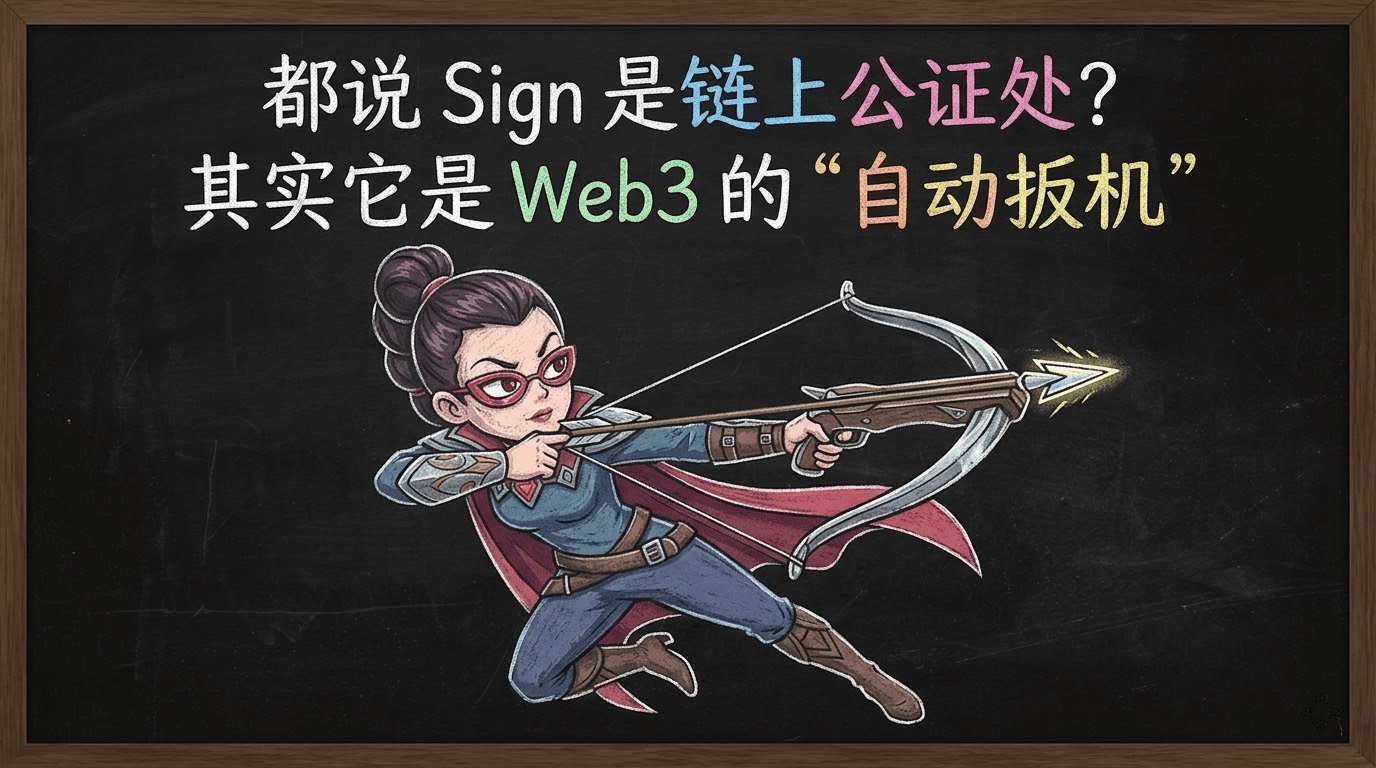
Usually when we talk about "proof", the first reaction might be an "electronic certificate of honor" issued on the chain, used to prove "I was here" and "I haven't been stolen from". To be honest, if we only see it as a tool for issuing static certificates, we might miss its true strategic ecological position.
In the complex underlying world of smart contracts, Sign Protocol is definitely not just a 'static notary', it is actually a 'dynamic trigger' that can fire at any moment.
How to understand this 'trigger'? We need to talk about a cutting-edge term in the current Ethereum ecosystem: intention-centric.
Playing DeFi right now is actually quite exhausting, isn't it? Authorization, cross-chain, staking, lending, each step requires manual confirmation, which is particularly anti-human. But the future Web3 should be 'intention-driven'—you only need to express a thought in your wallet: 'I want to earn an 8% annual yield under absolutely safe asset conditions.' The rest of the work will be automatically handled by the underlying protocol.#Sign地缘政治基建
But there is a critically fatal logical gap here: smart contracts are actually 'blind'. They only recognize code; how do they know that the external environment is 'absolutely safe' now? How do they determine whether your account meets the requirements?
At this point, Sign Protocol should shine. It plays the crucial role of being the 'truth verification hub' on-chain.
Imagine this scene: when the issuer signs several hard conditions as an attestation, confirming a few rigid conditions, such as: your on-chain credit score meets the criteria, the protocol you are going to invest in has just passed a top security audit, and your identity is also compliant, it will generate a proof.
The moment the proof is generated is like pulling the trigger of a precision mechanism; it will instantly and without delay trigger the downstream smart contracts, automatically helping you complete the subsequent lending or investment operations.
In this logical closed loop, we can derive a comparison formula that hits the essence:
(1) Chainlink = responsible for feeding the smart contract 'prices'. It tells the contract how much ETH is worth now, determining whether we will be liquidated.
(2) Sign Protocol = responsible for feeding the smart contract 'truth and state'. It tells the contract whether the current environment is safe, whether users comply, and whether things in the real world have really happened.
Everyone knows that Chainlink solved the 'price island' problem of smart contracts in the last cycle, directly supporting the oracle track's hundred billion market value.
In the all-chain era we are about to welcome, and the trillion-level wave of real assets going on-chain, if there is no underlying protocol like Sign Protocol that can provide 'programmable trust', then all automated contracts and the entry of traditional compliant funds are just an empty check.
So, this is the underlying logic for large funds to heavily bet on Sign. They are not just laying out a simple issuing tool, but the automated 'trust foundation' for the next decade of Web3. Once we see through this layer, our participation in this ecosystem will naturally be different.
