

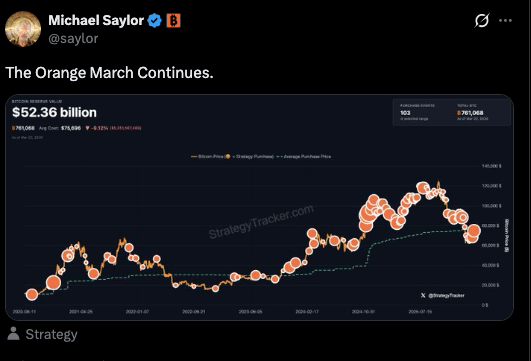
17 hours ago, MicroStrategy's Michael Saylor posted an orange Bitcoin dot matrix chart on X, see the image above.
Old investors all know that as long as they see his Twitter post in orange, they know this guy is calling for a position increase again.
Let me do some calculations for everyone. He currently holds over 761,000 BTC, with an average price of around $75,696. Based on today's market price, this position is actually facing a paper loss of about 10%, with a hole as high as $5 billion. But he doesn't care at all, still daring to increase his position despite the $5 billion loss.
Today, March 23, coincidentally a Monday, I casually flipped through Binance Square, where there were retail investors anxiously arguing over pullbacks of dozens or hundreds of points. But in the eyes of institutions at Saylor's level, they are playing the long-term dilution of the balance sheet and are not looking at the current fluctuations.
However, many people overlook a very realistic blind spot when praising Saylor: MicroStrategy's 'blatant strategy' is an absolute anomaly in traditional business warfare.
Everyone thinks that Saylor publicly shares his wallet address, average holding price, and purchase quantity every day is particularly cool, believing this is the core charm of Web3. But he dares to do this because his only current business is to 'hold on'. He is a solo player and does not need to settle with upstream and downstream, nor does he need to guard against competitors stealing orders.
If this logic of 'full network disclosure' is applied to traditional manufacturing giants or Wall Street market makers preparing to enter the market, it would be a disaster.

Assuming a large physical factory really uses the Ethereum network for global fund settlement. This means that their procurement bottom price, major client list, and even cash flow exhaustion point are all live-streamed 24 hours a day on the blockchain explorer. Competitors can spend two thousand dollars to hire a fresh graduate who understands on-chain data analysis and can completely strip your company's financials.
The core pain point for large funds has never been how to go on-chain, but how to legally 'go incognito' on-chain.
So I think @MidnightNetwork 's underlying framework is worth repeated consideration. Because it provides an extremely rare 'physical-level data isolation' capability currently available on the market.
In the past, we always thought that compliance audits must hand over the ledger. But the ZK technology in Midnight actually plays the role of a particularly ruthless 'on-chain blind box notary'.
When a company needs to prove to regulators that its funds are clean, its system is only performing mathematical operations in a local data center and then broadcasting a signal light that has passed through encryption algorithms to the entire network. Regulators can only see that this signal light is 'green', but can never open the blind box to check who the trading counterpart is and what the amount is.
It completely separates the actions of 'verifying authenticity' and 'data visibility'. This is equivalent to building an impenetrable firewall for the company's core business secrets, which is precisely the prerequisite for old money to dare to move their business in.
Take a look at #night that has been criticized by the outside world for its dual-token design. Many retail investors don't understand it and think it's a waste of effort.
But if you stand from the perspective of corporate finance, this is actually an extremely clever 'internal hedging mechanism'.
Imagine if a company uses a public chain and encounters wild speculation on meme tokens, leading to network congestion, where gas fees can surge dozens of times a day. If one day coincides with a large corporate settlement, who will bear the exorbitant transaction fees? The company's IT budget can't be approved at all.
The logic of Midnight is to allow enterprises to hold underlying assets $NIGHT , to self-'store water', continuously generating fuel DUST for paying network fees. This is equivalent to the enterprise establishing an internal fund pool completely unaffected by external cryptocurrency price fluctuations, completely escaping the deadly 'tide effect' of public chains.
Today the market is still torturing people, watching the news of old MicroStrategy's increased holdings, many think this is the barometer. But the NIGHT market looks much better, having reached a low of 0.04188 yesterday, seemingly breaking the previous lowest price when the spot was launched, but fortunately, it was pulled back today, creating a feeling of a double bottom.
Brothers, don't forget that the funds that treat BTC as digital gold are just a small part. The truly massive wealth transfer in the future will come from industries with extremely complex settlement needs and a high sensitivity to business secrets.
When this torrent truly flows in, they will never use those transparent ledgers that can sell them out at any time. Only those foundational infrastructures that can provide absolute firewalls and budget hedging capabilities will be able to catch this wave of immense wealth.