
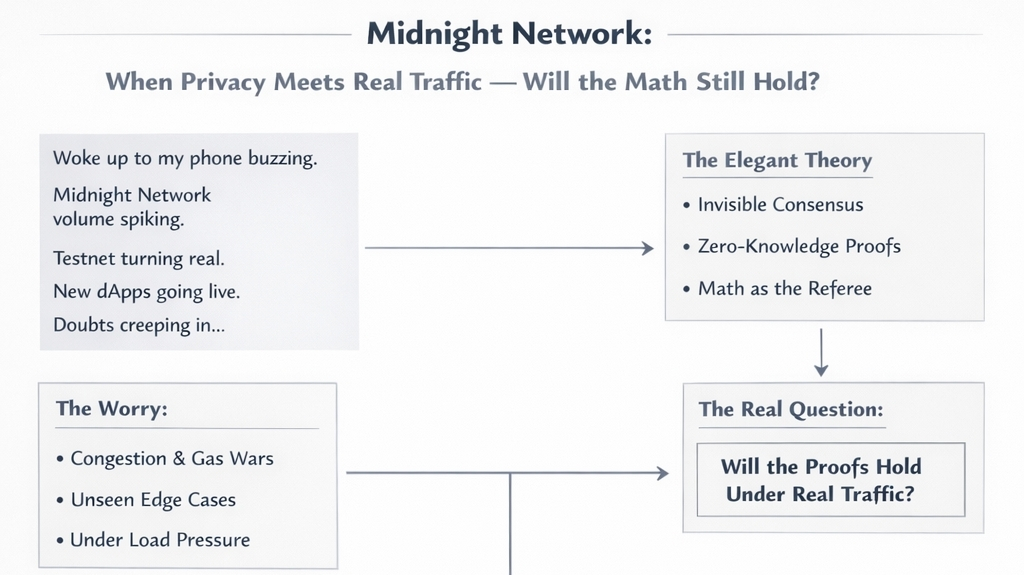


I woke up this morning to my phone buzzing like it had opinions. Not the usual airdrop spam or price alerts just a sudden flood of notifications about Midnight Network. Volume was spiking somewhere in the background, testnet traffic turning real, a few apps quietly going live and for the first time it felt like people were actually showing up.
That’s when the doubt crept in my mind.
Because up until now Midnight has been this elegant, almost theoretical thing private functions executing in the dark, proofs proving without revealing, validators nodding along without ever peeking. It all looked so clean on paper. Invisible consensus. Math as the only referee. But math has never had to deal with thousands of real humans hammering the same chain at 3 a.m. because some new dApp just dropped and everyone wants in at once.
I started replaying the usual blockchain horror stories in my head: congestion that turns elegant designs into traffic jams, gas wars that expose what was never meant to be exposed, edge cases no one stress-tested because “it worked in the lab.” And I caught myself wondering will Midnight’s proofs still hold when the traffic isn’t polite anymore?
That’s the quiet tension nobody really talks about. The network doesn’t show you the data, sure. But when real usage hits, the system still has to process it all in the background. Validators still have to verify those zero-knowledge guarantees under load. The selective disclosure still has to stay selective even when the queue is exploding. One tiny crack in the proof logic, one unexpected interaction pattern, and the whole “trust without peeking” promise could start to feel… fragile.
I tested a small private transaction myself just to feel it. It went through instantly, no trace left behind, same calm confirmation as always. But I kept thinking: that was one user. What happens at ten thousand? At a hundred thousand? When the network is no longer a quiet experiment and becomes someone’s actual financial life or business operation running in the dark?
Of course, none of this survives without the right incentives. That’s where $NIGHT slips in so quietly you almost miss it—rewarding the validators who keep showing up and doing the unseen work, nudging them to stay honest even when the pressure is invisible. It’s not flashy staking theater; it’s just the steady hand making sure the math doesn’t get tempted to cut corners when traffic gets loud.
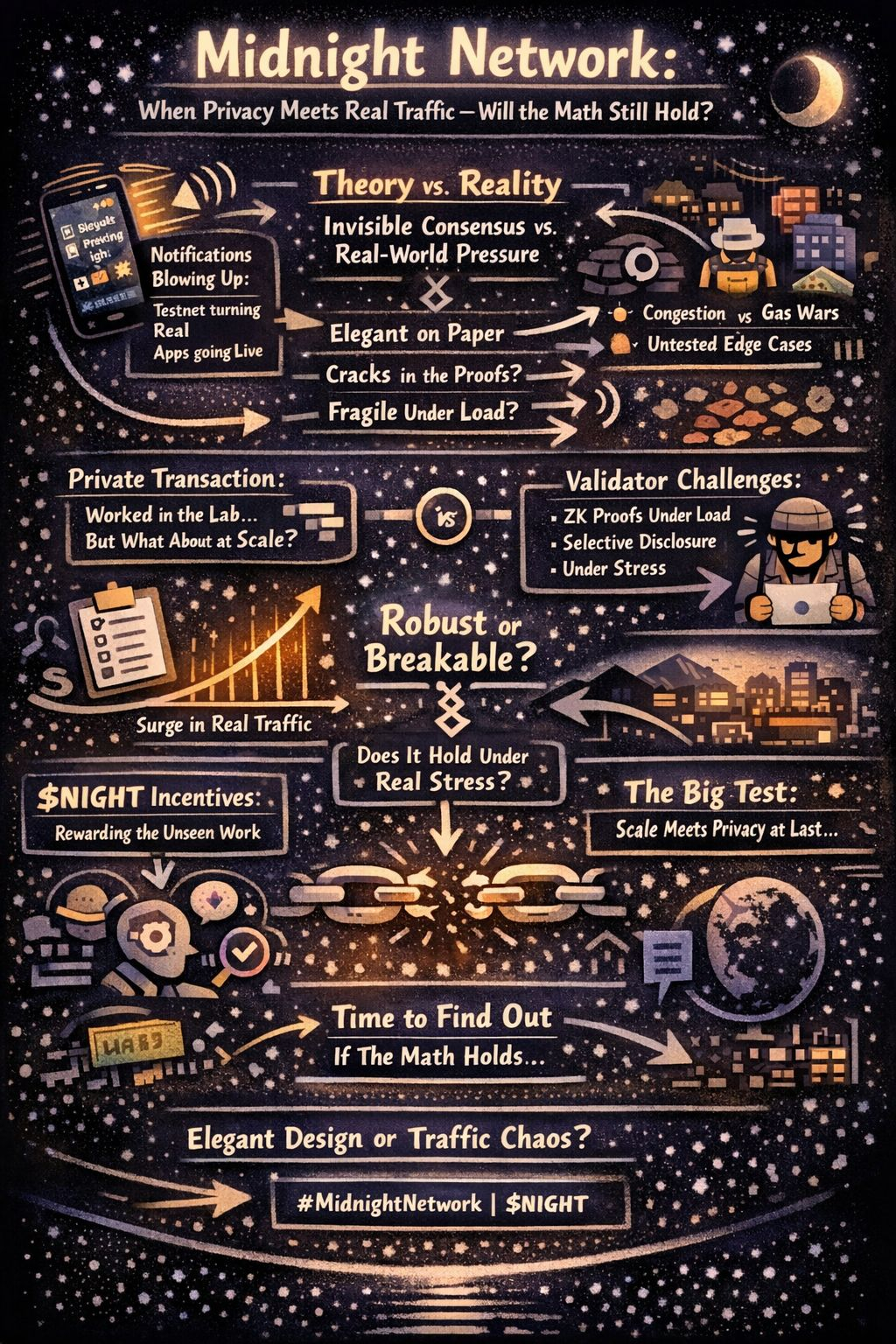
Still, I’m sitting here with my coffee going cold, staring at the screen, because the elegant architecture is one thing. Real stress is another. We’ve watched other chains look bulletproof until the first real wave hit—then suddenly everyone’s watching the same public mempool they swore they’d never need again. Midnight is betting everything on the opposite: that the proofs stay solid precisely because nothing is public. But that bet only works if the system doesn’t bend when the weight of actual adoption lands on it.
Maybe the math really is that robust. Maybe the layered proofs and distributed validation were built exactly for this moment—when privacy finally meets scale and still refuses to blink.
Or maybe, just maybe, the first big traffic spike will reveal something the whitepaper never imagined. One clever edge case. One overload pattern. One validator under pressure who starts to question whether “invisible” still means “unbreakable.”
I don’t know yet. I’m not panicking, but I’m also not pretending it’s guaranteed.
Right now Midnight still feels like that delicate experiment beautiful in theory, quietly confident in practice. But the real test isn’t coming in the lab. It’s coming the moment people stop lurking and actually start living on it.
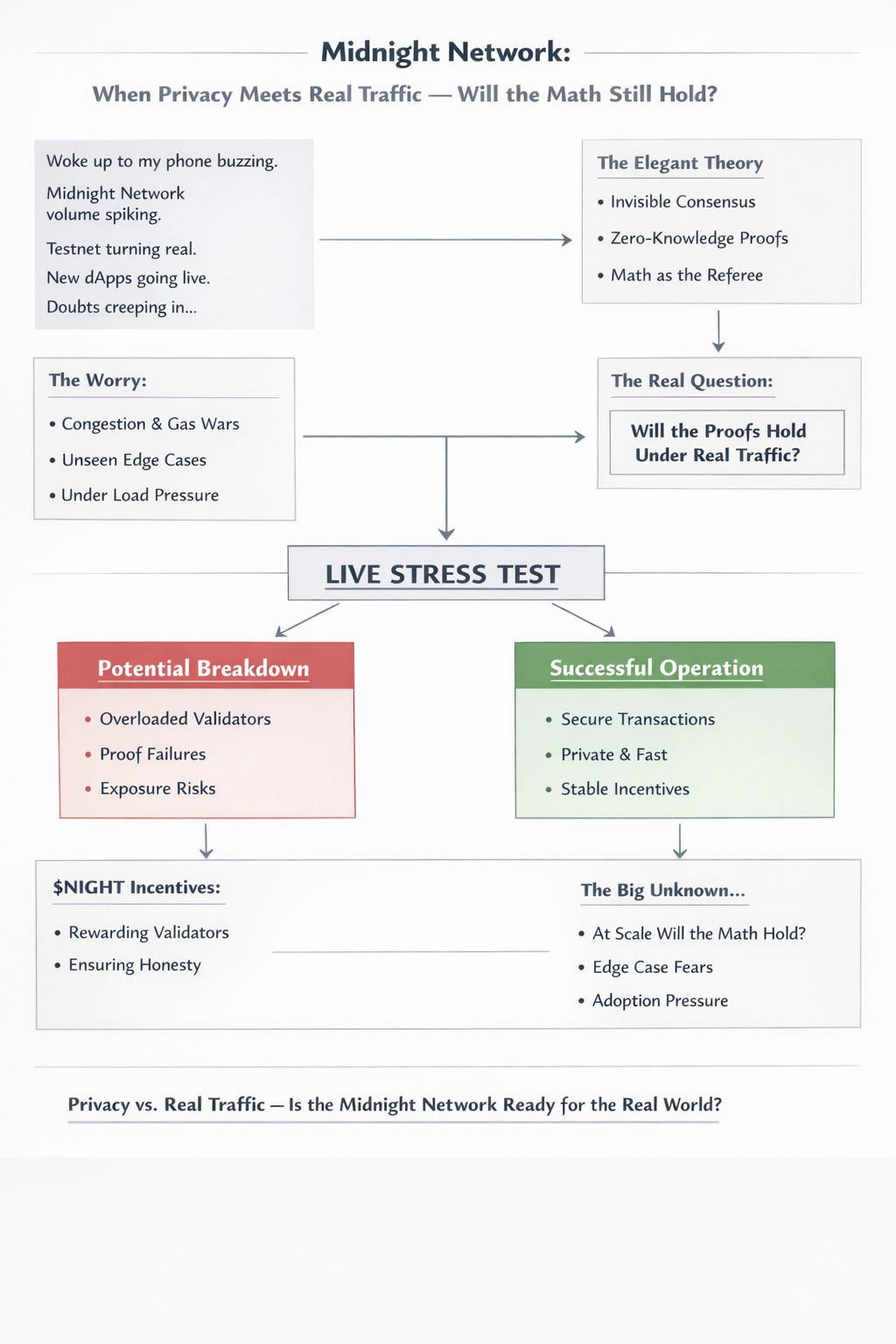
And when that moment arrives, we’ll find out if the math holds… or if even the most private blockchain still has to learn the hard way that traffic doesn’t care how elegant your secrets are.
@MidnightNetwork #night $NIGHT
