
Brothers, have you ever thought that our current Web3 identity is actually just a string of addresses starting with 0x? Although this address is anonymous, it acts like a transparent 'digital avatar'; all your interaction records and asset flows are tied to this avatar, and can be traced throughout the network. This kind of 'pseudonymous' privacy is nearly indistinguishable from 'real-name' in front of on-chain analysis tools.
I have a big shot working on a project next to me, and recently he was targeted. Hackers analyzed his address and trading habits through on-chain data, and then precisely sent him phishing emails, almost draining his wallet. This incident made me realize that there is a huge paradox in the current Web3 identity system: we want privacy, but the transparency of the blockchain leaves us nowhere to hide.
So, is there a way that allows us to enjoy the trust and transparency of blockchain while protecting our most basic identity privacy? The answer is yes, the Midnight Network was specifically created to address this pain point.
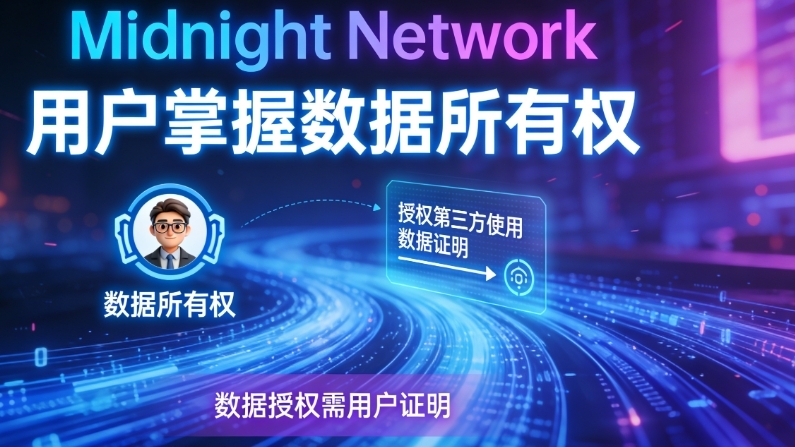
Midnight's core breakthrough is the complete separation of "data ownership" and "data usage rights." Most of the on-chain applications we currently use have data ownership actually belonging to the project parties or miners, because every time you perform an operation, the data is permanently recorded on a public ledger. But on Midnight, your data is stored off-chain or processed through encryption, and you have full ownership of the data.
Doesn't this sound a bit like the "invisible mode" in AI painting? No, it's much more advanced. It introduces a concept: verifiable credentials. For example, if you want to participate in a Launchpad that only "compliant users" can join. Traditionally, you would need to undergo KYC, uploading sensitive information like your passport and proof of address to the project party. If the project party's database is hacked, your identity information could be leaked, posing a high risk.
On Midnight, you can do this: first, an authoritative KYC organization issues you a "compliance certificate," but this certificate is not a photo of your ID card; rather, it is an encrypted digital signature that only contains the information "some address is a compliant user." When you participate in the Launchpad, you only need to present this certificate to the project party and generate a ZK proof to prove that "this certificate is real and valid." Once the project party receives the proof and verifies it, you are allowed in. Throughout the process, your real identity information never leaves you, and the project party cannot see any of your personal privacy data.
This model directly opens up the imaginative space for digital identity applications. Imagine a future Web3 social platform where you can prove you are a "Blue V certified" artist without having to tell others your real name; you can prove you hold membership in a certain NFT club without exposing other assets in your wallet; you can prove you passed a skill assessment from a certain DAO without sharing your degree certificate.
Midnight's system perfectly addresses the "minimum disclosure principle" in identity verification. It takes back the initiative of privacy protection from the platform and returns it to the users. This is a significant breakthrough for the current Web3 ecosystem.
Now we are on the chain like we are running in transparent clothes. Midnight is like a magical tailor, custom-making a garment for you that allows you to change its "transparency" at will. You decide whom to show it to and which parts to display. This may truly signify the beginning of "sovereign individuals." When your identity is no longer a series of addresses that can be infinitely traced, but a certificate that can self-verify and be self-controlled, only then will Web3 truly mature.@MidnightNetwork #night $NIGHT $ETH