
Brothers, doesn’t the current market feel a bit confusing? Bitcoin is stagnant, altcoins are not rising, those playing contracts are facing liquidation, and those in spot trading are anxious. Everyone is asking, what will be the next hotspot that ignites the whole scene? Is it RWA? Is it AI? Or is it some new zoo that just came out?
If you ask me, we should stop focusing on those projects that only know how to 'tell stories'. In this bull market, what can truly navigate through bull and bear is definitely not those air coins that only have concepts but no implementation, but rather those infrastructure giants that 'sell shovels' to the entire industry. Today, I want to chat with you about a project I have been deeply researching recently - SIGN.
At first glance, SIGN, signature? It feels like it lacks technical depth? Wrong! Totally wrong! If you understand it as "electronic signature," then you are thinking too small. The official positioning is "global credential verification and token distribution infrastructure," doesn’t that sound a bit convoluted? Don’t worry, I’ll translate it for you.
In simple terms, SIGN wants to solve two of the most troublesome problems in the Web3 world: first, "What gives you the right to prove you are you?" and second, "How to safely and compliantly send money/tokens to you?"
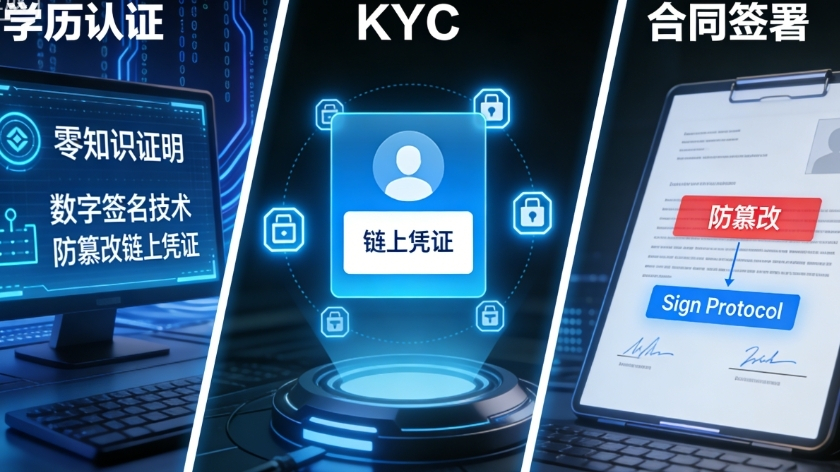
Let’s first talk about the first issue. What are we most afraid of while playing with Web3? We fear KYC leaking information, we fear wallet addresses being monitored, and we fear on-chain data being scrutinized to the bare minimum. But if you don’t do KYC, big projects won’t let you participate, and compliant airdrops won’t come your way. It’s like a vicious cycle. What is SIGN’s solution? They created a core Sign Protocol, which you can think of as a super powerful "privacy version of an ID system." It follows W3C’s verifiable credential standards and uses zero-knowledge proof technology. What does this concept mean? It means that when you go to an internet café, you don’t need to pull out your original ID and household registration book for the operator to see; you just need to scan your face at the entrance, and the machine tells you, "Over 18, you can enter," so the operator knows the result, but he can’t see any of your private information, like your name or where you live. What SIGN does is exactly this. It allows the verification of sensitive information like identity, qualifications, and compliance proofs without exposing privacy. There’s even a SignScan browser that allows these credentials to be checked and verified, public and transparent while protecting privacy. Isn’t that amazing?
Now let’s talk about the second issue, token distribution. Brothers, have you ever experienced that kind of "mouse warehouse" airdrop? The project side claims "community first," yet all the airdrop allocations go to insiders, ordinary users either get nothing or are left with dump tokens. To solve this chaos, SIGN introduced TokenTable. This is an automated token distribution engine that supports large-scale compliant airdrops, scheduled unlocks, and permission control. The most powerful feature is that it can precisely connect to the identity credentials mentioned earlier. In other words, the project side can set the airdrop rules to be "only addresses that have passed SIGN’s privacy verification, are real, and not witch addresses can receive a share." This is equivalent to equipping the token distribution with a "precision-guided system," which can prevent witch attacks while ensuring compliance, allowing the airdrop to truly benefit real contributors.
What’s even more impressive is that SIGN is not just a tool; it builds a framework that integrates currency, identity, and capital. Its native token $SIGN is used for payment protocol calls and fees, and the entire system supports multiple chains like Ethereum, Solana, and TON, showing great ambition. Moreover, they already have practical cases, having successfully bridged CBDC in the Middle East and facilitated cross-border asset migration. What does this represent? It means SIGN has already begun to be recognized by sovereign-level institutions.
So, stop just focusing on those hyped MEME coins. While everyone debates what the next hot topic is, SIGN, this "infrastructure giant," is quietly paving the way for the entire industry. It not only bridges the trust gap between Web2 and Web3 but also balances business efficiency with regulatory requirements. I feel that SIGN has captured the essence of the bull market. Brothers, what do you think? Is anyone else researching this project? Let’s chat in the comments!