
Last Friday, I had some skewers in Beijing with Lao Zhang, who is involved in cross-border trade with the Middle East. After a few bottles of big Wusu beer, he started to vent his frustrations to me. Many people think that doing business in the Middle East is just about picking up money everywhere and being chummy with the rich in Dubai. Lao Zhang scoffed and said it’s all just a filter. He deals with bulk construction materials and equipment exports over there, and the toughest challenge isn't finding clients or competing in logistics, but rather the extremely fragmented, inefficient, and arrogant 'trust verification' system.
If you want to get a huge sum of money out of the Gulf countries, or if you need to bring in a batch of sensitive equipment that meets local standards, you have to go through countless proofs: proving that the source of funds is clean, proving that the company hasn't crossed any sanction lines, proving that the actual controllers behind this shell company are you. Lao Zhang said the most desperate situation is often not lacking documents, but having a notarized document stamped domestically, only for the local compliance officer to insist that you go through another lengthy and rigid consular double certification process.
In this high-friction geopolitical hub, the cost of 'proving this matter is real' is often higher than the profit from the business itself.
After listening, I poured him a drink while calculating in my mind. I said, 'Old Zhang, your current pain point matches perfectly with a project we've been keeping an eye on called @SignOfficial .' When Old Zhang heard 'Web3,' he waved his hand and said not to talk about those token issuing scams. I quickly interrupted him: 'Don't rush to conclusions; let’s peel off the hype around cryptocurrencies and see what real-world problems this thing is actually solving.'
Tear off the 'certificate issuer' label and see the foundation of digital sovereignty.
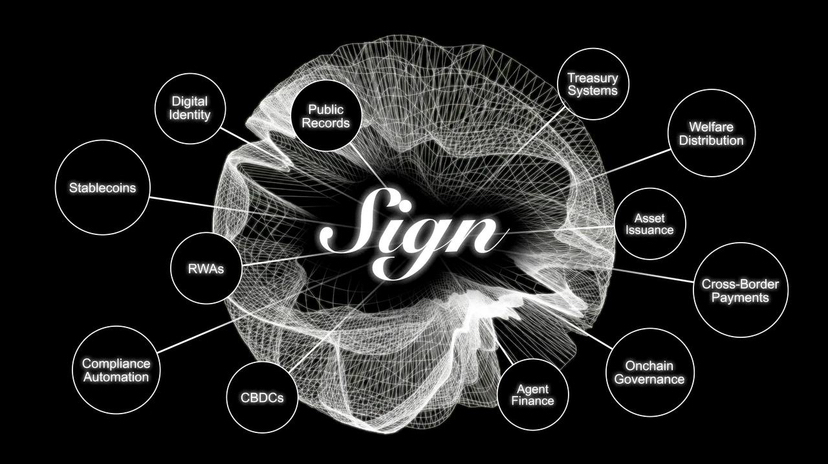
Many people have too shallow an understanding of Sign, thinking it is just a toy for issuing certificates on the chain. This is a big mistake. The true positioning of Sign is the 'Evidence and Attestation Layer.' You can think of it as a 'global digital notary office and rule enforcement mechanism' that crosses borders and cannot be altered by anyone.
For example, the qualifications of you, Old Zhang, the origin of the goods, and even the customs release order, as long as they are stamped with a cryptographic red seal through Sign's Schema (equivalent to a standardized digital mold) and stored on the chain, this becomes a forever valid, easily verifiable, and non-repudiable digital certificate. This is not me bragging; the real data is there: Sign's TokenTable product has already handled over 4 billion dollars in asset distribution, serving hundreds of leading projects. EthSign has completely transformed the electronic signature process onto the blockchain. Once a contract is signed, the rules are encoded in the software, and conditions are automatically executed without needing a middleman to gauge the situation.
Let’s broaden our perspective and return to the special context of the Middle East. Why does this place desperately need infrastructure like Sign? Because those sovereign nations in the Middle East are currently in an extremely anxious transitional period. They want to break free from their dependence on oil, diversify their economies, and attract global capital. Yet, at their core, they have a strong 'sovereign defense consciousness.'
The traditional financial infrastructure of the West (like SWIFT) makes them anxious, fearing that one day they could be directly cut off from the internet by long-arm jurisdiction. The Middle East needs a set of foundational multinational infrastructure that they can fully control but that the whole world can trust.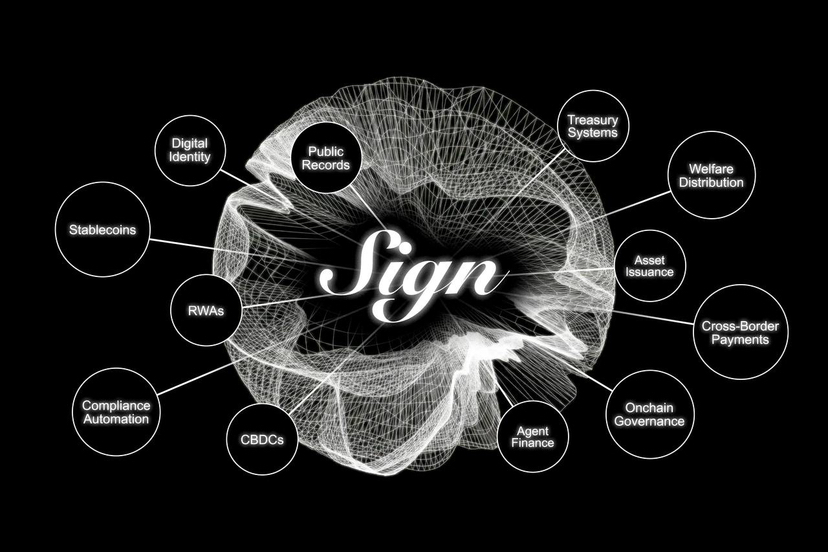
This is the most enticing part of the Sign narrative: it supports zero-knowledge proofs (ZK) and selective disclosure. What does this mean? It means that customs in the UAE or the financial regulatory agency in Saudi Arabia can use Sign to build a local network. Foreign enterprises can prove their innocence on it, simply needing to demonstrate to the system that 'I am compliant,' without having to expose their core business secrets or supply chain cards to others. This preserves national data sovereignty while maximizing verification efficiency for multinational business.
This kind of table that can serve as 'the digital sovereignty infrastructure for economic growth in the Middle East' is the real story worth big money. Once established, it will be the 'Suez Canal' of future digital trade in the Middle East, with growth potential and barriers that are unfathomable.
The conclusion is not absolute: first ensure survival, then consider the next steps.
But when Old Zhang's eyes lit up, I had to pull back a bit. When doing homework, one can boldly hypothesize, but when it comes to spending real money, our rule is: you can hype verbally, but you must be steady in action, first ensure survival, then consider the next steps.
I keep an eye on $SIGN , but there are still a few fatal questions lingering in my mind:
The landing cycle is hellishly difficult: this vision is extremely grand, but anyone who has done To G (government-level) and heavy To B business knows that the landing cycle is outrageously long. You need to get those deeply entrenched interest groups in the Middle East and the old bureaucratic systems to recognize and adopt a set of blockchain verification standards while holding their noses; this negotiation cannot be resolved just by writing a few impressive lines of Solidity code. A strategic cooperation signed today may be shelved tomorrow due to a policy change.
The true value capture of tokens: this is the core issue. If the UAE or Saudi Arabia really uses this network architecture but mandates that all verification fees (Gas) and tolls must be settled using their own issued digital dirhams for financial sovereignty, then what role does $SIGN play in this? If the token cannot become the indispensable 'lubricant' and 'toll' in this vast verification machine, then no matter how great the protocol is, retail investors buying tokens will just be spectators.
Before leaving, Old Zhang settled the bill, saying he would have to make another trip to the consulate for certification tomorrow. Looking at his back, I felt quite emotional. The world is becoming increasingly fragmented, and the friction cost of trust is visibly skyrocketing.
From this perspective, the track that Sign is betting on is extremely precise—in a world lacking mutual trust, 'standardized trust verification' will definitely become the most expensive resource in the next cycle. I will keep it on my watchlist and focus on its real on-chain usage, the actual progress of government and enterprise cooperation in the Middle East, and the closed-loop logic of the token economic model.
It could potentially become the underlying main artery of digital sovereignty in the Middle East, or it could be dragged into mediocrity by prolonged geopolitical games. Investing is like this: maintain a rational coldness, and place bets only when you're certain.