
In this era where big data understands you better than your mom, privacy is sometimes as thin as a piece of paper.
My friend went to the bank to handle business a couple of days ago and almost broke down on the spot: he was inputting his password inside, and the person behind him was crazily zooming in and taking pictures of his receipt.
In less than ten minutes, his transfer records and balance appeared in the friend circle: “Family, this person actually has 1000000!”

This is really called having no dignity.🙄
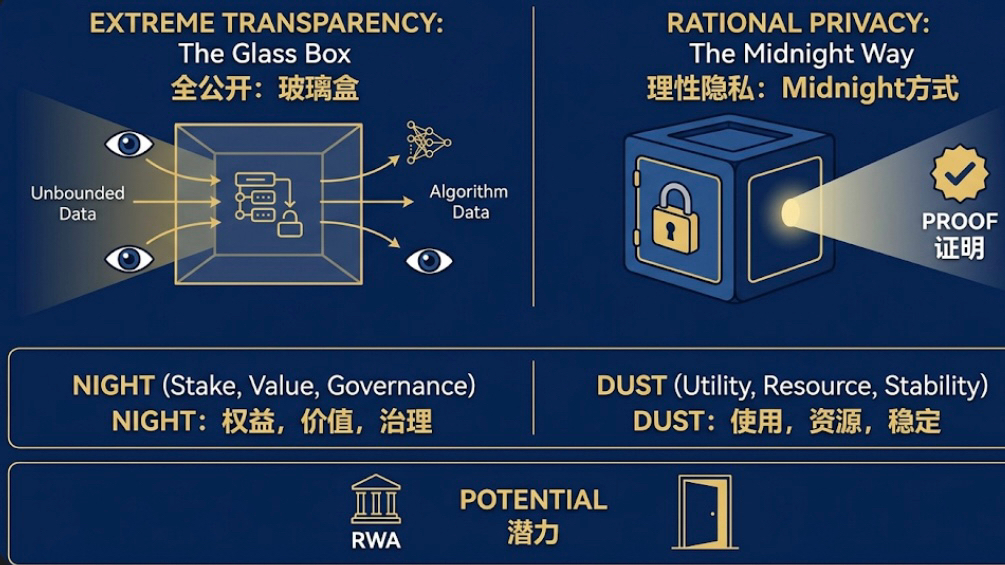
In Xiao Xi's view, the current on-chain world is essentially this unprotected “privacy bank.” Every transfer you make, every interaction with agreements, even your operational habits, are permanently etched in a public ledger. Many people think this is called “fairness brought by transparency,” but I increasingly feel that it equates to stuffing everyone into a surveillance system with no blind spots.
The key is that this game rule is not friendly to ordinary people. You can click around with a browser, while professional institutions rely on computing power, algorithms, and node advantages to sweep data in real-time. Just when you think about 'bottom fishing', they might have already secured their positions in advance. 'Transparency' instead amplifies the asymmetry of information.
So, Xiao Xi has begun to pay attention to @MidnightNetwork . What it wants to solve is not a simple 'on or off', but how to find a balance between trust and privacy. It is neither as fully open as Ethereum nor a black box like traditional privacy coins.
Midnight follows the 'rational privacy' route: using zero-knowledge proofs (ZKP) to separate 'data' from 'proof'. You can prove 'I am qualified' without having to hand over the original details. It's like identity verification; the system just needs to confirm 'you are fine' without needing to see a copy of your ID. I think this is the dignified way for adults: hiding what needs to be hidden and proving when it needs to be shown.
Its economic model is quite interesting. Many people focus only on $NIGHT 's price, but what really has substance is its dual-layer structure. In Xiao Xi's view, NIGHT is more like the rights layer, responsible for governance and long-term value; while DUST is actually used to pay for privacy computing.
I quite agree with this split. The traditional single-token model raises usage costs when the market goes crazy, which is unfriendly to those who genuinely want to use the network. NIGHT is responsible for market expectations, while DUST remains relatively stable. Essentially, it separates 'asset volatility' from 'usage costs', making the network more like infrastructure rather than a casino purely driven by emotions.
Of course, any project has a long way to go from design to realization. Xiao Xi is currently focusing on these points: first, the pace of the mainnet's progress, as the market is very sensitive to timing. Second, the actual usage of DUST; without a consumption model, it just idles. And then there's the retention of ecological applications; someone really needs to be dependent on it.
Their idea of a 'data disclosure proof' market is also quite attractive. Using ZK-audited credit or asset information, packaged into certificates directed at protocols needing risk control. In RWA and DeFi scenarios, this potential is significant. But the challenges are also clear: privacy computing has costs, and ZK proof generation is not zero-cost. If the fees during peak times are unfriendly, it could be a disaster for small-scale scenarios.
The underlying parameters are still being refined, and the officials have mentioned that Q3-Q4 of 2026 will gradually clarify. During this period, developers really need to be cautious. Token pricing and volatility will also affect actual adoption. Institutions want certainty; when the market fluctuates, budget planning becomes difficult. There will be share releases next year, and changes in liquidity also need to be monitored.
So Xiao Xi's current judgment is: the direction has value, but the core still lies in verification. If you want to participate, it's advisable to first run in the test environment and wait for the parameters to land. After all, if blockchain maintains extreme transparency, it will be hard to truly support large-scale business. No enterprise is willing to lay out their cash flow and customer strategies on a public ledger.
Privacy is not about hiding bad things, but rather preventing normal behavior from being overanalyzed. It's like that unprotected bank: it looks fair and open, but when it comes to doing business, everyone still wants a space with doors and walls. On the chain, if Midnight can build this 'door', its significance might be greater than we imagine. As for $NIGHT becoming part of it, I'm not in a hurry to draw conclusions. I prefer to continue observing how it evolves from a good idea into infrastructure.
In this era, the boundaries of privacy and compliance are becoming increasingly critical. Midnight is an attempt at 'rational privacy'. It optimizes efficiency with technology, and the dual-resource model isolates rights from costs. I think this aligns with the logic of infrastructure. Especially under the RWA boom, this middle state of 'not opposing regulation while not sacrificing users' could be a safe harbor.
The progress of the on-chain world is a redistribution of power. Extreme transparency gives algorithms the power of judgment, squeezing out the 'shadow space' of individuals. Without reasonable privacy, we become specimens. The significance of $NIGHT might be to leave everyone a corner where 'silence is allowed'.
In the era of data exposure, preserving a moment of quiet at midnight may be the last dignity. I will continue to keep an eye on the economic parameter updates for Q3. If it lands smoothly, I would love to see it establish that 'bank counter that can close'. Who wouldn't want a quiet place to think on the chain? 🤔