The airdrop group is often the noisiest not on the day the project makes an announcement, but on the day everyone is watching the unlocking schedule together.
Some people want to sell as soon as they receive it, some are counting the days until they can cash out, and some are watching the same batch of addresses to see if they will collectively dump.
This scene is too common in the crypto world.
The distribution design of many projects, to put it simply, is to push the emotions to the top first, and then leave the selling pressure to the market.
There is excitement, but later the price and confidence collapse together, which is not surprising.
So recently I watched Midnight again, but this time I first looked at how it released NIGHT.
It's not that token distribution is more important than technology, but how a project distributes its coins often reveals whether it wants to run a short sprint or really wants to get the network up and running.
The official NIGHT guide published in December 2025 outlines the rules in detail.
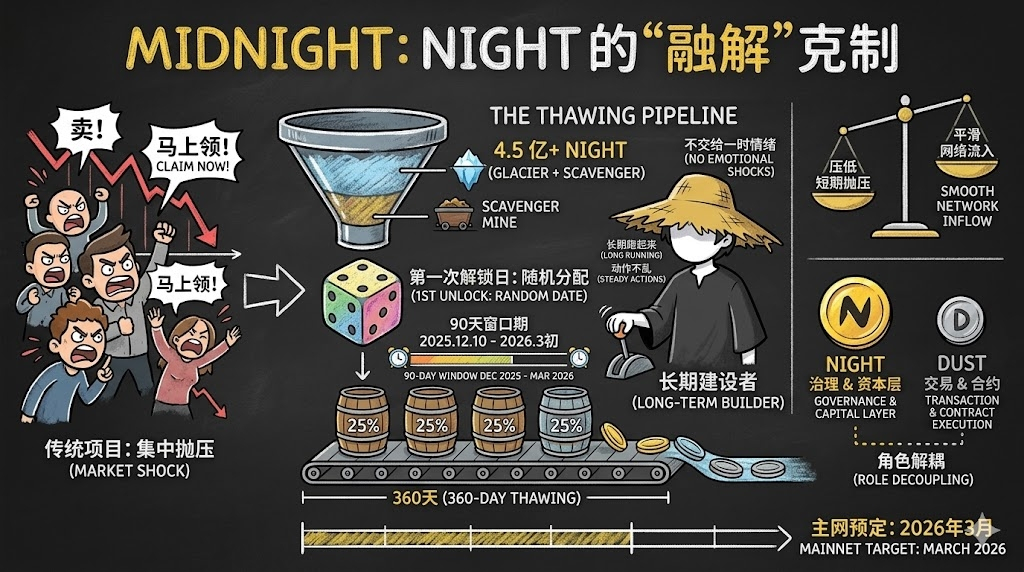
$NIGHT has already been launched on the Cardano side, and the community has collectively received over 4.5 billion NIGHT through the two phases of Glacier Drop and Scavenger Mine.
The first phase is aimed at self-custody holders of ADA, BTC, ETH, SOL, XRP, BNB, AVAX, BAT, with a distribution volume exceeding 3.5 billion and more than 170,000 participating addresses.
In the second phase, Scavenger Mine issued another 1 billion, with over 8 million participating addresses. This scale is not trivial.
But what's more interesting is not the volume, but how it resolves.
@MidnightNetwork did not take the route where everyone opened the floodgates on the same day.
The official statement is very clear: the community distribution will take 360 days of thawing, divided into four parts, each 25%. More importantly, the first unlock date for each address is not uniform, but randomly assigned within the 90 days from December 10, 2025, to early March 2026.
In other words, even if they all receive NIGHT, the actual time point when it starts flowing into the market is dispersed.
I think this design is very clever because it doesn’t press a single person’s desire to sell, but rather that common and damaging one-day concentrated selling pressure.
This detail actually feels very much like the overall impression Midnight gives me.
It’s not the kind of project that first turns on the stage lights and gathers applause before moving on.
It cares more about whether the system can run long-term, and whether the actions will suddenly throw itself off balance.
The token distribution step also follows the same line of thinking.
It’s not about putting everyone at the same time point to compete in speed and emotions, but rather breaking the rhythm first so that the distribution itself doesn’t become the first round of impact on the network.
Furthermore, this design is also connected to the role of NIGHT itself.
In the official definition, NIGHT is not just a trading target; it is the public native governance token of the network and the capital layer. What is consumed when executing transactions and smart contracts is DUST generated by NIGHT.
In other words, Midnight has been trying to separate the price of the coin from how the network is used from the very beginning.
You may not like the slow rhythm, but it's hard to say it didn’t consider what comes next.
Looking at Midnight now, the strongest feeling I have is not 'will it rise', but 'it rarely hands itself over to momentary emotions.'
From setting the mainnet in late March 2026, to the DUST resource model, and to the deliberately prolonged and dispersed thawing design of NIGHT, the entire project is doing the same thing: trying to prevent the most essential long-term building from being misled by the shortest-term noise.
In this market, such restraint is actually quite rare.
@MidnightNetwork $NIGHT #night