
Today, the alpha TGE fell asleep, and when I woke up, I found that time had passed. This is a big loss, unfortunately missed again, reminding me that what is yours will always be yours. Let’s continue to look at the situation regarding Midnight.
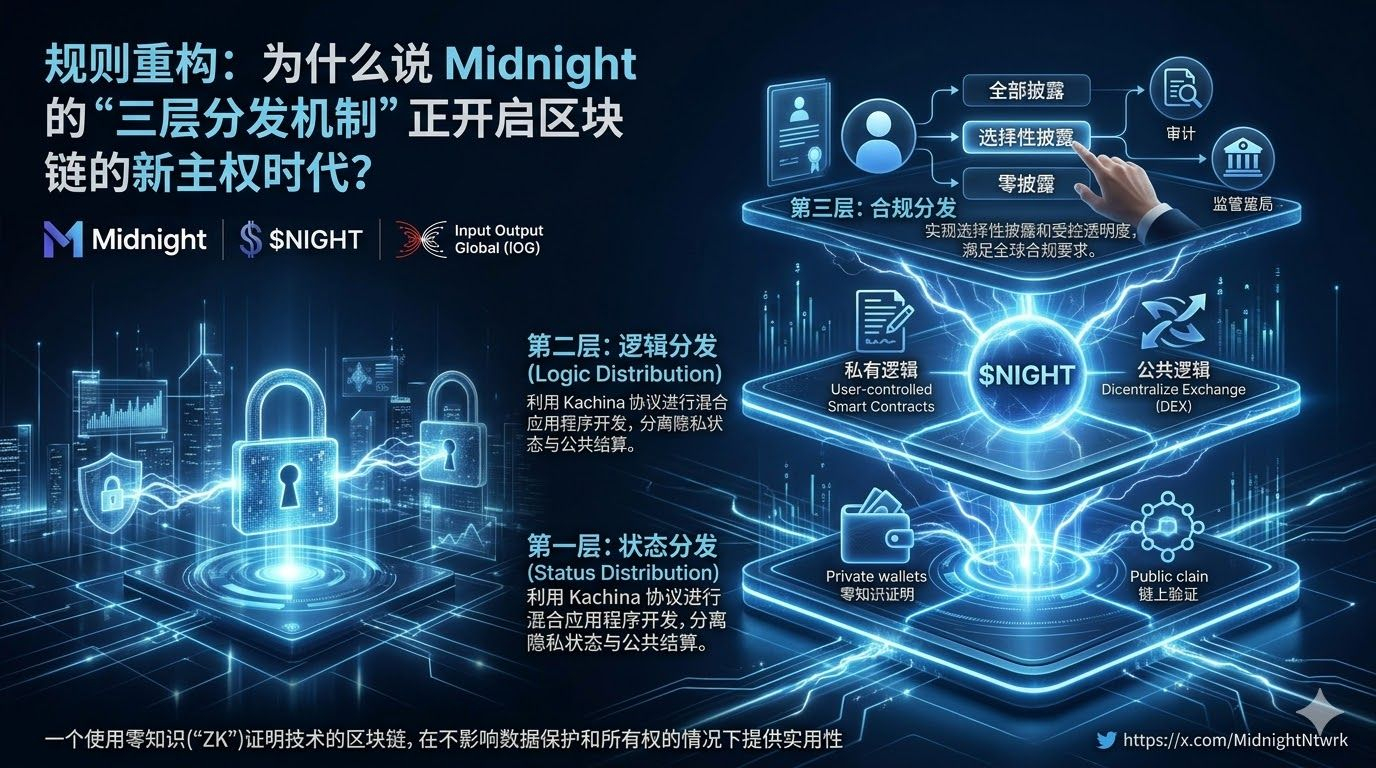
I found that the core logic of @MidnightNetwork is not simply about privacy encryption, but a sophisticated three-layer distribution mechanism designed to balance the interests of multiple parties.
Layer One: Status Distribution — The Dynamic Duet of Privacy and Publicity
Midnight's first layer of innovation lies in the redistribution of 'ledger status'. Traditional blockchains require all nodes to verify all data, which means that every transaction and every smart contract’s status is exposed to the whole network.
Midnight utilizes Zero-Knowledge Proofs for asynchronous state distribution
Off-chain Execution: Users prove the correctness of logic locally.
On-chain Verification: Only compact ZK proofs are stored on-chain.
This distribution mechanism ensures that necessary asset ownership is distributed among users, while system consistency proofs are distributed on-chain.
Layer Two: Logical Distribution - Hybrid Applications (Kachina Protocol)
If state distribution addresses who owns what, then logical distribution addresses how to use it.
Midnight introduces the unique Kachina protocol, a privacy-preserving smart contract architecture.
Before Midnight, privacy contracts often struggled to implement complex interactions.
Midnight's 'Three-Layer Distribution' intricately segments at the logical layer:
Private Logic: Handling sensitive parts involving personal identity and financial privacy.
Public Logic: Handling public parts that require consensus across the network and liquidity sharing.
By distributing logic between private and public state machines, Midnight allows developers to build hybrid applications that protect user business secrets while meeting on-chain logic settlement.
Layer Three: Compliance Distribution - Bridging Privacy and Regulation
This is $NIGHT the most forward-looking dimension. The collapse of previous privacy protocols often stems from their 'anti-audit' characteristics. Midnight proposes a compliance distribution mechanism with selective disclosure.
Through $NIGHT token-driven incentive systems, the protocol supports users in distributing a view permission or compliance proof to trusted third parties without exposing the underlying private key.
This is no longer a game of all or nothing.
This is a form of controlled transparency
This distribution mechanism allows Midnight to enter the mainstream financial system. It is not a cover for hackers but a vault for enterprise-level applications.
$NIGHT: The fuel and anchor of the distribution mechanism
In this three-layer architecture, #night plays multiple roles:
Security Anchor: As the network's native token, it ensures the security of the consensus layer.
Privacy Cost Balancing: Adjusting the resource allocation for ZK proof generation and verification.
Governance Weight: Determines how the protocol evolves its privacy protection boundaries in the future.
Summary: From 'Cryptography' to 'Empowerment'
The emergence of Midnight marks a paradigm shift in the privacy track from 'avoiding regulation' to 'empowering practicality.' Its three-layer distribution mechanism - privatization of state, hybridization of logic, and compliance selectivity - constructs an unprecedented digital space.