

There was a news story recently: in a certain encryption case, law enforcement relied on on-chain analysis to layer by layer restore a funding path that was thought to be 'cleaned'. The related addresses had almost no escape space.
Such things are no longer new.
After staying in this circle for a long time, you will gradually accept a fact: the so-called privacy on the chain is mostly just an illusion.
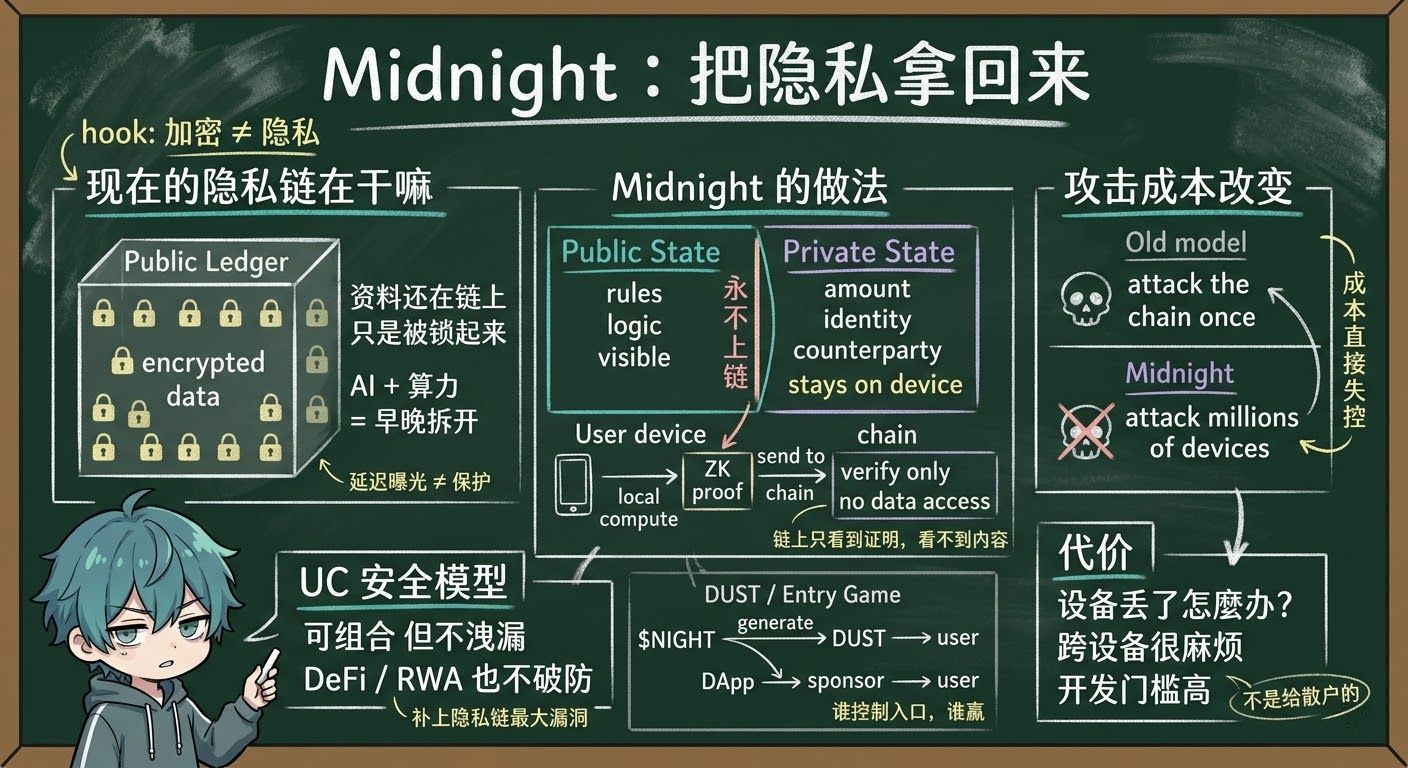
As long as the data remains on the public ledger, even if encrypted, the day it gets decrypted is only a matter of time with the advancement of computing power and analytical tools.
✃┄┄✁┄┄✃┄┄✁┄┄✃
It is also because of this that I revisited @MidnightNetwork Nightpaper.
$NIGHT handles it very straightforwardly: sensitive data is not placed on the chain.
Many current practices of 'privacy chains' are actually just encrypting data and continuing to place it on the chain. The essence hasn't changed; it's still a public database, just with an additional layer.
Once the day comes when cryptographic assumptions are shaken, or a key node has issues, the risks will be released all at once.
Midnight has changed direction.
They split the contract state into two parts: one part is public, and the other part remains completely local.
What is public are those contents that do not involve privacy, such as contract rules; what is private includes transaction amounts, identities, counterparties, and these things will not be uploaded.
It only exists on your device or in a trusted execution environment.
✃┄┄✁┄┄✃┄┄✁┄┄✃
Then how is the transaction completed?
The computation step should be completed on local devices.
After the calculation, a minimalist zero-knowledge proof is generated. The chain only receives this proof, and nodes are only responsible for verifying 'this transaction complies with the rules and has no double spending.'
As for how much you actually transferred, no one can see.
The methods of attack have also changed.
In the past, it was only necessary to breach one chain; now, each user's device must be breached one by one. The level of cost has directly changed.
Their underlying Kachina protocol adopts the UC security model, which is crucial.
When you combine it with complex scenarios like lending, RWA, and liquidation, privacy will not be weakened by the combination. Many projects have problems here; they try to fix everything at once.
✃┄┄✁┄┄✃┄┄✁┄┄✃
But the costs are also laid out.
Keeping data locally means that issues such as device loss, migration, and synchronization become real problems. Coupled with the complexity of this proof system, the development threshold is not low.
Teams accustomed to quick access find it difficult to adapt to this rhythm.
This chain was not initially aimed at retail investors.
It is more like infrastructure prepared for organizations that are extremely sensitive to data leaks.
✃┄┄✁┄┄✃┄┄✁┄┄✃
Looking at its other design layer.
Midnight separates 'holding' from 'using'.
DUST is not a freely transferable fee token; it is more like a distributed usage quota. $NIGHT Holders can direct it to addresses, and DApps can also bear the cost for users.
Users can even obtain usage capabilities indirectly through other assets without directly holding the related tokens.
The problem has changed.
It's no longer about who holds more, but who can deliver transaction capabilities to users.
Wallets can become a layer of abstraction; DApps can hide costs in the backend, and infrastructure can schedule in the capacity market.
Whoever is closer to the user and can provide this capability more stably will be positioned further ahead.
✃┄┄✁┄┄✃┄┄✁┄┄✃
This is actually very similar to the real world.
A newcomer, when no one knows them, has to try every step by themselves; once someone leads the way, the situation will change immediately.
Midnight also followed a similar path in early security.
The new chain's launch phase is the most vulnerable, with few nodes, low staking, and low attack costs.
It did not use high inflation to attract validators but borrowed from the existing SPO network of Cardano.
Initially, blocks are produced by permissioned nodes, and then gradually introduce SPO filtered by ADA staking weight. These nodes already have long-term returns and reputation binding in the original network, making the cost of wrongdoing very high.
What is borrowed is not just computing power, but also a complete set of established constraints.
✃┄┄✁┄┄✃┄┄✁┄┄✃
The traditional method of relying on high rewards for cold starts often releases tokens while bearing price fluctuations. The network is not yet stable, and participants are already wavering.