
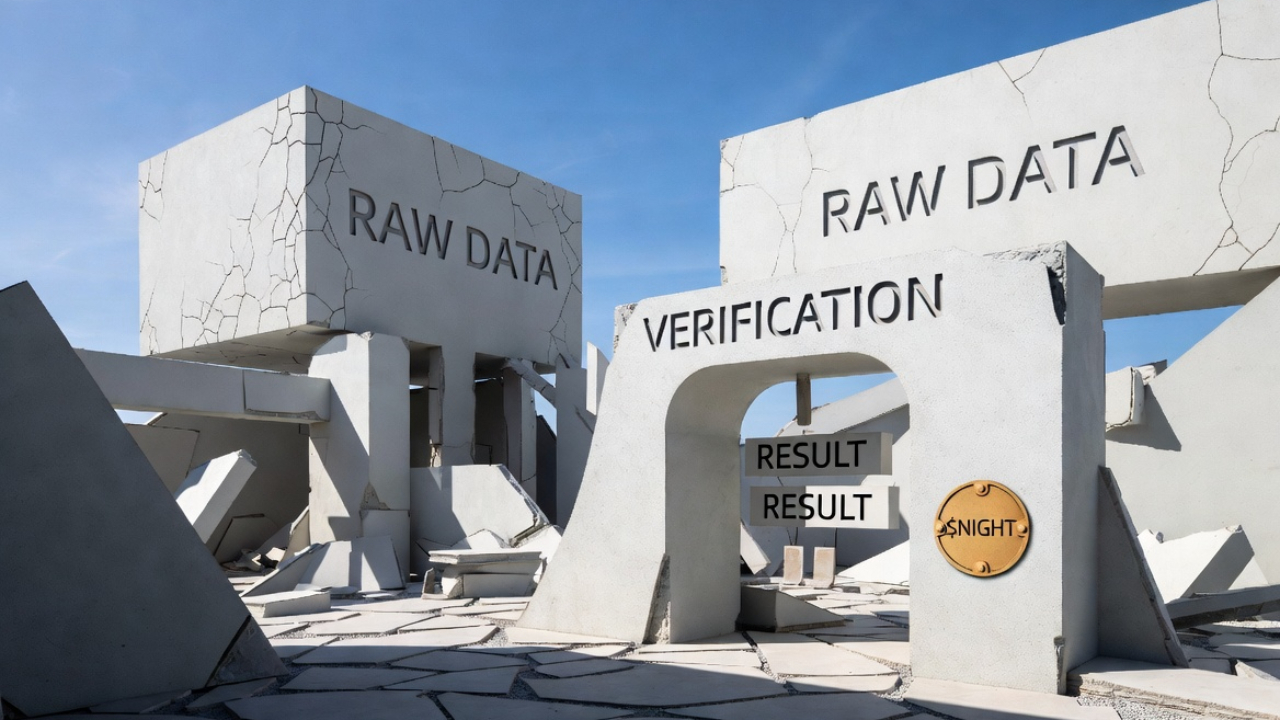
The on-chain world has a strange flaw: the more you want to be 'formal', the easier it becomes to turn into 'being searched'. Qualifications, limits, thresholds, compliance, risk control—these originally only require one conclusion, but processes often demand original documents: more fields, more records, more associations. In the short term, it seems to save effort, but in the long term, it turns users into data mines that can be repeatedly exploited. Data ownership in this mechanism will gradually distort: you own it, but you cannot control how long it is stored in the process, who copies it, or who pieces it together.
@MidnightNetwork 's route is relatively harsh and pragmatic: changing verification from 'submitting original documents' to 'submitting verifiable conclusions'. ZK here is not about showing off skills, but rather changing the interaction from 'trust you' to 'verify you', and trying to only verify the parts you want others to verify.
1) Treat 'conclusions' as products, rather than treating 'privacy' as a slogan
Many projects discussing privacy end up discussing hiding, resulting in business stagnation.@MidnightNetwork It is more like turning 'proof' into a product capability: verification must still be done, but the object of verification is the conclusion, not the original.
This will directly change a common scenario: participation qualifications, limit restrictions, permission proofs, rule compliance. You can perform actions, the system can verify results, but the process no longer inherently requires you to reveal all your cards.
2) The real enemy of data ownership is process inertia
The easiest way to steal ownership is not through one-time leaks, but through the process defaulting to 'keeping copies': forms, logs, audit materials, risk control samples, which accumulate and become long-term assets. The more fragments there are, the more complete the profile; the more complete the profile, the harder it is for users to explain what they have actually exposed.
@MidnightNetwork Attempt to cut off 'copy inertia': if proof can solve the issue, do not bring the original into the process. If the original does not enter the scene, control will not automatically slip away.
3) The practical value of ZK: reducing dispute costs, not just reducing exposure
Many people see privacy as a moral issue, but in actual collaboration, it is more like a cost issue: disputes, misjudgments, excessive collection, compliance friction.
When the process only obtains conclusions, many disputes can be resolved in advance: you do not need to explain a bunch of details to prove your 'compliance,' and the system does not need to retain a bunch of unnecessary sensitive materials 'just in case.' This is not romanticism; it is about reducing system friction.
4) The hard task of tokens: long-term supply and executable evolution
If proof and verification become fundamental capabilities, costs will exist in the long term: computation, verification, infrastructure, toolchain, exception handling. The network must also be able to upgrade, correct errors, and transition versions.
At this time $NIGHT it cannot just be a good-looking symbol; it is more like a component that allows the system to be usable in the long term: enabling 'usage' to feed back into supply, allowing 'evolution' to have an execution path, rather than relying on a halt when problems arise or an upgrade based on guesswork.
@MidnightNetwork 's sharp point is that it does not promise a more mysterious world; it just wants to ensure that on-chain tasks no longer default to swallowing people: verify if possible, but do not treat the original as a toll. It is only when this 'verifiable conclusion, no leakage of the original' interaction becomes the default experience that it truly becomes a watershed moment.