Most traders make the same mistake.
They think if the market isn’t moving fast, nothing is happening.
But in reality, slow markets are often the most important ones.
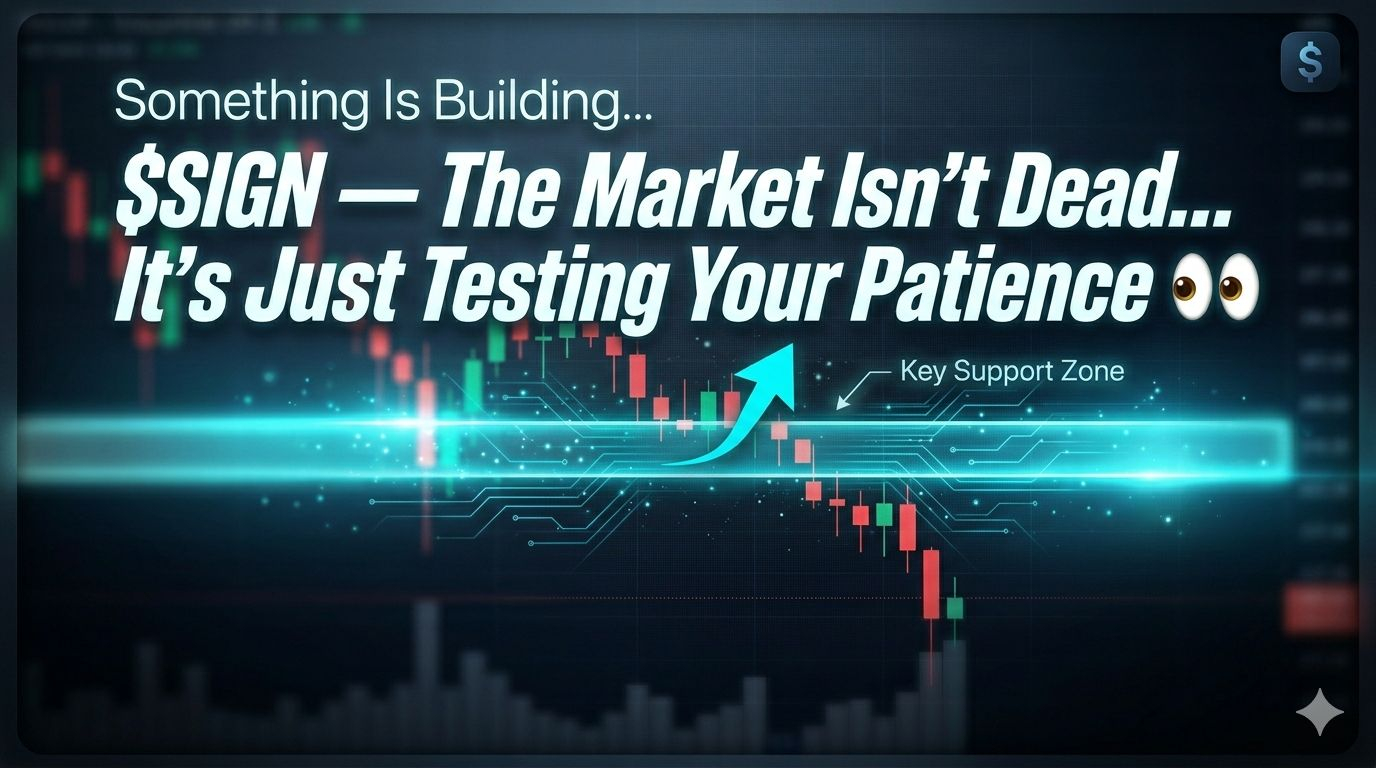
Right now, $SIGN is not giving explosive moves. No big breakout, no extreme volatility, no instant profits. For many, that makes it “boring.” But if you look closely, this is the phase where the market is quietly deciding its next direction.
The recent price action shows a shift from randomness to control. Earlier, moves felt reactive — quick spikes, fast drops, emotional trading. Now, things are different. Price is starting to respect levels. Support is holding more consistently, and pullbacks are not as aggressive as before.
This matters more than it looks.
When a market stops falling easily, it usually means sellers are losing strength. It doesn’t automatically mean buyers are in full control, but it shows that selling pressure is no longer dominant. And that’s often the first step before any meaningful upward move.
Another key detail is how SIGN behaves during dips. Instead of sharp breakdowns, price tends to stabilize quickly. This suggests that there is interest in buying lower levels, even if it’s not aggressive yet. Markets don’t need strong buying at the start — they need consistent buying. And that’s what seems to be building here.
On the upside, resistance is still acting as a barrier. Price approaches it, slows down, and then pulls back slightly. But the important part is that it’s not getting rejected hard. This creates a compression zone — a range where the market keeps testing both sides without fully committing.
This type of setup is often underestimated.
Compression builds pressure. The longer the market stays in a tight range, the more energy it stores. And when that energy finally releases, the move tends to be sharp. That’s why these quiet phases often come before strong breakouts.
From a practical point of view, this is not a “chasing market.” It’s a “watching market.” Traders who jump in without confirmation may get stuck in sideways movement. But those who wait for clear signals — like a strong breakout above resistance — usually get better opportunities.
At the same time, it’s important to stay realistic. Not every consolidation turns into a bullish move. If SIGN fails to hold its support levels, the entire structure can shift. What currently looks like preparation could turn into extended consolidation or even a gradual decline.
This is where discipline matters.
Instead of assuming direction, it’s better to observe behavior:
Does support continue to hold?
Does price keep returning to resistance?
Does volume increase during upward moves?
These small details often reveal more than any prediction.
Prediction (Clear View):
SIGN is currently in a transition phase.
If support holds and pressure keeps building below resistance, the probability of an upside breakout increases. And when it happens, the move could be fast and clean.
However, if support breaks, expect the market to slow down further and move into a wider range before any strong trend develops.
Final Thought:
$SIGN is not giving easy signals right now — and that’s the point.
This is the phase where weak hands lose patience, and strong traders build positions.
The market isn’t dead.
It’s just waiting… and testing who’s ready for the next move. 👀

@SignOfficial #SignDigitalSovereignInfra