
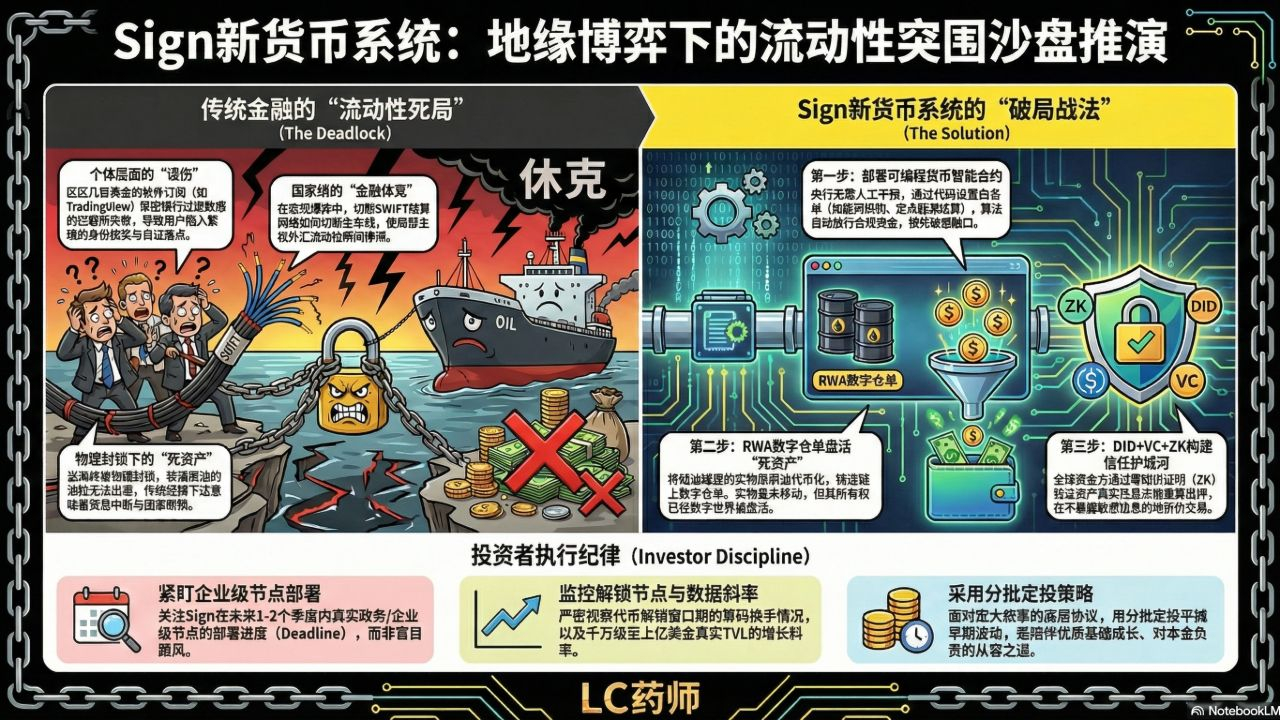
Last night, while renewing the TRADING VIEW subscription, I habitually selected a domestic VISA card, but not only did the transaction fail, the entire card was also 'risk-controlled' by the bank.
A mere few hundred dollars for software subscription, yet the domestic bank made three calls overnight to repeatedly verify my identity, fearing that your funds might cross the border into some unknown black hole.
This overly sensitive interception is indeed a compliance measure for traditional finance to avoid liability, but it instantly cuts off the efficiency of capital flow, making people exhausted from self-verification. In the geopolitical game of macro powers, it is actually magnified daily on a scale of tens of millions.
Let's objectively review the recent movements in the global market. The bargaining between major powers geopolitically is essentially about negotiating the liquidity of global markets and commodities on the negotiation table. In traditional financial settlements, sanctions often directly cut off the SWIFT settlement network, causing local sovereign foreign exchange liquidity to instantly go into shock, much like freezing your credit card at midnight or intercepting your several hundred dollars remittance.
Watching this traditional macro game, I noticed the article 'New Money System' published by @SignOfficial . It strips away the official narratives about reshaping macro finance; the underlying mechanism is actually very restrained and pragmatic.
To help everyone truly understand its commercial value, let's directly conduct a sandbox simulation: suppose a certain oil-producing country in the Middle East suddenly faces an extreme situation where the settlement network is cut off, and key straits are physically blocked, how does this system of Sign operate in actual business?
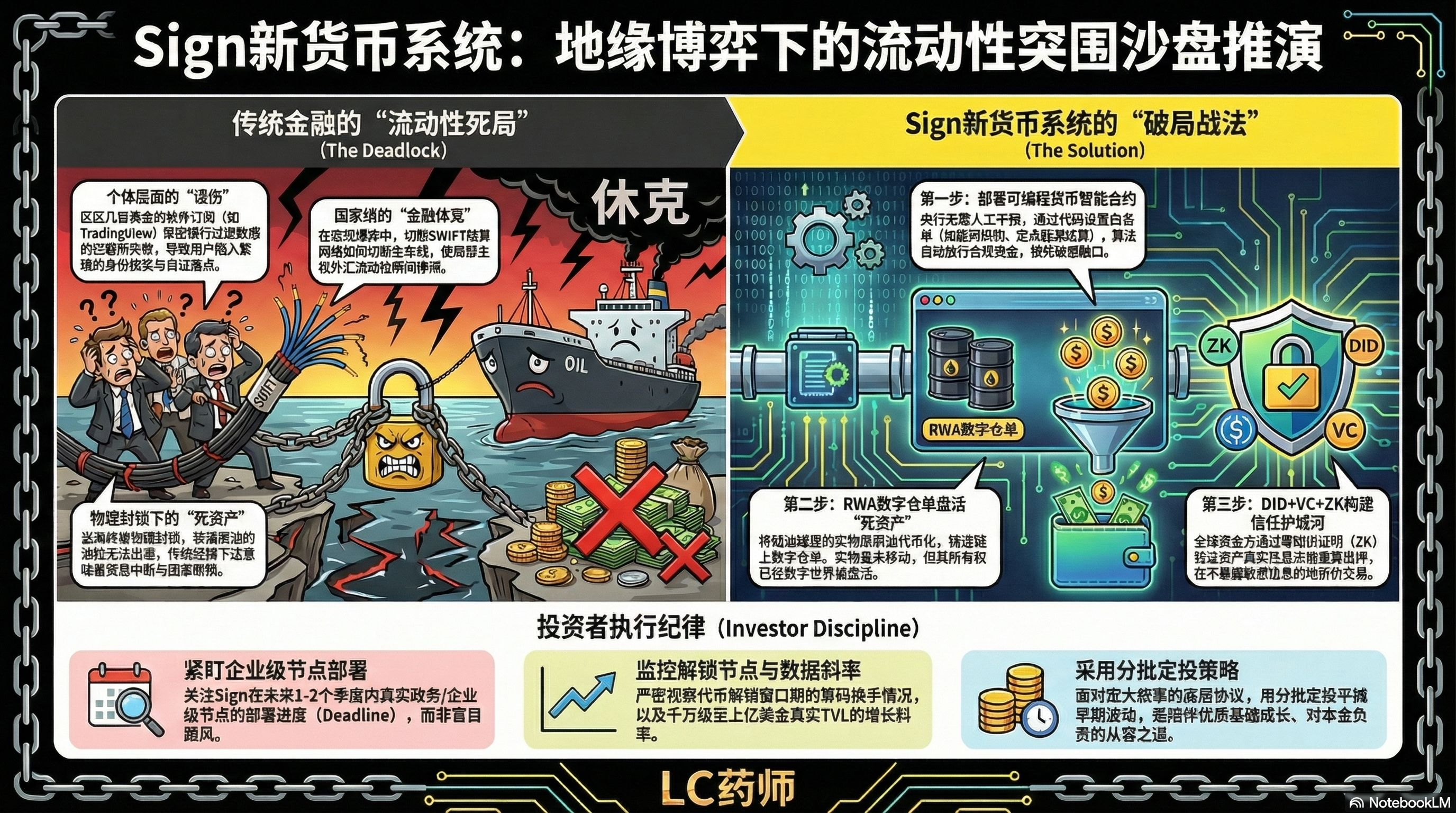
In the traditional script, once removed from the settlement network, the central bank of that country will likely panic and sell off reserve assets.
But if the country has already deployed the underlying architecture of Sign, the landscape will undergo a subtle change. The central bank will no longer need to manually intervene in every cross-border remittance, but will directly deploy a 'programmable currency smart contract' on the Sign network. The contract stipulates a rigorous logic: as long as the funds are for 'medical procurement' and 'designated energy settlement' from specific whitelist countries, the system will automatically release them; while other sensitive fund flows will be locked instantly by the code. This means maintaining the operation of core livelihoods and trade within a local area network using algorithms, even when completely cut off from the outside.
At this point, the physical strait is blocked, and the oil tanker filled with crude oil cannot leave the port at all. Many people who do not understand bulk trade may feel that if the oil cannot be sold, the country will immediately run out of food.
This is the moment that brings a knowing smile. In macro finance, 'physical delivery' and 'acquiring liquidity' are two different things. The country can directly call on Sign's RWA (Real World Asset tokenization) module to mint the tens of millions of barrels of crude oil in the storage tank directly into 'digital warehouse receipts (tokens)' on the blockchain. Although not a single drop of physical oil can be transported out, the digital assets representing ownership of this energy have already been activated.
How can buyers dare to touch these blocked oils? At this point, the core moat of the Sign system—DID and verifiable credentials (VC)—comes into play. The country does not need to sell the spot immediately, but can use these crude oil RWAs as underlying collateral. Global compliant funders only need to verify through Sign's Zero-Knowledge Proof (ZK) technology that 'this batch of oil truly exists and has not been double-pledged' to provide stablecoin loans via smart contracts. Alternatively, buyers can purchase these digital warehouse receipts at a 'geopolitical discount' to hedge against future oil price expectations.
So the final situation is: the oil tanker remains motionless in the port, but the frozen 'dead assets' have already been transformed into a lifeline of cash flow online. This is the use of algorithms to carve out a financial lifeline amidst besieged liquidity.
I put the mind map here, so it is clear and straightforward:
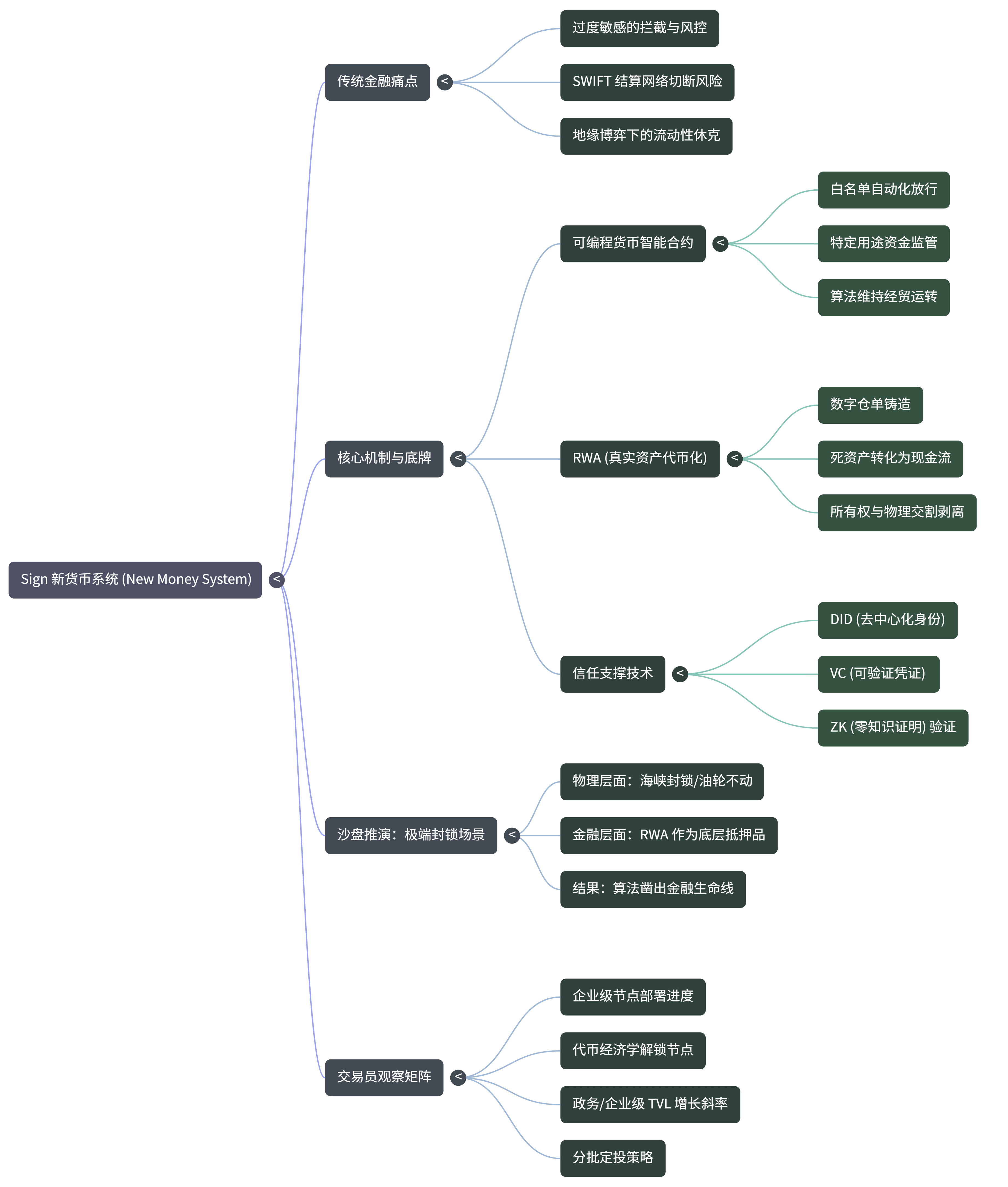
Transforming the back-and-forth pulls in macro negotiations into cold and absolutely executable smart contract code is indeed a clever leap in the evolution of financial infrastructure. However, at this point, as rational spot traders, we still need to establish a set of objective data observation matrices when formulating strategies.
There is one piece of information that cannot be ignored: reshaping sovereign-level currency infrastructure will inevitably require crossing a long commercial landing cycle. Our current action point is not to gamble on which country will announce adoption tomorrow, but to closely monitor the real deployment progress of Sign at the enterprise-level nodes within the next one to two quarters (Deadline).
At the same time, the upcoming unlocking nodes designed in token economics are a key window for this project to undergo real market liquidity testing. For spot traders, patiently observing the turnover of chips during this period, seeking the range where long-term capital re-anchors value, and closely monitoring the slope of data growth in real government/enterprise TVL in the tens of millions or even hundreds of millions of dollars is the most rigorous discipline. In the face of such underlying agreements with grand narratives, adopting a phased investment approach to smooth out early price fluctuations is not only responsible for one's own capital but also a calm way to accompany the growth of quality infrastructure.
