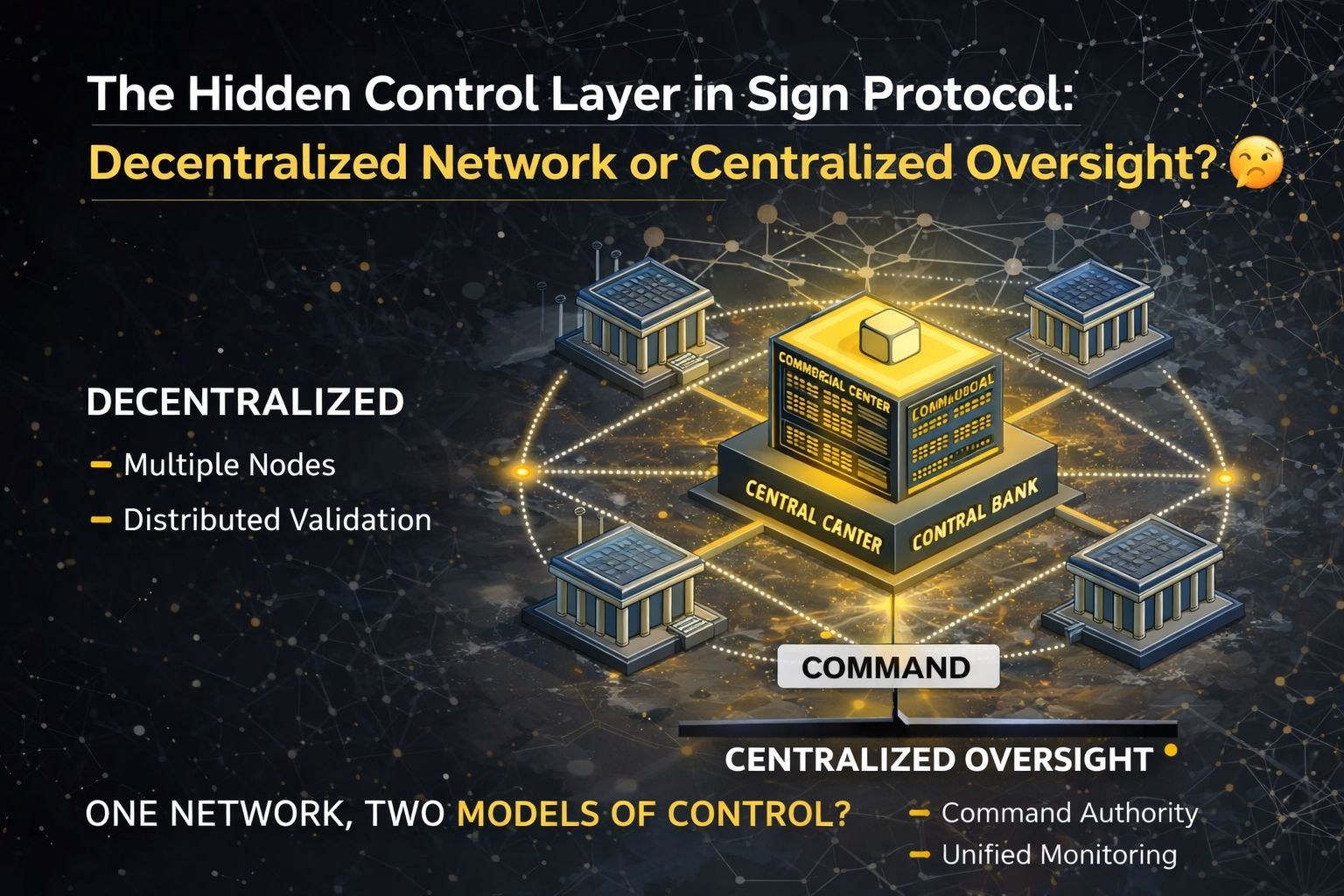
The Control Layer Nobody Talks About 🤔
Honestly, I used to think the real power in blockchain systems lived at the validation layer — the nodes, the consensus, the mechanics of transaction approval.
But after going through the Sign Protocol whitepaper, especially the part on the Control Center for Central Bank Oversight, that assumption feels… incomplete.
Because the real control might sit somewhere else entirely.
At a surface level, the architecture checks all the familiar boxes. Multiple nodes. Distributed participation. Independent validation roles. It looks like a network where responsibility is shared.
But then you notice the Control Center.
And it reframes everything.
This layer isn’t just about visibility — it’s about coordination. The central bank, through this mechanism, can monitor the entire network in real time: transactions, node activity, system status.
That alone is powerful.
But what’s more interesting is what’s implied beneath that visibility.
When a single entity has full-system insight, it often comes with the capacity to guide outcomes — whether through parameter control, transaction ordering influence, or governance enforcement.
So even if nodes validate independently…
👉 the environment they operate in is still centrally defined.
That’s the key insight.
The system distributes execution, but centralizes orchestration.
Now compare that to Ethereum.
There is no Control Center. No unified oversight layer. Visibility is fragmented, governance is decentralized, and changes emerge through rough consensus rather than top-down direction.
It’s slower. Less predictable.
But that friction is intentional.
It prevents any single point from shaping the entire system.
In contrast, the Sign Protocol model feels designed for clarity and control.
And to be fair — that makes sense.
CBDCs aren’t trying to eliminate authority. They’re trying to digitize it more efficiently.
But here’s where things get interesting.
The narrative often leans on the word “blockchain,” which carries assumptions of decentralization and trustlessness.
Yet in this model, trust isn’t removed.
👉 It’s repositioned.
Instead of trusting intermediaries, users are effectively trusting the Control Center — the entity that defines and oversees the system’s rules.
And that creates a subtle but important shift.
Because when oversight becomes centralized at a systemic level, the network stops being a neutral infrastructure…
and starts becoming a governed environment.
Almost like a financial platform with built-in policy enforcement.
There’s also a quiet contradiction here.
Distributing nodes across institutions increases resilience. It reduces technical failure points and strengthens the network’s infrastructure.
But centralizing oversight introduces a different kind of dependency — one rooted in governance rather than technology.
So the system becomes:
• Decentralized in structure
• Centralized in decision-making
And that’s not necessarily a flaw.
But it is a design choice.
And one worth paying attention to.
Because in the long run, the question isn’t just how transactions are validated…
but who defines the conditions under which validation happens.
That’s where real influence lies.
So now I find myself looking less at node distribution…
and more at control layers.
Because maybe the future of blockchain isn’t about removing control entirely.
Maybe it’s about redefining where that control lives.
And honestly? I’m still figuring out whether that’s progress…
or just a more sophisticated version of the same old system.