

Nasdaq and the New York Stock Exchange gather on the Web3 battlefield, with the former authorized to trade tokenized index ETFs, while the latter partners with Securitize to mint native digital securities. The two giants of the U.S. stock market aim to eliminate settlement delays through tokenization, achieving 24/7 trading, leveraging technological iterations to reshape global liquidity clearing paths, and ushering in a new financial era.
On March 18, the U.S. Securities and Exchange Commission (SEC) broke the long-standing prudent silence of Nasdaq with an approval document. The document shows that Nasdaq is authorized to trade Russell 1000 component stocks and core index ETFs in tokenized form.
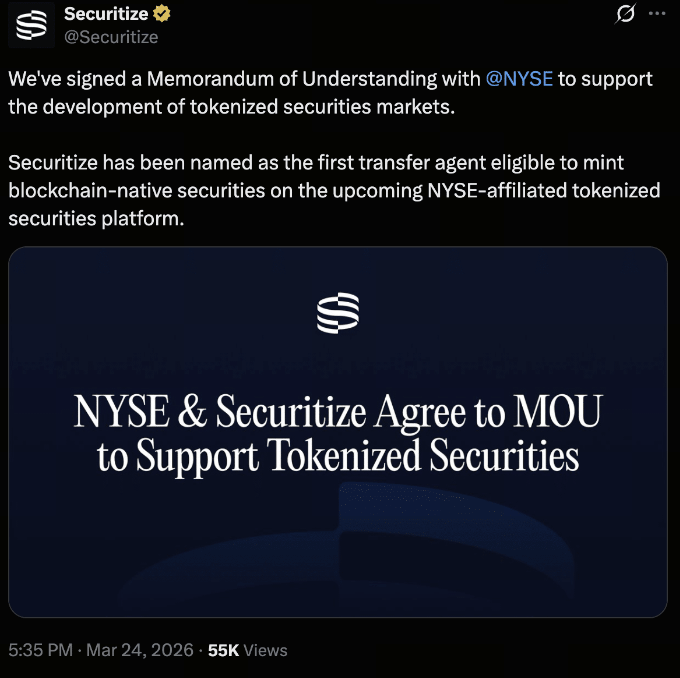
As the market is still digesting the far-reaching impacts of this information, on March 24, NYSE Group President Lynn Martin announced the signing of a strategic cooperation memorandum with the tokenization platform Securitize. Unlike Nasdaq's mild reforms, the NYSE has chosen a path that is almost a complete overhaul: minting native securities on the blockchain through digital transfer agents.
 Source: Securitize
This is the two most important exchanges in the history of US stocks, officially clashing on the battlefield of Web3 in the same month.
Conservatives' 'New Clothes' and Radicals' 'Foundation'
In this chess game of transformation, the backgrounds of the two operators determine their distinctly different styles of play.
1. Nasdaq's 'Pragmatist'
Nasdaq CEO Adena Friedman has always been known for her technology-driven approach. As the leader of the world's first electronic trading market, her logic has always been: technology must serve efficiency, not disrupt order.
In Nasdaq's proposal, the blockchain is cleverly designed as an 'optional packaging'. Even if you choose to hold Russell 1000 tokens in your wallet, the underlying clearing pipeline is still the decades-old system operated by the DTC. This proposal is like installing the most advanced GPS on a horse-drawn carriage; although the power system has not changed, the navigation precision and user interaction interface have entered the digital age.
2. NYSE's 'Iron-fisted Promoter'
In contrast, the NYSE under Lynn Martin has shown a certain ruthless determination to break the old system. Martin's wording in the press release is highly charged, skipping all clichés about 'exploration' or 'pilot projects' and directly discussing 'the development of new infrastructure'.
Martin is well aware that as the world's largest exchange by market capitalization, the NYSE carries a heavy historical legacy. But she understands even more that if 24/7 trading and near-instant settlement cannot be achieved, Wall Street will be defenseless against competition from emerging crypto forces. The ally she has found is Securitize—this tokenization pioneer backed by BlackRock, along with BNY Mellon and Citigroup, which are trying to directly build a new city on the ruins of the old world.
 Source: Google
Why is tokenization the endpoint for US stocks?
First, in the traditional financial system, although transactions occur at millisecond levels, settlements often require one business day (T+1). This means that at any given moment, hundreds of billions of dollars are in a 'in transit' state, unable to generate interest or be re-collateralized.
The essence of tokenization is to eliminate time in transit. What the NYSE and Nasdaq are competing for is the power to define the future global liquidity turnover speed. This leap in efficiency not only represents interest savings on financial statements but also the extreme extraction of capital utilization. When collateral can be transferred and re-collateralized across platforms in seconds, the liquidity in financial markets will present a 'superfluid' state, fundamentally changing the position management logic of institutional investors.
Second, this issue concerns the 'medium transfer' of trust. In the past, we trusted the NYSE because it had a license issued by the SEC and a two-hundred-year reputation. But in the tokenization era, this trust is shifting from post-event tracing to real-time validation.
As Lynn Martin said, the new infrastructure must retain the transparency and protection expected by investors. When ownership records are publicly accessible on the blockchain, and dividend distributions are automatically triggered by immutable code, the role of exchanges is evolving from authoritative intermediaries to code governors. This transformation means that future compliance will no longer be a cumbersome pile of legal texts, but automated reviews embedded in smart contracts.
Third, through tokenization, expensive index ETFs can be split into extremely small shares. This means that an individual investor holding $50 can enjoy the same underlying asset liquidity and transparency as a fund worth billions. This 'atomization' not only expands market capacity but more importantly, it changes the distribution of power.
Both giants are trying to lower the barriers to harvest the next generation of native on-chain investors globally. The release of this long-tail effect will allow US stocks to reach into previously inaccessible remote markets in traditional finance. Tokenized securities are no longer just playthings for Wall Street elites, but a global standard that can flow freely like information. This 'digital siphon' effect on global retail capital is precisely the technological high ground that both exchanges are willing to invest heavily to seize.
The clearing system becomes the frontier of national competitiveness.
Macro-wise, this is not just a business competition between two companies, but a defensive battle for American financial hegemony.
Financial Infrastructure Competition
In recent years, Singapore, London, and Hong Kong have rapidly advanced in the field of tokenized bonds and funds. If US stocks continue to maintain outdated settlement mechanisms, their attractiveness will eventually be diluted.
The SEC's statement reflects a subtle shift in the regulatory attitude, from a past of strict guarding to now approving Nasdaq's rule revisions. Washington clearly realizes that in the narrative of digital assets, silence equates to retreat. If dollar assets cannot first complete on-chain integration, then non-dollar-pegged stablecoins and decentralized finance (DeFi) protocols will grow wildly outside the traditional system, ultimately undermining the dollar's clearing status.
Dual-line Experiment of Regulation
The differences between Nasdaq and NYSE's proposals are essentially two attempts at regulatory logic. Nasdaq's compatibility model attempts to give the old engine a digital shell, ensuring a slow evolution within controllable boundaries; while the NYSE's native model attempts to rebuild the rule of law in the digital wilderness.
This dual-line parallel experiment is essentially the U.S. exporting its 'American standard' for future global digital financial regulation. As Goldman Sachs CEO David Solomon puts it: 'The future of the financial system is not the change of assets, but the reshaping of infrastructure.' When both the NYSE and Nasdaq step onto the field, it means that the U.S. has chosen blockchain as the underlying operating system for the next generation of global financial hegemony, aiming to continue locking down the clearing paths of global capital through technological iteration.
24/7 Era's Liquidity Harvesting
From a more macro perspective, tokenized securities are an extension of national financial sovereignty. When US stocks achieve 24/7 trading, it will break the geographical time zone limits and directly siphon funds during late-night hours in other countries. This around-the-clock financial suppression makes the traditional financial defenses vulnerable. The 'knife fight' between the two exchanges is essentially building a more concealed and efficient digital distribution network for the U.S. that bypasses traditional banking wire systems (such as SWIFT).
Conclusion
The battle between the NYSE and Nasdaq marks the official end of Wall Street's 'Classical Era'.
We are about to enter a never-ending financial world, without weekends, without settlement day buffers, and capital will shuttle across the globe at almost mad speeds. Institutional investors will be able to complete cross-platform pledging and rebalancing in seconds, while global retail investors can participate in top-tier asset allocations with very low thresholds. This is undoubtedly a victory for efficiency, but the extreme of efficiency often comes with increased systemic fragility. Technical security, cross-border regulatory coordination, and the transitional pains of traditional intermediaries all need to be gradually resolved in the advancement.
What is about to happen is very simple: all assets that can be tokenized may be tokenized; all time that can be compressed will be compressed. And in this process, the winner will not be the earliest entrant, but the one who first masters the 'new clearing order'.