

Introduction:
From $0.126 to $0.032, was this Binance airdrop project misjudged, or is the market really not buying it?
In April 2025, Binance HODLer airdrop project SIGN officially launched its 16th phase.
After a short period of rapid rise after the launch, it peaked at $0.126, and many people thought that they had struck gold again.
But who would have thought that in less than a year, the price fell to $0.032, a decline of 74%.
The complaints in the community are also increasing:
“Is it another air coin?”
“Is the airdrop the peak?”
“Have we been harvested again?”
But today I want to say: don't rush to conclusions. The SIGN project might actually have some value.
Main text:
What exactly does SIGN do?
You can first imagine several scenarios:
When you look for a job in Dubai, employers need to verify your education.
When you go to Saudi Arabia for pilgrimage, you need to prove your identity;
When you buy a house in the UAE, you need to sign an electronic contract.
If following traditional processes, it basically goes like this:
Submitting materials, back and forth running, waiting for review, stamping confirmation, the whole process is time-consuming, inefficient, and very troublesome.
What SIGN wants to do is to move these 'certificates' and 'signatures' onto the blockchain.
Its core product is called EthSign.
Simply put, it is 'blockchain-based electronic signature.'
You upload the contract, sign online, and the records are directly kept on the chain, publicly verifiable, and difficult to tamper with.
There is also a product called TokenTable, mainly helping project parties with airdrops and token unlocking management.
The large-scale airdrop from Starknet used their technology.
In summary:
What SIGN wants to do is actually a 'notary system + identity verification infrastructure' in the Web3 world.
Such projects may not be sexy, and the hype is not as fierce as meme coins.
But if it can really be implemented, it may actually survive longer.
⸻⸻⸻⸻⸻⸻⸻⸻⸻⸻⸻⸻
Why has it dropped so badly?
First, let's look at several key price points:
2025.4.28: Listed on Binance, opened with a surge, approximately $0.0826.
2025.9.24: Historical high $0.1311
2025.10.10: Historical low $0.0222
2026.3.27: Current price approximately $0.032
In this round of decline, I think the core reasons are mainly three.
1. The selling pressure from airdrops is too heavy.
HODLer airdrop projects have a very practical problem:
Most people's first reaction after getting the chips is not to research the project, but to sell directly.
Especially for projects with high initial popularity, they are more likely to form concentrated cash-outs in the early stage.
If someone makes a profit and runs away, there are fewer people to take over, and the price naturally cannot hold.
2. Unlocking pressure continues to be released.
From October to December 2025, SIGN will have continuous large-scale unlocking.
The market was originally weak, and with the added pressure of unlocking, the pressure on the price can be imagined.
Many projects do not die from 'lack of stories',
But it died because 'the release of chips was too unsightly.'
3. The narrative is retreating.
In 2025, concepts like 'on-chain identity', 'digital credentials', and 'electronic signatures' will still have heat.
But by 2026, market attention has obviously shifted to AI, RWA, and popular public chain ecosystems.
Once the track cools down, the funds will withdraw.
It’s not just SIGN that has problems, but this type of topic is no longer the direction that the market wants to chase the most.
But also precisely because of this,
Most of the bad news that should have come out has already been released.
The selling pressure from airdrops has been released.
The peak unlocking has also been experienced.
The market has also seen the cooling of narratives.
Next, we need to see,
Does this project still have new catalysts, and can it be re-priced by the market?
⸻
What is really worth watching is actually the investment lineup behind it.
To be honest, this is actually an important reason why I still keep my attention on SIGN.
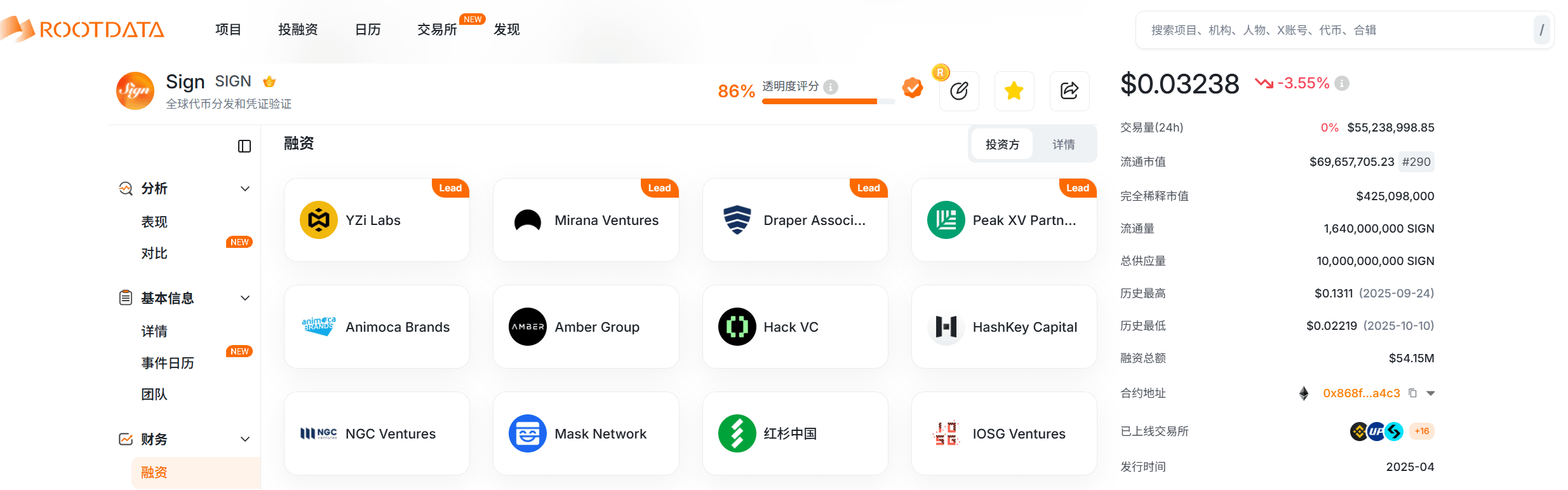
According to public information, SIGN's total financing is about $54.15 million, and the institutional lineup behind it is quite impressive.
Lead investor.
• YZi Labs: Binance ecosystem fund, investing in over 100 projects.
• Mirana Ventures: A well-established crypto fund in Switzerland, managing over $1 billion.
• Draper Associates: Legendary Silicon Valley Tim Draper's firm, invested in Skype, Tesla.
• Peak XV Partners: Formerly Sequoia India/Southeast Asia, has invested in ByteDance, MongoDB.
With investors.
• Animoca Brands
• HashKey Capital
• Sequoia China
• IOSG Ventures
• Amber Group
• Hack VC
• NGC Ventures
• Mask Network
What does this mean?
In simple terms:
Binance ecosystem resources, established dollar funds, and top Asian crypto institutions have basically all stood on the stage.
This does not mean the project will definitely succeed.
But at least it indicates one thing:
It is not the kind of project that you can tell just by looking at it that it only wants to ride the heat to cut a wave.
To put it more directly:
Projects coming from such a lineup may fail.
But it is very likely not that kind of purely for issuing tokens and then disappearing gameplay.
For a project that has already dropped 74%,
This point is actually very important.
⸻⸻⸻⸻⸻⸻⸻⸻⸻⸻⸻
What I am most concerned about is actually the variable of the Middle East.
If you only look at the short-term trend, SIGN indeed does not look good.
But if you stretch the perspective a bit, its potential opportunity may actually be in the Middle East.
Why?
Because from 2025 to 2026, the Middle East's investment in blockchain, digital identity, and digitized government affairs is clearly speeding up.
What SIGN is doing is precisely not the kind of topic that relies solely on emotional drives.
What it does is identity verification, electronic signing, digital credentials, compliance infrastructure.
These things have real demand in the Middle East.
1. Identity verification is a necessity.
There are a large number of cross-border laborers and cross-national mobile populations in the Middle East.
Work visas, education verification, identity verification, employment contracts, all of these rely on 'trustworthy proof.'
2. Electronic signatures and digital contracts have real scenarios.
Whether in government services, real estate transactions, or cross-border business cooperation,
On-chain signing and verifiable credentials can theoretically improve efficiency and reduce intermediaries.
3. Such infrastructure is easier to enter into long-term narratives.
The market may not chase such projects temporarily.
But as long as regional policies and real needs still exist, there is space for continued development.

So I would think that,
If SIGN can really secure decent cooperation in the Middle East and even enter higher-spec application scenarios, then its current market value may not have a re-evaluation space.
The more critical point is,
These investment institutions behind it also have layouts in the Middle East.
Do you think they are just pure financial investors?
I don't really believe it.
More like positioning in advance.
⸻⸻⸻⸻⸻⸻⸻⸻⸻⸻
My conclusion
Reasons I am bullish.
✅ The product is not just pure PPT, and it indeed has practical application directions.
✅ Binance has listed it, and liquidity and market recognition are still there.
✅ The investor lineup is strong, and the resource integration capacity is not weak.
✅ The line of digital identity/electronic signatures in the Middle East may have stories to tell later.
✅ The price has already dropped a lot, and the market has digested most of the bad news.
Reasons I am bearish.
❌ Team transparency still has room for improvement.
❌ There is still pressure from token unlocking in the future.
❌ The competition in the identity track is not small, with Worldcoin, ENS, Civic all being potential rivals.
❌ The current market style does not favor such projects, and there may not be funding attention in the short term.
⸻⸻⸻⸻⸻⸻⸻⸻⸻⸻
If it were me, how would I handle it?
My view is very simple:
It can be followed, but don't come in with heavy positions.
A more suitable strategy is:
Put it on the watch list.
Small positions for trial and error.
Focus on whether there are new cooperations, new implementations, and new narratives in the future.
If the future is just repeating stories without substantial progress, then don't self-congratulate.
Because in the crypto market,
Just because it has dropped a lot does not mean it is necessarily cheap;
But similarly, just because it has dropped sharply does not mean it is completely worthless.
⸻⸻⸻⸻⸻⸻⸻⸻
The last sentence.
This is not investment advice.
Cryptocurrency drops of 50% in a day have never been a new thing.
So only use the money you can afford to lose to play.
But if you believe,
In the future, Web3 will not only be about trading coins, but will also move towards identity, compliance, signing, and credentials, which are more fundamental infrastructures.
Then SIGN is at least worth putting on your watch list.
After all, from $0.131 to $0.032,
The worst may really be over.
Do you think SIGN is a value pit or a value trap?
Let's chat in the comments section👇
Follow me for the next issue where I continue to analyze Binance's latest airdrop projects.
