
$BTC $ETH $BNB
#085-2026.03.04
Event Overview
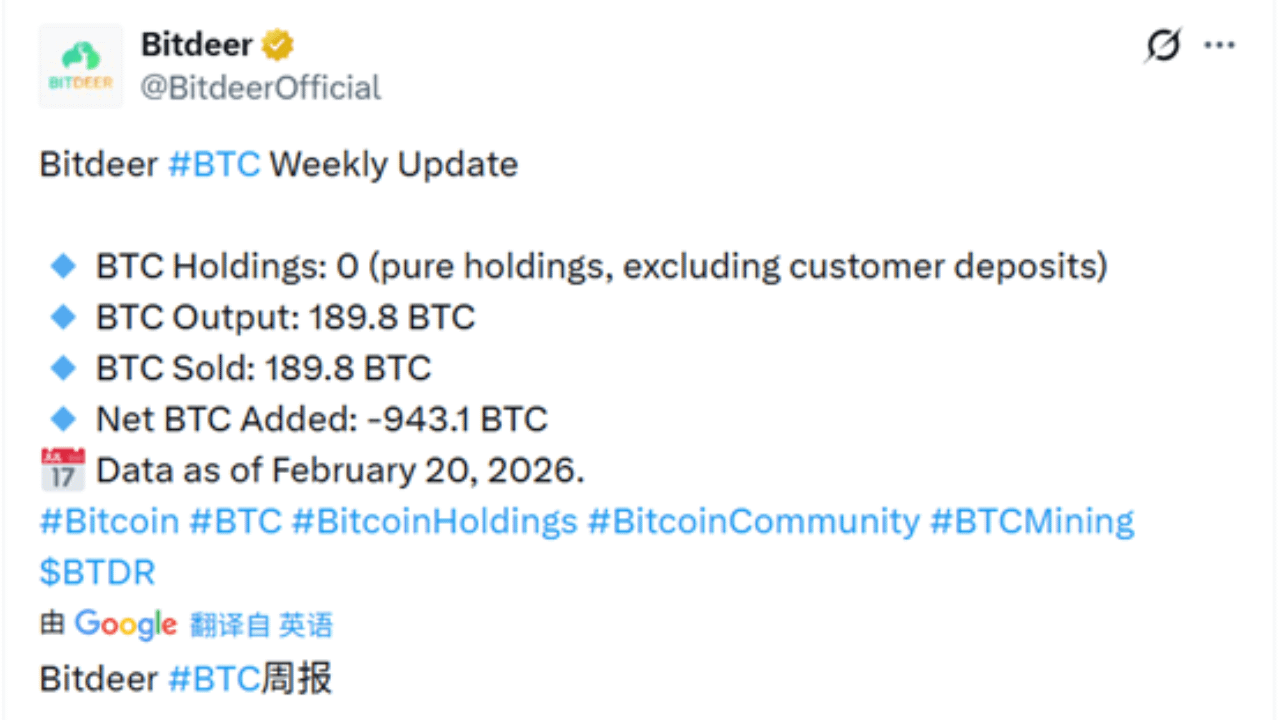
On February 20, 2026, Singapore's Bitcoin mining company Bitdeer (Nasdaq: BTDR) completed a remarkable Bitcoin liquidation. The company phased out its entire Bitcoin reserves: from approximately 2,000 BTC at the end of 2025, to 1,530 by the end of January, to 943.1 on February 13, until finally zeroing out in the last week. This marks the complete depletion of Bitcoin holdings of the largest listed mining company based on self-mining hash rate.
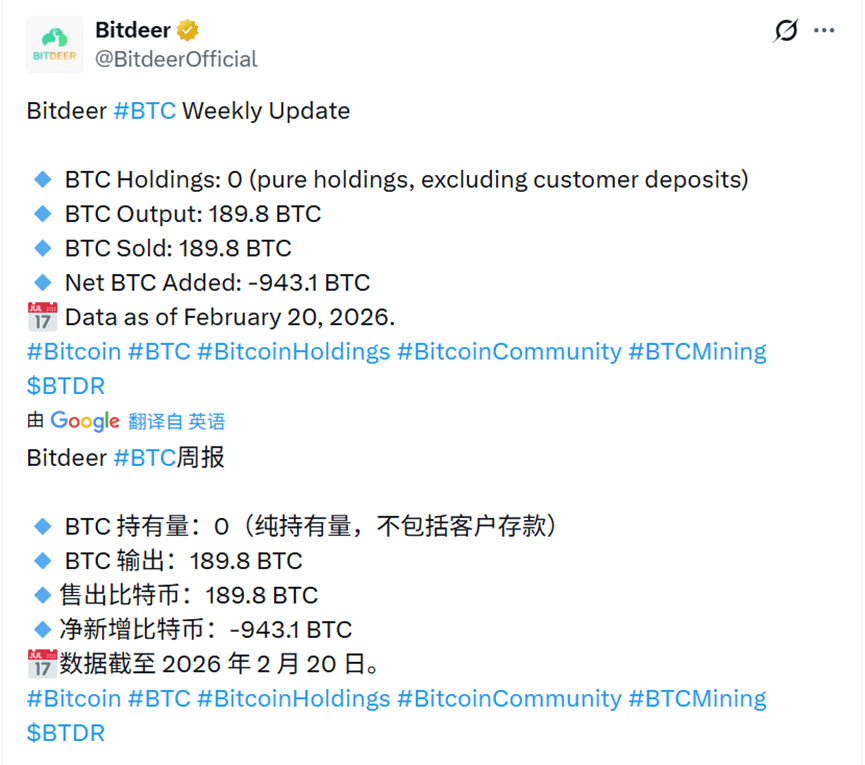
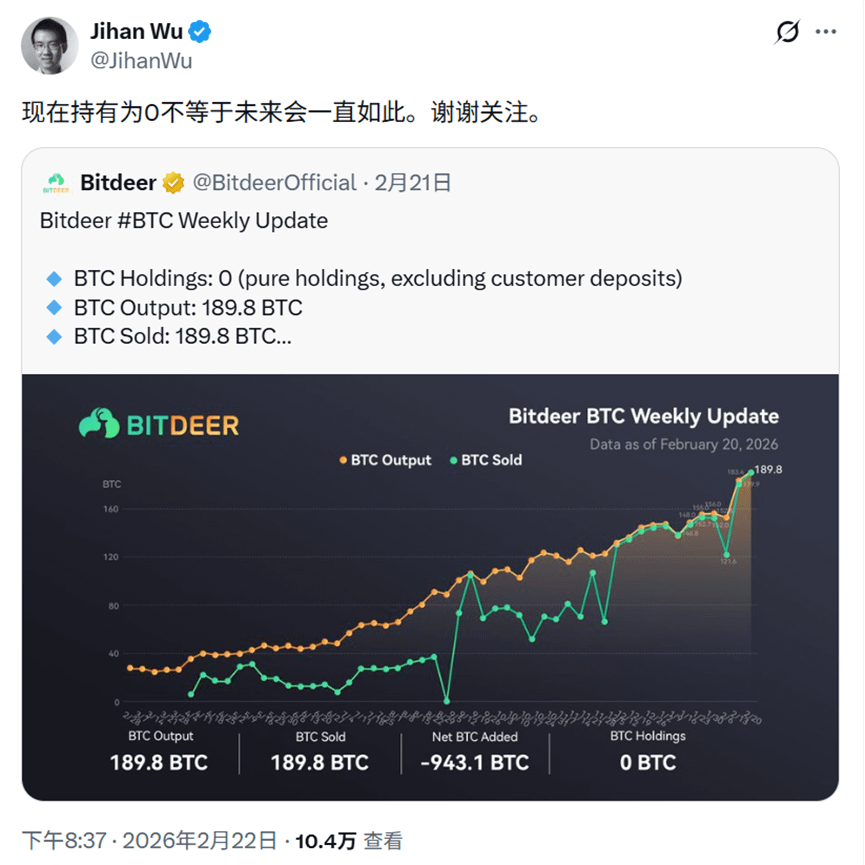
In response to market doubts about its 'complete abandonment of Bitcoin,' Bitdeer emphasized on the X platform: 'The decision to sell Bitcoin should not raise market concerns; we are evaluating multiple power land acquisition opportunities, and preparing liquidity now is a prudent move.' CEO Wu Jihan also clarified, 'Holding 0 now does not mean it will always be 0 in the future.'
The liquidation behind this is a comprehensive tightening of mining economics and a strategic choice for AI transformation. The difficulty of the Bitcoin network recently surged by 14.7%, and computing power prices fell below $30/PH/s/day. Bitdeer's gross margin for the fourth quarter dropped from 7.4% a year ago to 4.7%. The reduction in block rewards after the halving, fluctuations in energy costs, and intensified competition have turned mining into a capital-intensive survival battle.
However, Bitdeer's operational data remains robust: in January, it mined 668 BTC, a year-on-year increase of 430%, with self-mining computing power reaching 63.2 EH/s. The company has chosen to stop hoarding Bitcoin and instead completed a $325 million convertible bond and a $43.5 million equity financing, directing funds towards AI data center expansion, high-performance computing (HPC), and AI cloud services. The company is deploying NVIDIA GB200 NVL72 systems in Malaysia and is transforming several mining sites in the U.S. and Europe into AI data centers. Unlike Bitcoin mining, which is influenced by price cycles and halving, AI and HPC contracts can provide more predictable revenue streams.
Evaluation analysis
Bitdeer's eight-week liquidation action is essentially a business choice between 'value storage vs. cash flow.' While Strategy (MSTR) positions hoarding Bitcoin as the core of its corporate strategy, holding over 717,000 BTC and its stock price fluctuating with Bitcoin, Bitdeer has chosen the opposite path: viewing mining as a production activity rather than an expression of faith, immediately converting output into cash to invest in capital-intensive AI infrastructure. This divergence reveals the fundamental dilemma faced by mining companies: in an environment where profit margins are compressed, should they continue to 'believe in hoarding coins' or pursue more stable AI revenue?
From a purely commercial perspective, Bitdeer's logic is not without merit. Bitcoin mining is influenced by price cycles, halving events, and fluctuations in network difficulty, resulting in highly unpredictable profit margins. Although the initial capital expenditure for AI data centers is higher, they can secure long-term revenue through HPC contracts, unaffected by the dramatic volatility of the crypto market. When gross margins drop from 7.4% to 4.7% and computing power prices continue to decline, it is rational to allocate limited capital to areas with more certain returns. The AI transformation can alter the market valuation logic of mining companies, shifting from 'leverage proxies of Bitcoin prices' to 'digital infrastructure providers,' which may be more favorable for long-term valuations.
This is not an isolated incident, but a reflection of a strategic shift across the industry.
Riot Platforms sold $200 million worth of Bitcoin to pivot to AI, Bitfarms downplayed its 'Bitcoin company' identity, and MARA plans to enter the HPC field through the acquisition of French Exaion. In contrast, the number of mining companies still adhering to a hoarding strategy is dwindling: Strategy holds over 717,000 BTC, MARA holds about 53,250 BTC, and Riot holds about 18,000 BTC—yet the latter two are also simultaneously expanding their AI business. When leading players in the industry collectively pivot, it is no longer just a stopgap measure for individual companies, but rather a collective vote on the fundamentals of mining.
But this transformation does not necessarily imply a denial of Bitcoin; rather, it resembles a pragmatic adjustment of capital allocation strategies. If even professional mining companies believe that holding Bitcoin is less advantageous than investing in AI, the narrative of 'digital gold' indeed faces challenges, but it may just be a tactical choice that occurs cyclically. The decentralization security of the Bitcoin network relies on dispersed computing power. When major mining companies shift resources towards AI, it could weaken network resilience—however, these companies have not exited the mining business; rather, they are seeking income diversification while maintaining computing power. CEO Wu Jihan emphasized that 'holding 0 now does not mean it will always be 0 in the future.' This somewhat vague statement reveals the possibility of flexible portfolio adjustments.
The real issue is not how many coins Bitdeer has sold, but whether the entire mining industry still believes in what it is mining. From a longer-term perspective, when will Bitdeer hold Bitcoin again? The answer may depend on several key conditions: first, an improvement in cash flow. Once the investment in AI infrastructure is completed and begins to generate stable cash flow, the company will have the flexibility to reallocate assets. Second, the transition of market cycles. When Bitcoin prices enter a new upward cycle and mining profit margins significantly improve, the opportunity cost of hoarding Bitcoin naturally decreases. Third, the restoration of the industry environment. When network difficulty adjusts and computing power prices recover to healthier levels, the appeal of holding coins will re-emerge.
About Bitdeer
Bitdeer Technologies Group was established in January 2021, spun off from Bitcoin mining chip manufacturer Bitmain, with co-founder Wu Jihan as its founder. The company is headquartered in Singapore, with its U.S. headquarters located in San Jose, California. It went public on Nasdaq in April 2023, with a valuation of $1.18 billion. As one of the largest miners in terms of computing power globally, Bitdeer operates multiple data centers in Tennessee, Texas, Ohio, and regions like Norway and Bhutan. In recent years, the company has actively transformed, launching an AI cloud platform in collaboration with NVIDIA and securing a $100 million equity investment from Tether, expanding its business from pure mining to blockchain and high-performance computing.
Main reference
https://bitcoinmagazine.com/news/bitdeer-btdr-dumps-bitcoin-treasury
https://www.thestreet.com/crypto/markets/bitcoin-mining-giant-dumps-entire-treasury
https://www.coindesk.com/markets/2026/02/23/bitdeer-empties-bitcoin-treasury-as-miners-accelerate-industry-wide-ai-pivot
https://en.wikipedia.org/wiki/Bitdeer