
A couple of days ago, I shared an interesting story with a friend when I went to renew my ID card; I saw a lady loudly complaining about how to prove 'my mom is my mom,' and many friends kindly gave me a thumbs up. Today, let's continue to delve into the logic behind this issue and the marginal role that S.I.G.N can play in geopolitical infrastructure.
Some friends may have encountered this situation: when processing a certain cross-departmental administrative procedure, they are often worn down by the massive administrative machine, cumbersome forms, and countless approval nodes that require stamps. To maintain the operation of this centralized system, society and enterprises are consuming huge friction costs every day.
Coincidentally, I recently revisited a deep research report published by (Forbes) last year, and I found that an objective macro trend is taking shape: global sovereign nations are pragmatically moving their complex public services and underlying trust mechanisms onto the blockchain. In simple terms, they hope to achieve the ultimate goal of a 'big country, small government' that we often mention through blockchain technology.
Behind this trend lies a classic political economy appeal—how to compress the massive and bloated administrative machine into a minimalist 'small government' while maintaining the effectiveness of national governance?
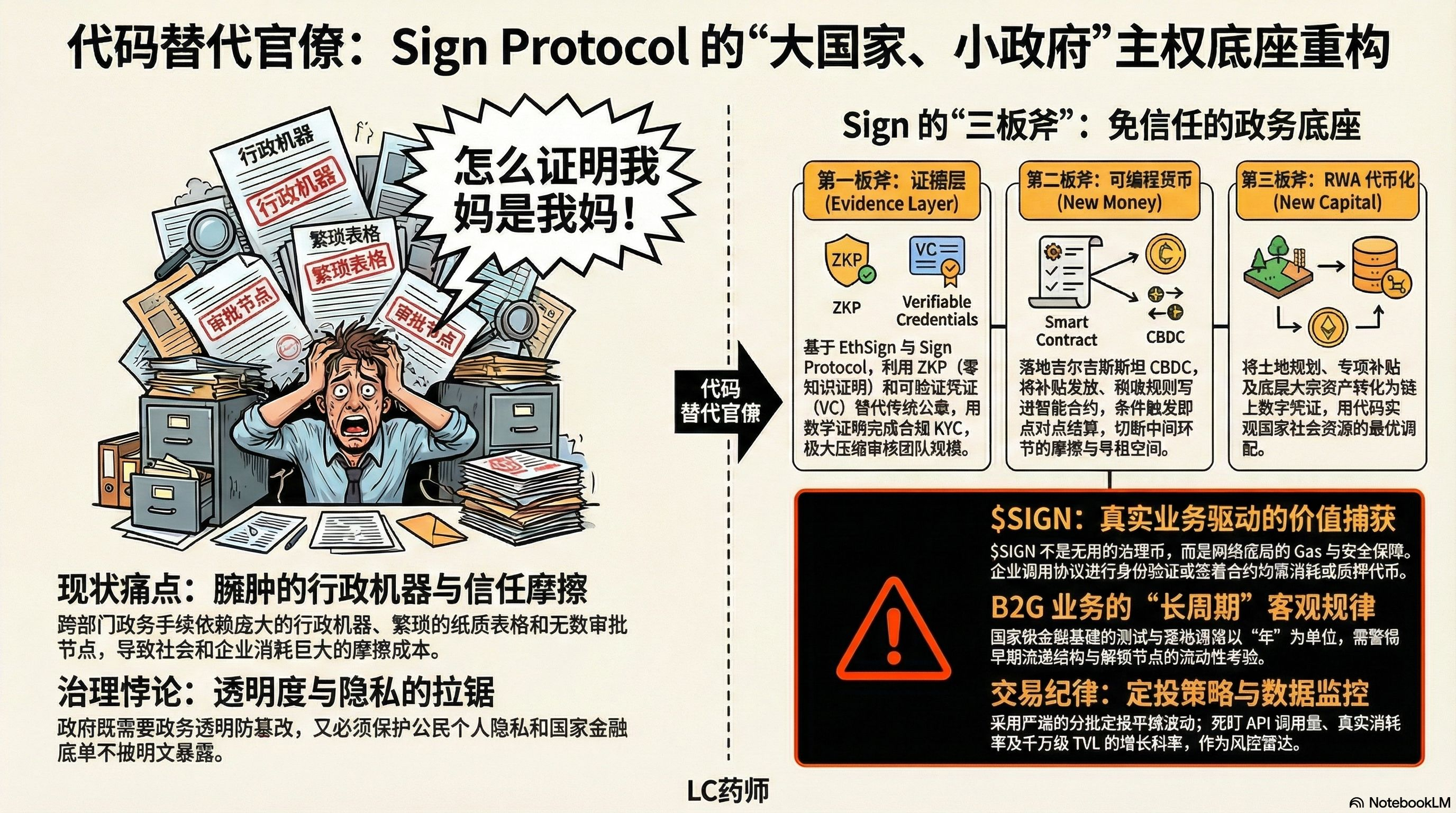
This is definitely not just a sci-fi narrative that stays on white papers. Let's objectively review the current progress: Estonia's digital identity (e-ID) and medical system have long been operating on-chain; Georgia has directly anchored land ownership to the blockchain; even the U.S. Department of Commerce is trying to publish core macroeconomic data on-chain. The core appeal of sovereign nations is very clear: to replace redundant 'administrative review' with rigorous 'code' and achieve a minimalist compression of social governance structures.
However, in this process, the state faces an objective paradox: it must ensure that government affairs are transparent and tamper-proof, while absolutely not allowing citizens’ personal privacy and the country’s financial bottom lines to be explicitly exposed on the public chain.
In this (Forbes) research report, a real case that breaks this technological bottleneck is explicitly named—@SignOfficial .
Currently, Sign is deeply collaborating with the National Bank of Kyrgyzstan to provide modernization upgrades for the country's CBDC (Central Bank Digital Currency) and underlying financial infrastructure. If you carefully break down Sign's product matrix, you will find that the narrative of this 'small government' is not an empty slogan, but rather the intricately interlocking 'three axes' in the underlying code.
Evidence Layer based on EthSign and Sign Protocol.
This is the core component that replaces traditional administrative approval. In the past, businesses needed signatures and seals from various department heads to process certificates; now they can directly complete legally binding on-chain electronic signatures through EthSign; while Sign Protocol uses ZKP (zero-knowledge proof) and Verifiable Credentials (VC) to complete qualification verification while protecting privacy. The government no longer needs to maintain an extremely large review team; a mathematical proof can legally and compliantly complete KYC, forming the trustless foundation of a 'small government.'
Programmable Currency (New Money).
This is the CBDC logic being deployed by Kyrgyzstan. Once the first axe (evidence layer) is verified, there is no need for manual disbursement; the rules for issuing subsidies and collecting taxes will be directly written into smart contracts. When conditions are triggered, funds are instantly settled point-to-point into citizens' self-managed wallets, completely cutting off friction and rent-seeking opportunities in the intermediary process.
RWA Tokenization (New Capital).
A small government in physical architecture also requires efficient allocation of social resources. Through this protocol, the country's land planning, special subsidies, and even underlying bulk assets can become digital certificates that circulate on the chain, achieving the most efficient resource allocation through code.
The evidence layer solves trust verification, the new currency provides automated settlement, and the new capital revitalizes real resources. These three components are seamlessly nested in the 'hybrid architecture,' condensing what originally required thousands of people to maintain the government hub into cold and absolutely executable code.
But at this point, as rational spot traders, we still need to bring our focus back to the market and establish a warning line for token economics and cycles.
There is one piece of information that cannot be ignored: in Sign's underlying network, $SIGN tokens are not useless governance tokens. Whether it is enterprise nodes calling the Sign Protocol for massive identity verification or frequently signing EthSign contracts on-chain, tokens need to be consumed or staked as underlying Gas and security guarantees. This real business consumption is the core card for capturing token value.
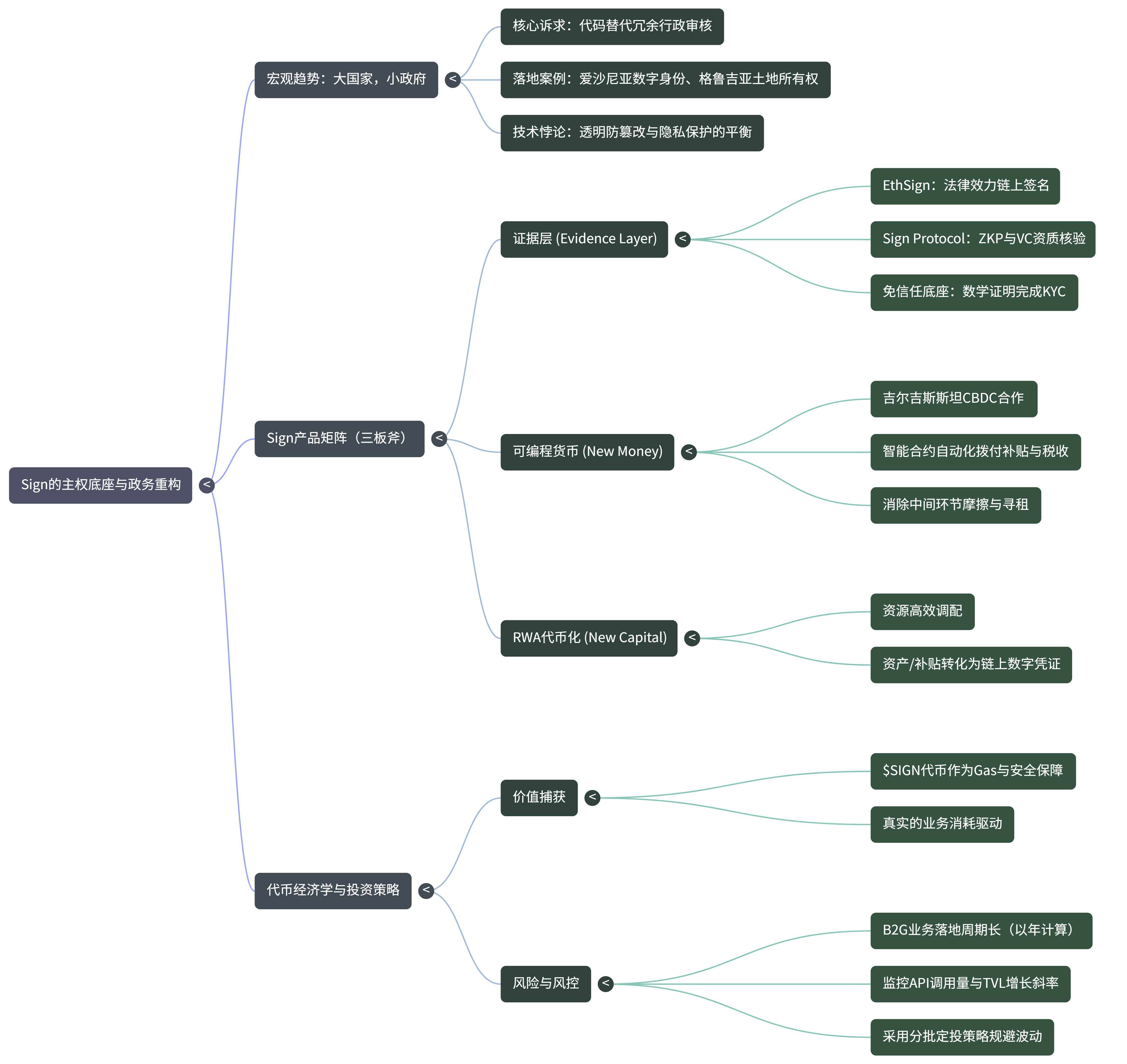
As with the last issue, I have placed the mind map here to help everyone understand the article and my arguments:
However, we must view the landing rules of B2G (business to government) objectively. The underlying deployment involving the lifeblood of national finance typically has a testing, compliance, and ultimate landing cycle that is measured in 'years.'
In contrast, the current secondary market faces an objectively early circulation chip structure, as well as the liquidity tests inevitably brought by future unlocking nodes. The grand national narrative needs real time to digest. In this market full of games, understanding the potential of sovereign infrastructure requires us to maintain the restraint of veterans.
Adopt a rigorous staggered investment strategy to average out price fluctuations during this long landing cycle; at the same time, closely monitor the real consumption rate in the token model, observing the API call volume of EthSign and Sign Protocol on the administrative side, as well as the growth slope of the tens of millions in TVL. Using the grand narrative as a radar for asset searching, and the underlying consumption data as risk control for trading, is the most rigorous discipline in responding to cycles.
