
The internet is no longer what we are familiar with.
It is now 2025-2026, and over half of the traffic online is actually generated by bots. Malicious bots alone account for 37%. AI content farms have skyrocketed 60 times in three years, churning out thousands of fake articles every day. Deepfake videos, bots liking and commenting... it's everywhere.
"The theory of a dead internet" is no longer a conspiracy theory; it is a blatant reality.
The true human voice is buried under a massive amount of garbage, and trust is collapsing day by day. If we don't solve this, by 2030, our open internet that we grew up with may be completely gone.
Let me clarify upfront, this is not another 'AI + blockchain = wealth' hype piece.
Sign Protocol never aimed to be a social media star; it is simply honest infrastructure—a sturdy and unpretentious fortress.
While others are chasing the next hot trend, it’s quietly piecing together the puzzle that can enable large-scale cryptographic trust.
The most critical point: Sign Protocol is the world's first truly cross-chain proof system.
No matter which chain you are on—Ethereum, Solana, TON, BNB Chain… you can create, verify, and share tamper-proof digital proofs without being locked into a specific chain or app.
First, define a 'schema' (like a proof template: identity, qualifications, credentials, etc.), then the generated attestation (proof record) is a signed, portable, privacy-protected credential.
This is simply the 'digital notary' that the Internet has been missing for years in the AI era.
This is not just talk.
Sign has already served tens of millions of real users and helped distribute over $2 billion in digital assets.
It has helped the governments of countries like Sierra Leone and Kyrgyzstan launch national digital ID and stablecoin projects.
Its design of 'public transparency + private sovereignty layer + zero-knowledge proof' has already been successfully implemented in real national-level pilots—requiring both openness and privacy protection, a high level of difficulty, but it has withstood the test.
Meanwhile, reports from robots and AI content studies are showing the problems are getting more serious.
The current real-time proof numbers and cross-chain tools of Sign are the only solutions that have gone live and can truly keep pace.
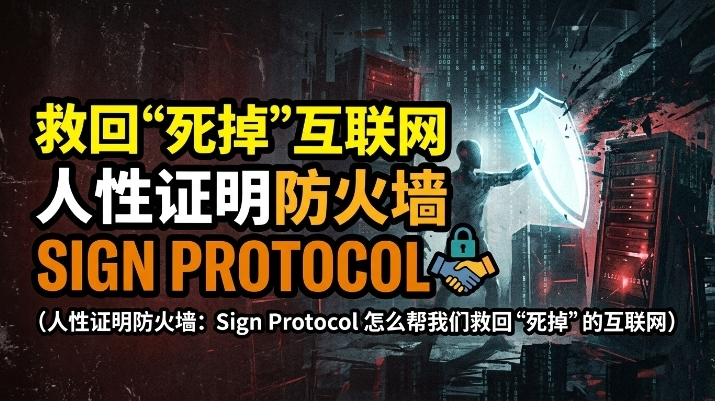
Sign Protocol is the 'humanity proof firewall'.
It’s not just about simple KYC; it provides everyone (or trusted institutions) with a universal, portable, privacy-respecting cryptographic method:
"I am a verified, unique real person, signing this at this moment."
In the future, every post, every vote, every comment, and every transaction can be checked against this proof before being released.
The dead Internet has been filtered out at its roots.

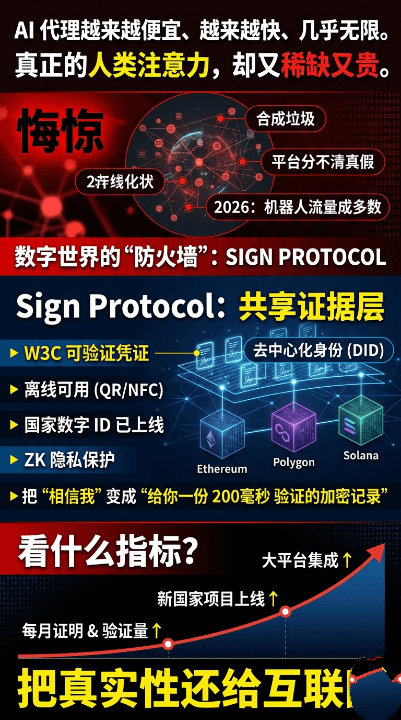
AI agents are becoming cheaper, faster, and almost limitless.
But genuine human attention and real verification are both scarce and expensive.
Platforms can no longer distinguish between real human interactions and synthetic garbage.
The government wants to return digital identity to the people, rather than feed it to big tech companies.
Web3 also urgently needs effective mechanisms against witch hunts.
2026 will be a turning point: robot traffic will become the majority, AI content will dominate everything, and sovereign blockchains will take off.
Now is the last window to build a 'shared real evidence layer'—miss it and it's gone.
Sign Protocol itself is not a blockchain; it’s a 'shared evidence layer' running on top of any blockchain.
It has truly made W3C's verifiable credentials and decentralized identity (DID) fully usable and portable across the entire chain, while adding zero-knowledge selective disclosure.
In short: turning 'trust me' into 'here’s a cryptographic record verifiable in 200 milliseconds, anywhere on any chain.'
It has powered EthSign document signing, TokenTable compliant token distribution, and various S.I.G.N. national projects.
The pilot phase has long passed.
The national digital ID project has launched, and ordinary citizens are using it every day.
Collaboration with governments has proven: it can meet strict privacy laws and regulatory requirements, and even support offline (just scan a QR code, NFC tap will do).
This is not a fantasy of a test network, but an infrastructure that has already been embedded in real sovereign systems.
1. Schemas—versioned templates that anyone can create at any time (for example, 'Proof of Humanity v1', 'Citizen Qualification v2').
2. Attestations—real records signed according to templates with timestamps.
These records can be fully on-chain, off-chain with on-chain proof, and can also use zero-knowledge to protect privacy.
Verification speed is fast, cross-chain usage is casual, and it can be revoked if needed.
Issuers (governments, DAOs, and even ordinary people through trust networks) are responsible for emitting 'human signals'; others only need to verify the math.
This transforms the Proof-of-Humanity on Ethereum from a niche experiment into something usable by the entire Internet.
No matter how impressive the proof is, it depends on whether there are trustworthy issuers and platforms willing to demand it.
Not all websites will connect tomorrow.
The first time you receive 'proof of humanity' still requires an anchor point in the real world—perhaps biometrics, government ID, or mutual guarantees from friends.
Zero-knowledge can protect privacy but won’t make all troubles disappear.
No matter how good the firewall is, it depends on whether the people and institutions behind it are trustworthy.
Several potential risks: a certain issuer having too much power, national standards conflicting, platforms sacrificing authenticity for traffic, ZK costs and cross-chain speeds occasionally stalling…
These are not dead ends, but require smart governance and reasonable incentives to continue running healthily.
Don’t just focus on the price.
What we really need to focus on:
How many proofs have been issued monthly, and how many have been verified?
How many countries have officially launched now?
Have major platforms started adopting schemas?
In spaces using proof of humanity, is user retention higher than purely bot areas?
These numbers steadily going up indicate that the firewall is indeed working.
SIGN (total supply 10 billion) is a utility + governance token.
Creating and verifying proof requires a small fee, cybersecurity professionals are rewarded, and the community can vote to decide the direction.
40% is specifically allocated for community incentives, including TGE airdrops and long-term support—the design philosophy is long-termism, not quick in and out.
Tokens are not the main character; the protocol is.
But if issuers, verifiers, and indexers have no economic incentive to participate, this evidence layer cannot truly decentralize.
Sign Protocol is one of the most grounded and reliable projects I’ve seen that aims to 'return authenticity to the Internet'.
The technology has gone live and has stood the test of practical application; the actual adoption situation for infrastructure projects is already impressive, prioritizing privacy while catering to ordinary people and respecting government needs.
It’s not a panacea—people still need to genuinely want 'human signals'.
But for now, it seems to be the clearest and most practical path out of the dead Internet quagmire.
- The query volume and proof growth curve of SignScan.
- New national project launch status.
- Major platforms announcing integrations.
- Advances in ZK proof costs and cross-chain speeds.
- The ratio of human-verified content vs. content growing wildly.
If these numbers keep rising in 2026-2027, you’ll know the firewall is really being built.
The essence of the dead Internet is not that the technology has failed, but that we increasingly cannot tell if the entity on the other side is a living person.
When every interaction can carry a 'human signed' cryptographic seal, the Internet will no longer be a mirrored maze, but will revert to genuine dialogue.
Sign Protocol did not claim to 'save' the old Internet; it simply handed the tools to us so we can collectively build a new Internet that can still prove 'people are still here'.
We defeat AI not by banning it, but by ensuring that every statement, every idea, and every cultural work clearly carries the signature of a real person.
If you are building a platform, add Sign proof today, and use it as your human filter.
If you are in government or an institution, see how S.I.G.N. can help you achieve true digital sovereignty.
If you’re just an ordinary person, tired of the noise, wanting to hear some truth—then support the space demanding PoH, and start issuing proofs yourself.
The firewall has been built.
There is only one question left:
Are we going to continue hiding behind robots, or finally stand up and prove with cryptography— we are still here and we are real people.
Sign Protocol has never claimed it would save the Internet.
It simply hands us the tools to prove we are still alive.
How we use it next depends on all of us.