
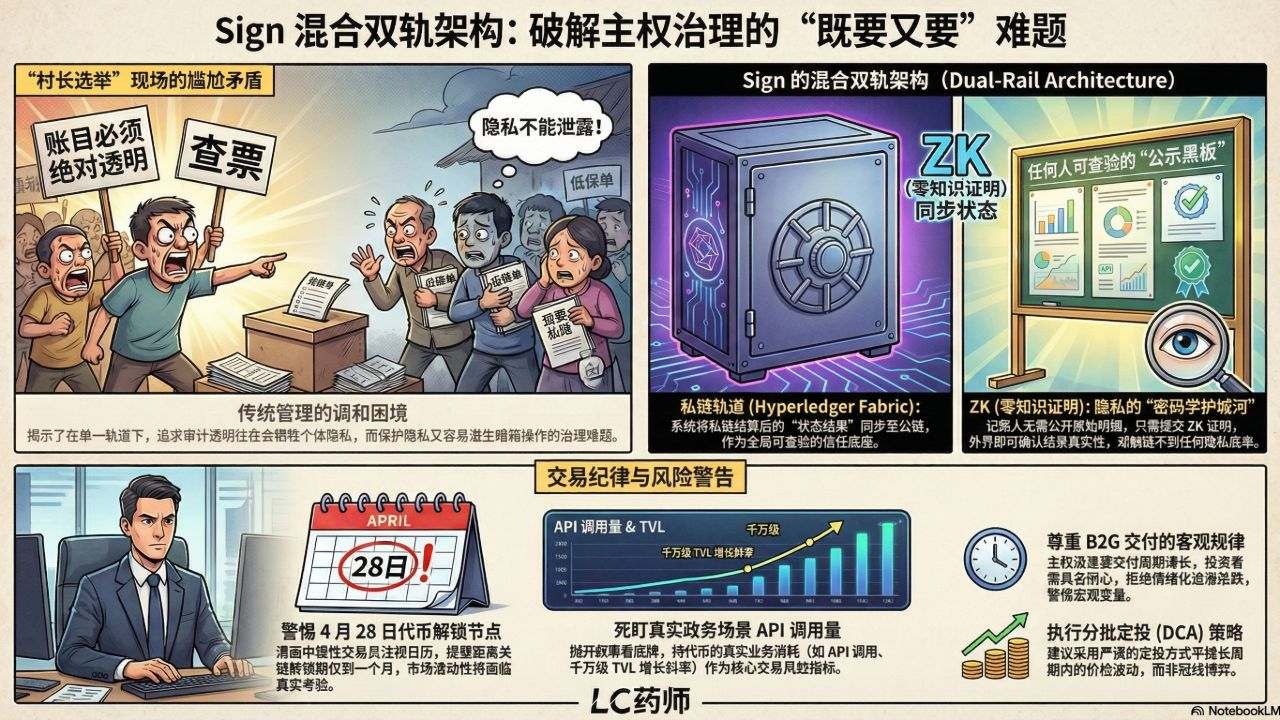
A few days ago, I returned to my hometown and happened to catch the village's periodic public disclosure of village affairs and finances. Everyone was discussing it enthusiastically; to say it was 'enthusiastic' is also to say that the scene at the time was quite amusing:
On one hand, everyone demands that the accounts be 'absolutely transparent'—where has the village's money gone? Who voted for whom? It must be open for inspection to prevent any behind-the-scenes manipulation; but on the other hand, everyone also needs 'absolute privacy'—how much low-income support each family receives, and who exactly Zhang San voted for, this kind of sensitive personal data, no one wants it posted on the village's big blackboard for everyone in town to see.
On the one hand, we need global transparency to prevent tampering, and on the other hand, we need absolute confidentiality of the underlying data, which is a difficult contradiction to reconcile in traditional management structures.
Looking at the chaotic governance pain points at the grassroots level, I instead thought of the Sign Protocol that has been repeatedly dissected in the investment research circle recently. There is a tedious term in the white paper, the underlying 'Dual-Rail Architecture', which attempts to solve the very issue of 'both wanting and needing' sovereign trust.
Let's objectively dissect this architecture to see what operational logic it has in our real-world scenarios:
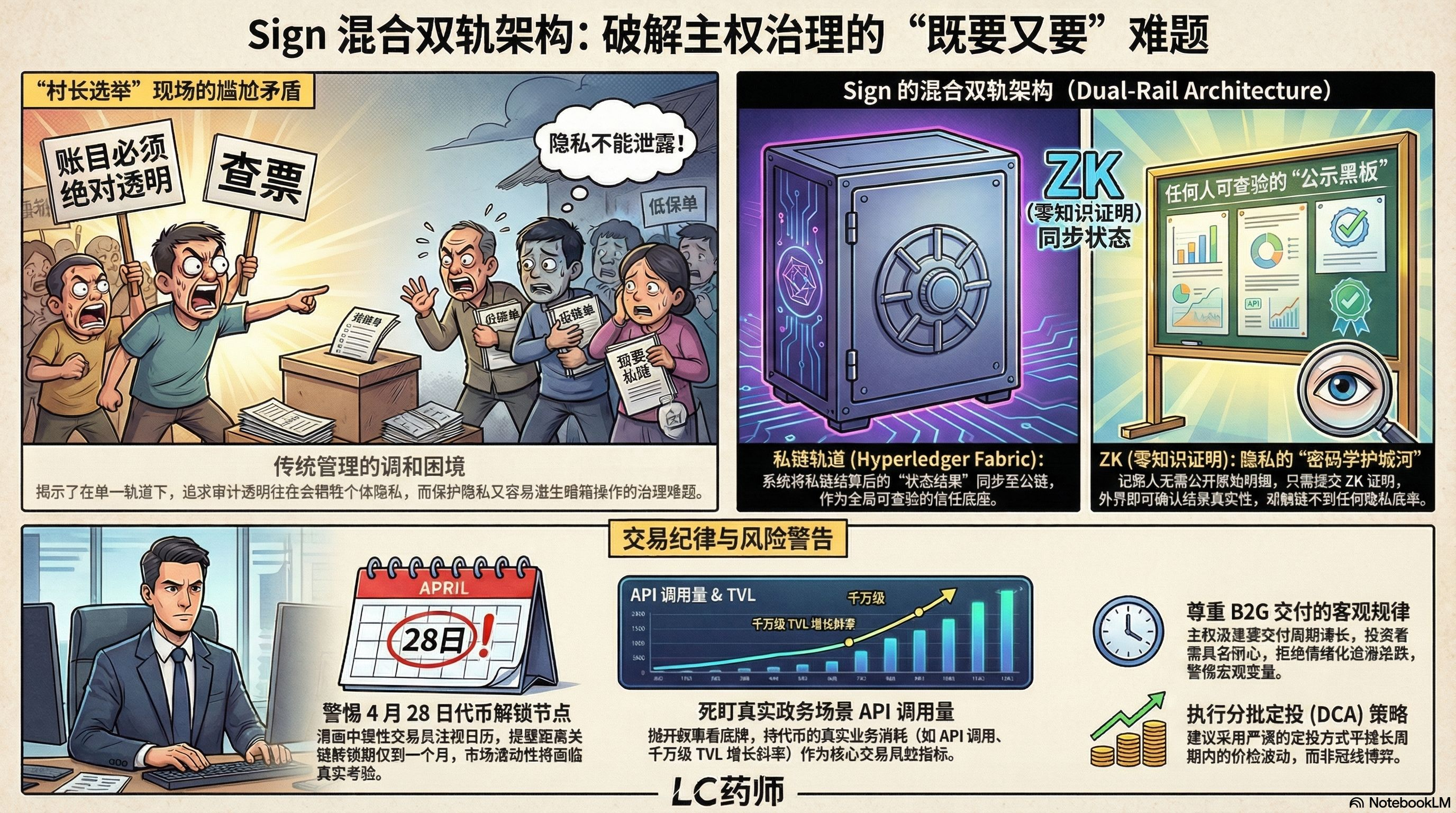
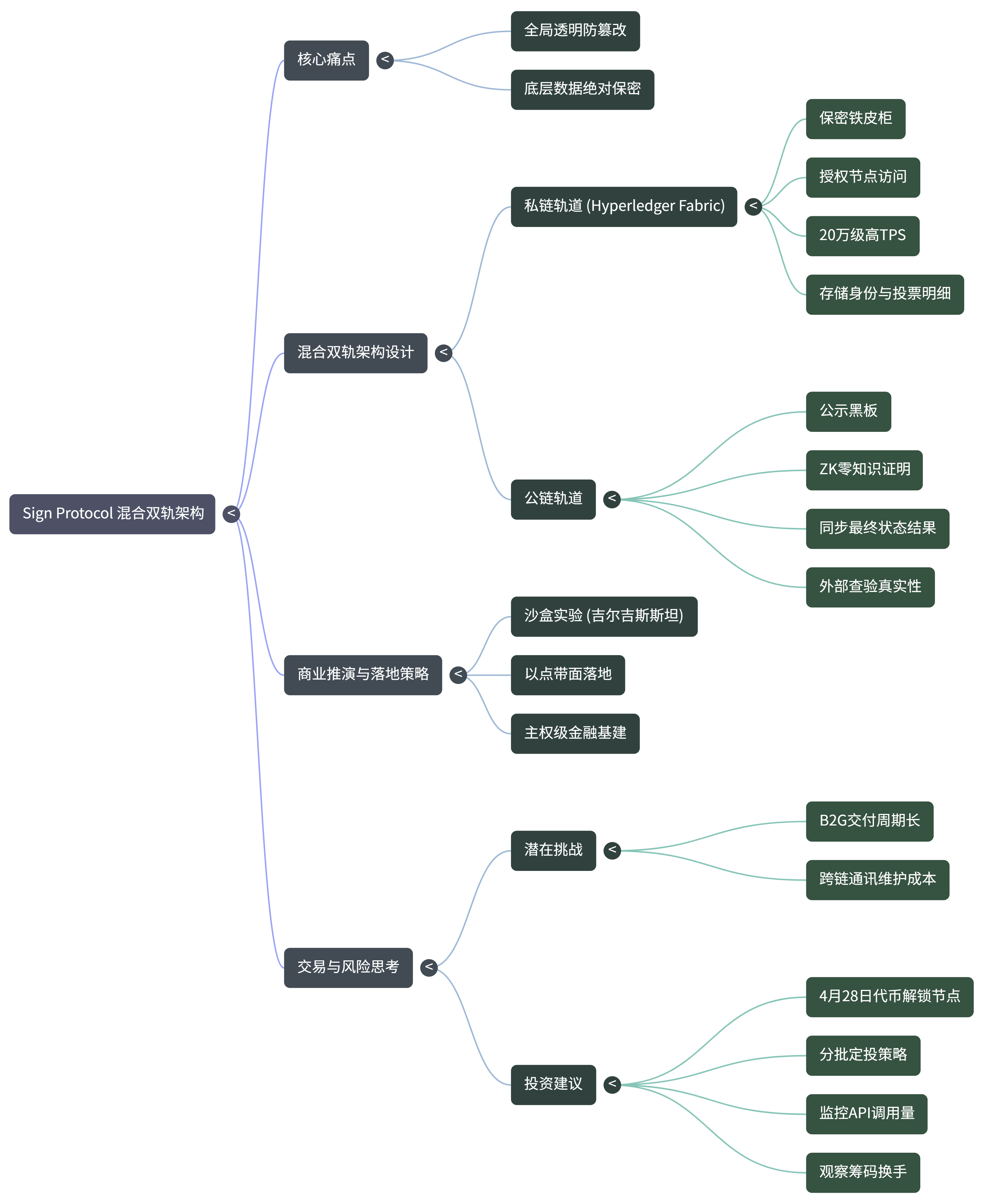
The private chain (Hyperledger Fabric) serves as an internal 'confidential filing cabinet'
In plain language, this is a foundational network that only authorized nodes (such as government agencies or village committees) can access. Its core function is to process extremely private concurrent data, with a TPS (throughput) design reaching up to 200,000. The villagers' identity base, specific voting details, and the actual flow of subsidies all operate rapidly within this filing cabinet. In this track, sovereign institutions have absolute control, and underlying privacy is tightly sealed, preventing external scrutiny.
The public chain track serves as a 'public bulletin board' that anyone can verify.
Once the accounts in the private chain are settled, the system synchronizes the final 'status result' to the public chain. Here, ZK (zero-knowledge proof) technology is utilized. The accountant does not need to nail the thick original details to the bulletin board; they only need to submit a cryptographic proof to the public chain. Anyone from the outside can verify this proof and instantly confirm that 'the election results are real, and the accounts are stable', but cannot touch any individual's privacy base.
Scaling this logic up to a macro scenario helps to understand Sign's current commercial evolution path.
Why are early collaborators often relatively small economies like Kyrgyzstan? This is actually a pragmatic sandbox experiment. Disruptive sovereign-level financial infrastructure cannot be replaced all at once in large-scale superpowers that are interconnected. It must first run this 'confidential filing cabinet + public bulletin board' dual-track system in a 'sandbox', obtain a rigorous operational report, and then gradually open the door to larger regulatory bodies. This is a typical 'point-to-surface' implementation strategy.
Alright, enough said. It's the weekend, I'm going to find the village party secretary for a drink, and by the way, I'll enlighten him on web3 and Sign knowledge.
@SignOfficial #Sign地缘政治基建 $SIGN
