

The large-scale adoption of Bitcoin by institutional investors has resumed, but global instability and rising inflation risks in the U.S. are limiting Bitcoin's ability to break through the $70,000 mark.
The consolidation of Bitcoin (BTC) continued until Thursday, as bullish investors struggled to hold the $70,000 level. The current market structure of Bitcoin contrasts with its increasing institutional adoption, while overall bearish factors continue to negatively impact the U.S. stock market.
Bloomberg analysts indicate that data shows institutional investors are returning en masse to the Bitcoin market, reinforcing the view that Bitcoin has already 'bottomed out,' citing Bernstein's expectation that Bitcoin will rise to $150,000 by the end of 2026.
At the beginning of March, Bitcoin spot ETF saw nearly $1 billion in net inflows for a week. Meanwhile, Strategy purchased 22,237 Bitcoins through its newly launched perpetual preferred stock Stretch (STRC), with a total value of $1.6 billion. Besides the success of STRC, Strategy also announced plans to raise additional funds to buy back $44.1 billion worth of Bitcoin.
More signs of institutions returning to the crypto market come from Morgan Stanley, which manages $10 trillion in assets and has submitted an application to launch its own Bitcoin spot ETF. Morgan Stanley suggests that investors allocate 2% to 4% of their assets to cryptocurrencies. On March 26, a new regulation proposed by the U.S. Department of Labor advanced to the White House for regulatory approval, aiming to allow brokers managing $10 trillion in 401(k) retirement plans to invest in Bitcoin.
On Thursday, Coinbase also launched a mortgage down payment service that allows token payments, enabling Bitcoin and USDC holders to finance mortgages. This move allows Bitcoin holders to unlock liquidity without selling or triggering tax events.
How important is the $70,000 support level for Bitcoin?
Although institutional investors' interest in buying Bitcoin has clearly returned, the price volatility of Bitcoin and the downward trend over the past six months remain major obstacles. The ongoing conflict between the U.S. and Iran, along with President Trump’s threat to send ground troops to Iran, continues to negatively impact the stock and cryptocurrency markets.
On Thursday, President Trump posted on the Truth Social platform, stating that Iranian negotiators "had better take it seriously as soon as possible, or it will be too late; once it happens, it cannot be undone, and the outcome will not be pretty!" The massive troop buildup by the U.S. in the Middle East has raised market concerns that ground actions may begin this weekend.
 President Trump posted on Truth Social. Source: Truth Social
Following a series of statements from the president, the U.S. stock market generally fell, with the Dow Jones Industrial Average dropping 400 points, and the S&P 500 and Nasdaq falling by 1.49% and 2.07%, respectively. On the other hand, both WTI and Brent crude oil prices surged significantly, with an increase of over 4%.
As the situation between the U.S. and Iran becomes more uncertain, and the long-term impact of high oil prices on U.S. inflation and the broader economy becomes clearer, investors are choosing to reduce their exposure to volatility.
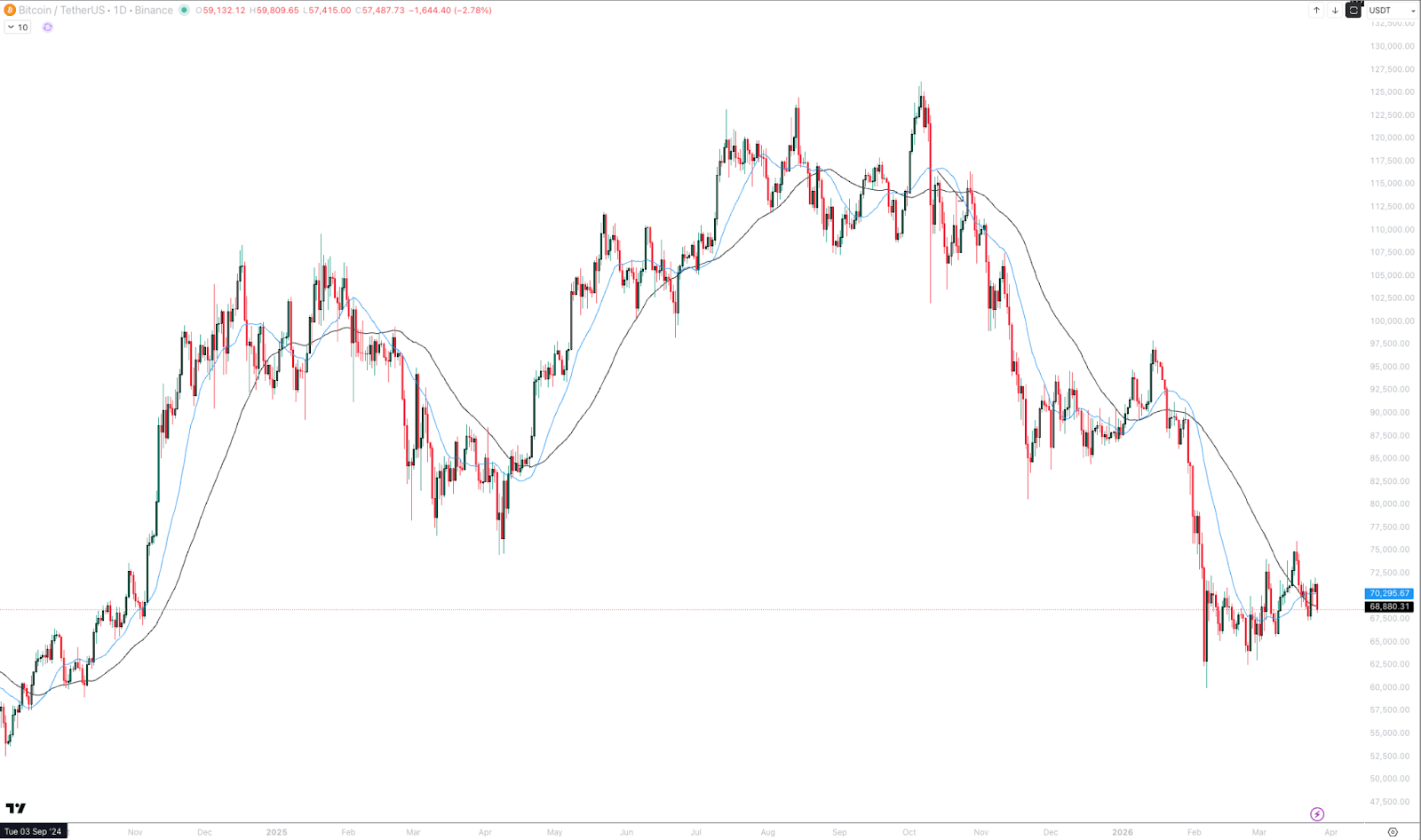 BTC/USD daily chart. Source: TradingView
This explains why Bitcoin repeatedly falls below $70,000 and why rebounds within the $71,000 to $76,000 range are difficult to sustain. The positive factor is that both institutional and retail investors seem to view the area below $70,000 as an ideal buying zone, further solidifying that price level as support.