
The Digital Finance Primer: Understanding the Future of Global Money
1. Introduction: A New Era of Financial Freedom
Welcome to the frontier of global finance. For years, the world of digital assets was viewed as a "Wild West"—a speculative space defined by high risks and fragmented oversight. Today, we are witnessing a fundamental shift as the industry moves from a "Trust Us" model based on reputation to a mature, "Verify Us" model defined by institutional compliance. This evolution is driven by a core mission: increasing the freedom of money for everyone.
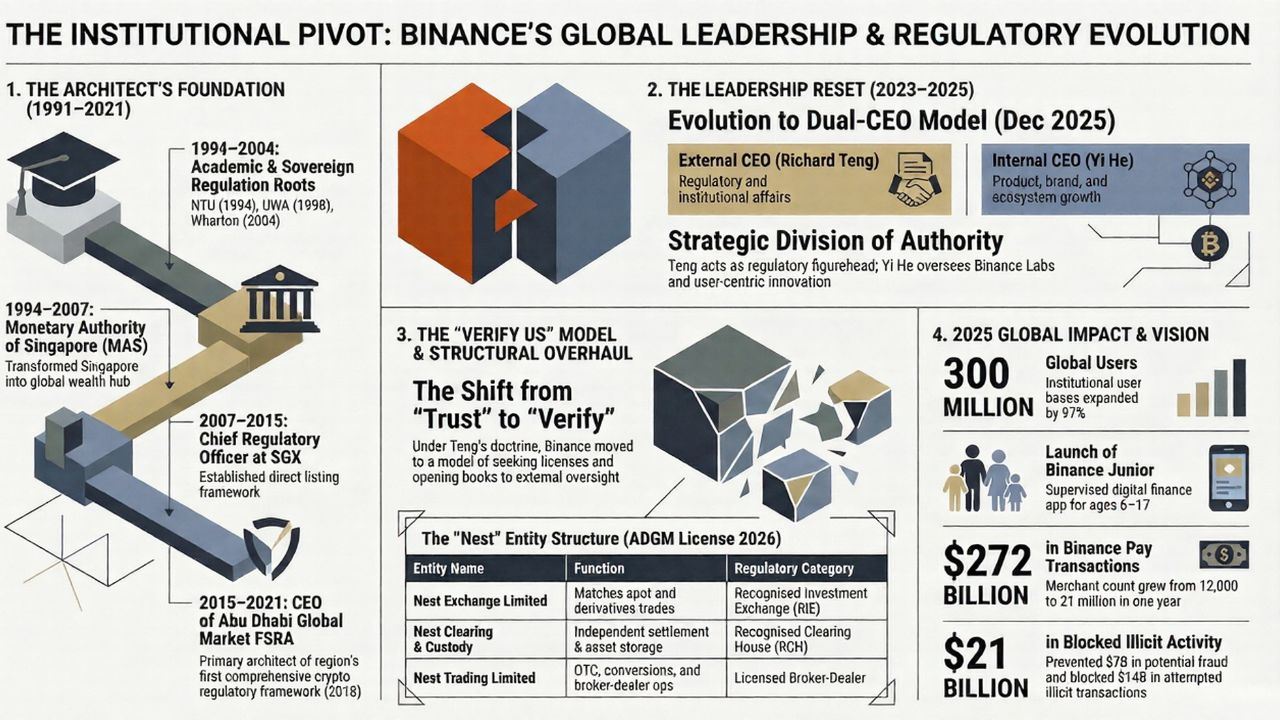
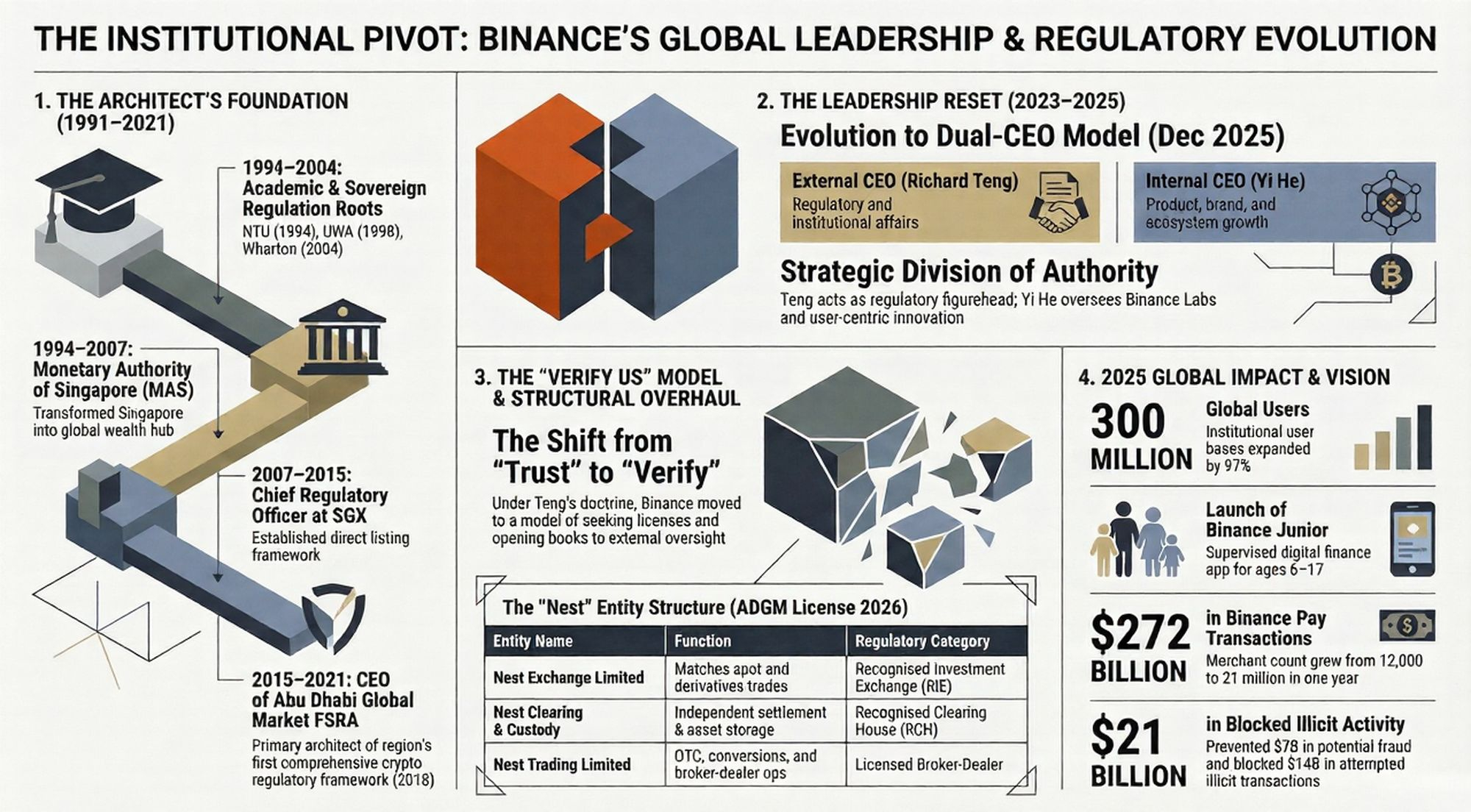
This transition to maturity is physically represented by a new dual-leadership model at the world's largest exchange, where Co-CEOs Richard Teng and Yi He combine deep regulatory expertise with a relentless focus on product and user experience. By merging the rigorous safety standards of traditional banking with the speed of blockchain technology, digital finance is moving beyond its niche origins to become the backbone of a new, inclusive global economy. To understand the significance of this shift, we must first examine the inherent limitations of the legacy financial systems that have governed our world for decades.
2. The "Slow and Expensive" Problem: Why Traditional Finance is Changing
Traditional banking continues to struggle with the friction of moving value across borders. Sending money internationally often requires navigating a labyrinth of intermediary banks, each extracting fees and adding delays. These hurdles—high costs, slow processing speeds, and the restrictive nature of "banking hours"—create a massive barrier for global trade and individual financial freedom.
The following table highlights how modern digital infrastructure addresses these fundamental pain points:
Feature
Traditional Banking
Digital Asset Infrastructure
Cost
High costs due to intermediary fees and currency exchange spreads.
Transactions occur at a fraction of the cost by removing unnecessary layers.
Speed
Cross-border transfers can take several days to clear and settle.
Transfers are nearly instant, moving at the speed of the internet.
Availability
Restricted by "banking hours," weekends, and regional public holidays.
Always-on infrastructure that operates 24/7/365 across all borders.
As we seek to bridge this gap between legacy systems and modern needs, stablecoins have emerged as the essential tool for providing price stability within this high-speed digital framework.
3. Stablecoins: The Backbone of Modern Payments
For those new to the ecosystem, stablecoins can be understood as "USD 2.0." Unlike volatile cryptocurrencies, stablecoins are designed to maintain a steady value by being pegged 1:1 to a sovereign currency like the U.S. Dollar. Their primary utility lies in providing a stable medium of exchange for everyday use while utilizing blockchain technology to operate without geographical limits.
2025 Growth Snapshot
The scale of stablecoin adoption has reached a historic tipping point, as evidenced by these 2025 milestones:
Market Capitalization: Total value has increased by approximately 50% year-to-date.
Total Wallet Holders: The global user base has climbed to 130 million users.
Settlement Volume: In 2024, daily stablecoin settlement volume officially surpassed that of Visa.
Daily Volume Peaks: During periods of high activity, assets like Tether have exceeded $10 billion in daily volume.
These digital assets are only as effective as the technology they run on—a 24/7 permissionless infrastructure that fundamentally changes how markets operate.
4. 24/7 Permissionless Infrastructure: Moving Beyond Banking Hours
The true power of digital finance is its "always-on" nature. In the traditional world, markets close; a wire transfer sent on a Friday evening may not settle until Monday. Digital finance operates as a "24/7 NASDAQ," where the underlying blockchain allows for instant settlement at any second of the year.
For a small business owner in an emerging market, this "So What?" is life-changing: it means capital is no longer trapped in transit. Instant settlement allows for immediate reinvestment and better cash flow management, collapsing the traditional boundaries that once favored large institutions with deep liquidity. This infrastructure is no longer a concept for the future; it is actively powering national payments and merchant networks around the globe today.
5. Real-World Utility: From Instant Settlements to National Payments
Digital finance has moved decisively into the realm of everyday utility, with adoption spanning from local merchants to entire nations. This shift is highlighted by the massive scaling of payment networks and strategic national shifts:
Binance Pay Expansion: The merchant network grew from 12,000 to nearly 21 million in a single year. More importantly, Binance Pay processed $272 billion in transactions in 2025, demonstrating that digital assets are now a significant driver of global economic throughput.
National Adoption: Nations are integrating these tools into their sovereign infrastructure. Bhutan recently became the first country to launch nationwide digital payments powered by Binance Pay, linking the system to renewable-energy initiatives and a native blockchain ecosystem.
Global Strategic Shifts: As the United States moves to position itself as a "global crypto hub," other major economies are reassessing their strategies to remain competitive in this new financial landscape.
Institutional Scale: Businesses are increasingly using stablecoins for cross-border value transfer to avoid high bank fees. This institutional confidence has helped propel the industry to a cumulative trading volume exceeding $125 trillion.
As these tools become a permanent fixture of global trade, we are increasingly focused on ensuring the next generation is equipped with the literacy required to navigate this landscape.
6. Financial Literacy: Empowering the Next Generation
In an era where money is digital, financial literacy is no longer an elective—it is a basic life skill. Tools like Binance Junior have been developed to provide users aged 6–17 with a secure environment to build foundational blockchain and digital finance skills. By introducing these concepts early, we ensure that the next generation can navigate the future of money with confidence and responsibility.
To ensure a safe learning environment, the app includes robust parental safeguards:
[ ] Parental Oversight: Parents have full visibility and must approve every transaction.
[ ] Supervised Sub-Accounts: Minors access the platform via sub-accounts linked to a parent’s verified profile.
[ ] Educational Integration: The app features specific modules designed to teach digital asset management and security.
This focus on education is mirrored by a "Safety First" approach in global regulation, where new frameworks are being built to protect users of all ages.
7. Trust and Transparency: The "Verify Us" Model
The transition from "Trust Us" to "Verify Us" marks the end of the unregulated era. Under this model, digital finance platforms adopt the strict transparency and "unbundling" standards of traditional finance. A primary example is the Abu Dhabi Global Market (ADGM) framework, a gold standard in regulation that requires the separation of clearing, custody, and trading to prevent conflicts of interest.
Regulated activities under the ADGM framework commence on January 5, 2026, through three distinct "Nest" entities:
Nest Exchange Limited: Functions as a Recognised Investment Exchange (RIE) and operates a Multilateral Trading Facility (MTF) for Spot and Derivatives trading.
Nest Clearing and Custody Limited: A Recognised Clearing House (RCH) that provides secure custody and operates a Central Securities Depository (CSD), ensuring assets are segregated from trading risks.
Nest Trading Limited: Operates as a licensed Broker-Dealer, managing activities such as OTC services, asset management, and money services.
This unbundled structure provides the audited oversight that institutional investors and sovereign funds require, ensuring that the digital ecosystem mirrors the resilience and safety of the world's most established stock exchanges.
8. Conclusion: Your Place in the Future of Finance
Digital finance has evolved from a speculative experiment into a critical tool for financial inclusion and global efficiency. By solving the age-old problems of high costs and slow speeds, this system is empowering "forgotten economies" across Africa, Latin America, and Southeast Asia.
With over 300 million registered users already on board and a clear goal to reach one billion, the industry has moved past its initial growing pains. Led by a dual leadership focused on both innovation and rigorous compliance, the digital transformation of money is providing a more open and fair financial system for everyone. This transformation is only beginning, and your journey into the future of money starts now.