
Recently, I have been helping an oil service team stationed in the Middle East with local compliance procedures. In order to open a local corporate account and secure labor visas for several key engineers, I have truly been worn out by those compliance officials from foreign banks.
Brothers who have done international business understand this sense of humiliation. Foreigners want to check your qualifications; not only do they require your passport and business license, but they also want detailed financial statements from your domestic company for the past three years, and they even want to conduct a thorough review of the personal asset proof of the shareholders. To prove that you are 'qualified' to take this business order, you have no choice but to hand over a pile of extremely sensitive business documents to a local intermediary you are not familiar with at all.
In traditional multinational due diligence, if you want to prove your compliance, you must 'run naked' in front of others.
While smoking at the hotel at night, I flipped through the developer documentation of @SignOfficial that I have been struggling with recently. Don't be fooled by those people in the circle who shout about sovereign infrastructure every day; what I really care about is the underlying design called New ID System (新身份系统) inside it. There is a very hardcore and obscure term called Selective Disclosure (选择性披露).
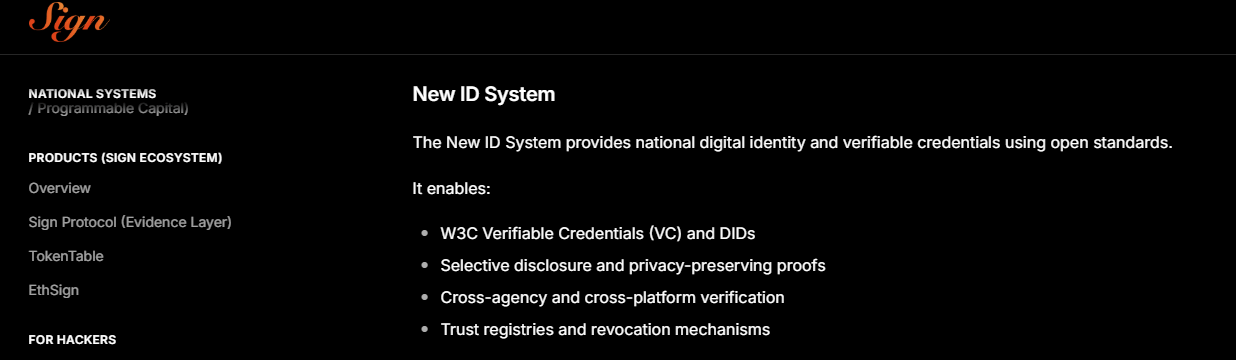
This thing is simply the antidote tailored for us multinational traders who are tortured by compliance every day.
If you use this W3C verifiable credential (VC) to run multinational business, how does the system compromise with reality? It cunningly hides your bottom line.
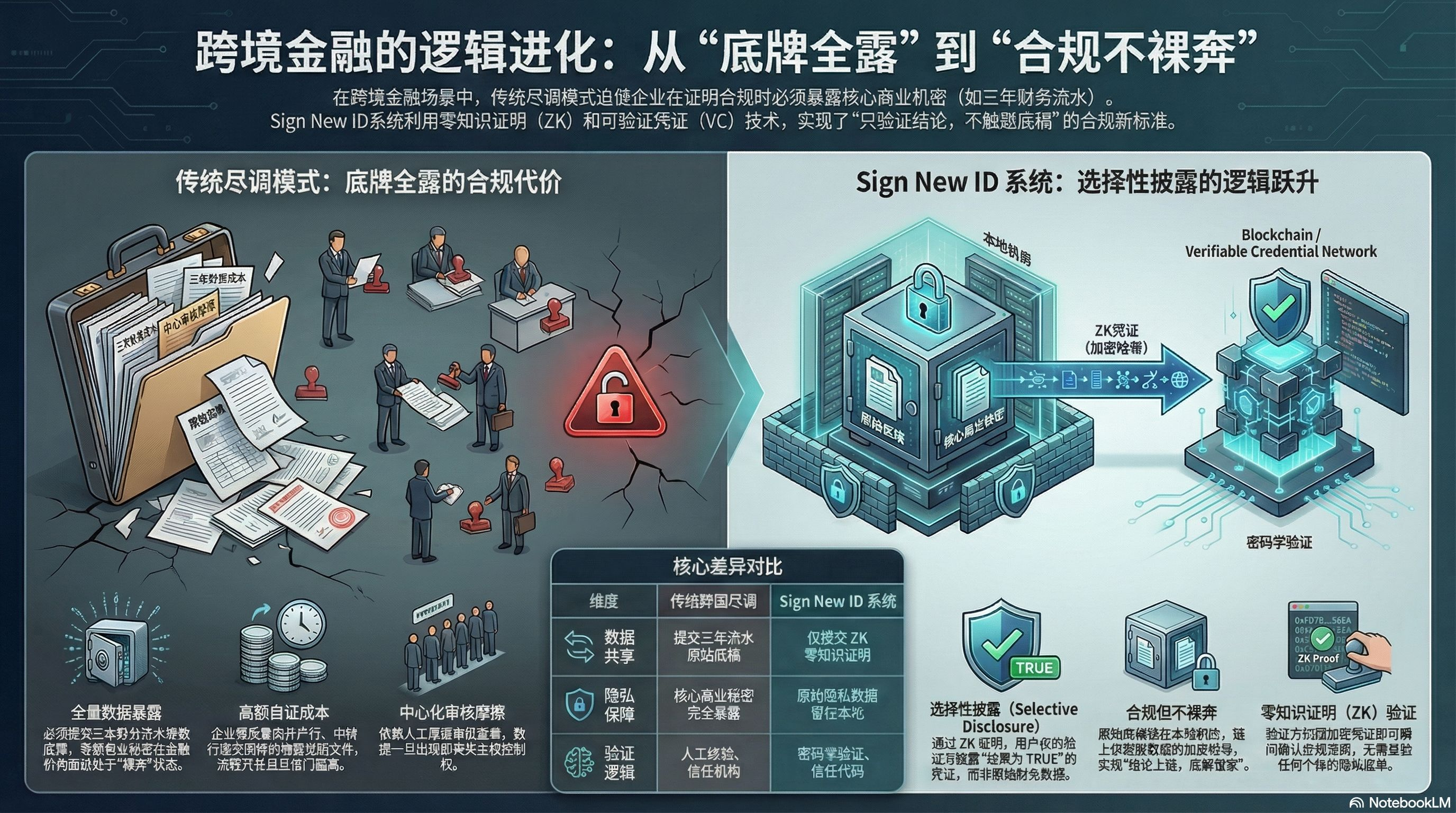 For example, local banks require you to prove that 'account funds exceed 1 million US dollars.' In the Sign system, you do not need to send over thick three-year bank statement PDFs. You only need to use ZK (zero-knowledge proof) technology to generate a cryptographic credential on the chain and hand it to the other party.
The compliance officer on the other side scans the device, and the system only tells him a cold conclusion: 'This person meets the funding requirements, result is TRUE.' As for whether you have 1.01 million or 5 million, whether your money comes from PetroChina or Dubai, the other party cannot see any of it. This is the dimensionality reduction strike of 'only giving results, without revealing the draft.'
But is this logic really flawless? As a veteran who has been through the business world, I have to throw some cold water on those geeks.
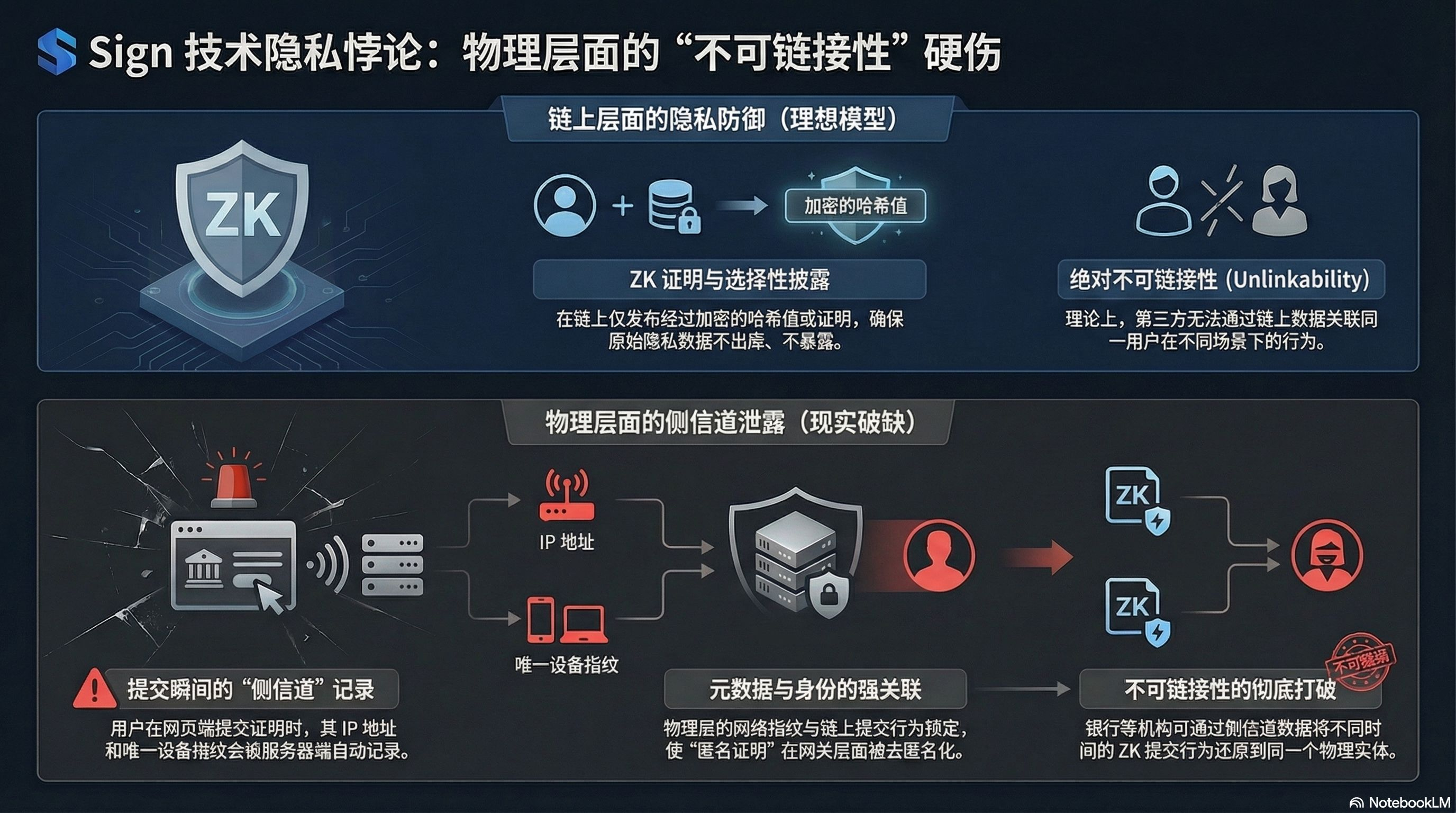
The white paper boasts that this mechanism has absolute 'Unlinkability,' claiming that no one can track you. Nonsense. Cryptography indeed has no issues, but in the real physical world, the moment you submit this zero-knowledge proof to customs in the Middle East or to a bank's webpage, their server has already recorded your IP address, device characteristics, and browser fingerprint. No matter how perfect the privacy in the code is, the side-channel leaks at the physical network layer can still piece together your identity. The barriers of the physical world cannot be filled with just a few lines of smart contracts.
Of course, a flaw does not obscure the merits. I heard that Sierra Leone's Ministry of Communications has already started piloting this digital ID. If this really can expand to more multinational nodes, the impact for people like us in the real economy would be immeasurable. It seems necessary to buy some $SIGN to hold onto for now, or wait until the creator rewards are fully distributed, and others have sold out, then I can buy in at a low point.

When negotiating deals in the Middle East and dealing with compliance in the future, I will directly throw out the encrypted credential. It can prove to investors that my cash flow can withstand scrutiny, while also keeping my upstream and downstream client list hidden from competitors. Whoever can first use this anti-spying trust gateway in international trade can cut off the most disgusting compliance friction and turn all the time saved into real profit.