
⇒ The white paper
⇒ The tokenomics
⇒ The Roadmap
⇒ The team behind the project
⇒ The Backers
⇒ The community
I am forced to divide this article into 3 parts so that it is not too long and easy to digest.
Let's go with the White paper 🗞️, the tokenomics.
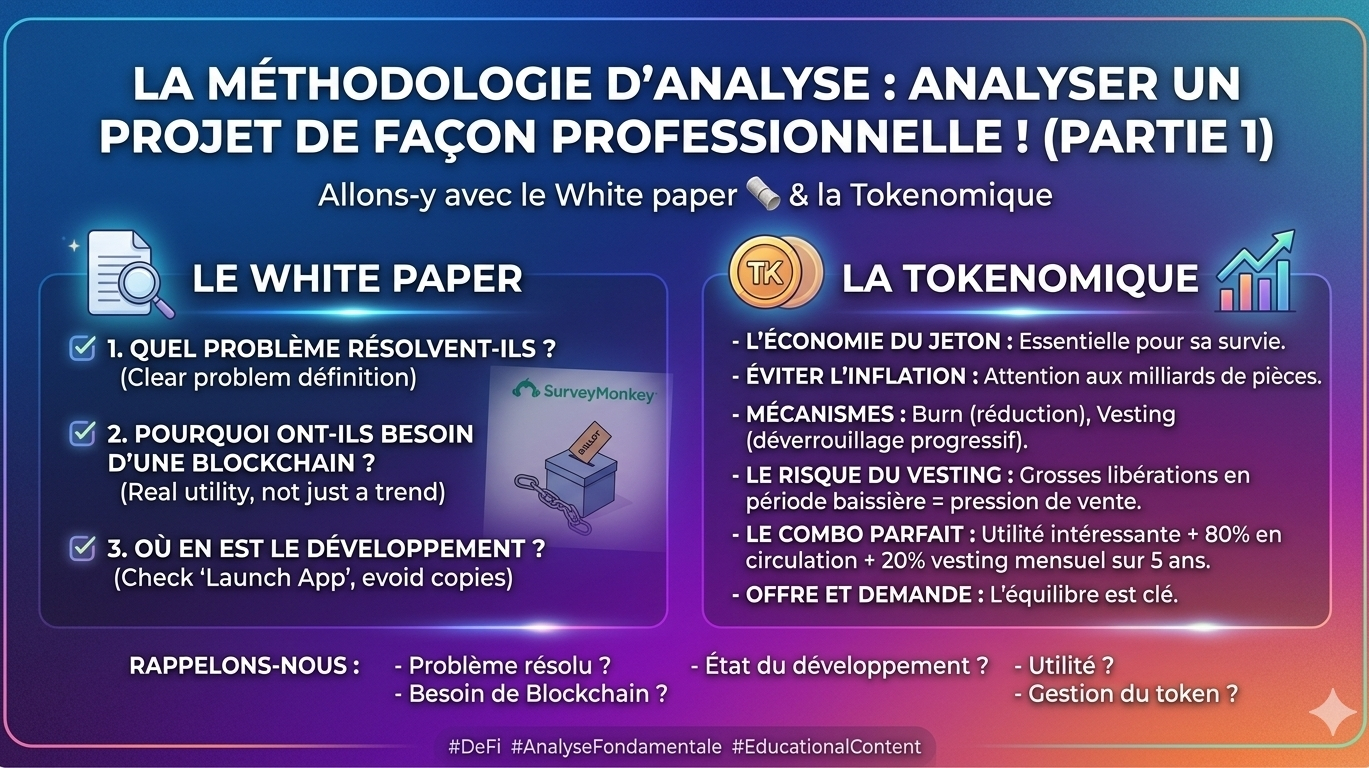
When you want to analyze a project, always start by reviewing the White paper, you need to ask yourself these 3 main questions:
×××> What problem do they solve?
×××> Why do they need a blockchain?
×××> Where is the development?
Many projects are just copy-pastes of other existing projects; anyone can get up and create a token and put it on the market to extort funds from misinformed users. When you ask the first question and the answer is vague, move on.
Several projects do not necessarily need a Blockchain to function. There are many projects that can function quite well without Blockchain; most of the time, people just want to follow the trend by putting the name of the Blockchain in front, but can they thrive?
For example, implementing a voting program on the Blockchain for small businesses means that users or stakeholders have a wallet; this is already an accessibility problem for average users. SurveyMonkey can manage this task quite well.
Seriously ask yourself this question while reading the White paper.
Now, where are we with the development of their product?
The best projects often put “Launch App” on their site... with that you can easily see where the development of the proposed product stands. Otherwise, move on and observe them for the first 3 months to see how they progress with the launch of their products.
Let's see what to look for in tokenomics, the guiding thread, the economy of the token!
Tokenomics contains the essential element for the token's survival. A project can have a brilliant idea and good intentions, but if its economy is poorly programmed, it will not last long and will struggle over time.
It’s not for nothing that Bitcoin has managed to reach this level today.
There will be a maximum of 21 million coins in circulation, and the people they serve are hundreds of millions and its utility is of a global reality.
There are other projects with interesting fundamentals, but that have millions of billions of coins in circulation... in the end, if you look at their performance over 5 years, they are stable like a stablecoin.
Other projects are implementing a burn mechanism to gradually reduce inflation, and others are gradually putting coins into circulation through vesting (unlocking tokens). What is wrong with vesting is when it is poorly managed, like large releases during a bearish period when there will be no demand to accompany the new supply; large releases intended for ICO participants, if they decide to sell, the price crashes again.
The perfect combo is: The interesting utility + Average quantity totally or almost entirely 80% in circulation, with monthly vesting of the remaining 20% over 5 years.
Think a little about the concept of supply and demand. If a product has a low quantity in circulation but is desired by several people, the price naturally rises. But if the product is not liked but has a high concentration, the price will never rise because no one wants it.
Remember:
×××> What problem do they solve?
×××> Why do they need a blockchain?
×××> Where is the development?
×××> The utility of the project
×××> The token management mechanism