
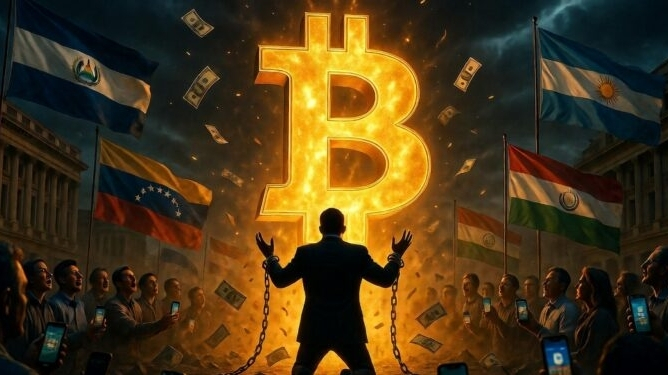
$BTC ☄️⚡️🚨🔥🚨PAY ATTENTION TO THIS INFO, IT WILL MAKE BITCOIN SOAR THIS YEAR!🚨🔥🚨🤑🇦🇷 Whether due to necessity or future vision, cryptocurrencies are already being established as public policy.
But something changed. It's no longer just that they stop pursuing; they begin to use them. And not due to a sudden ideological enlightenment or love for decentralization. They do it out of necessity. The same necessity that pushed millions of citizens to adopt Bitcoin and stablecoins as a release valve from the fiat disaster they created themselves.
This turn is not benevolence. It is survival.
No one exemplifies this better than El Salvador. Its economy has been dollarized for more than two decades, which means that its monetary policy is decided by the Federal Reserve of the United States. Bitcoin is the closest thing to monetary sovereignty they have had since 2001.
This is probably what displeased the IMF. And despite the truth about whether they are really still accumulating BTC remaining nebulous, and despite having removed the legal tender (which, in fact, is good), the transparency of Bitcoin allows for the verification of bitcoin holdings in their reserves. More than 7,600 BTC in state coffers is the proof that when money is controlled by another, the best option is to take refuge in the hardest currency on the planet.
In Venezuela, U.S. sanctions closed traditional trade routes. Since 2018, the government discovered what Venezuelans had known and taken advantage of for years due to the control of access to foreign currency: that Bitcoin allowed them to access the international market without censorship. Yes, there were corruption scandals like the PDVSA-crypto one. But the use of cryptocurrencies, especially stablecoins to allocate foreign currency to companies, continued to grow.
Bolivia repeated the script. Crisis of international reserves, scarce physical dollars, uncontrolled inflation. In 2024, they lifted the total ban that had weighed on the country for ten years, and stablecoins became de facto the reference of value for businesses and families. The Minister of Economy, José Gabriel Espinoza, established at the end of 2025 that “digital assets will function as legal payment instruments within the financial system.”
Paraguay offers the most ironic twist. For years it chased illegal farms that “stole” energy from Itaipú. Now, in March 2026, ANDE (National Electricity Administration) announced that it will reuse 30,000 confiscated machines in a public-private project with Morphware. The State goes from enemy to partner, mining Bitcoin with its own excess energy. And while the proposals to give legal tender status to bitcoin from 2021 have not resurfaced, now, instead of pursuing, ANDE itself signs agreements and its representatives appear at bitcoin conferences recognizing that mining with excess energy from Itaipú does not affect the electrical system.
This very week, the Central Bank of Cuba issued Resolution 4/2026: it granted the first ten licenses to companies to use cryptocurrencies in international payments. It is not a general opening. It is a selective and controlled permission. But the message it sends is “we need dollars and Bitcoin brings them to us.” After years of regulatory attempts that never landed, the economic crisis forced the regime to take the step.
All these cases have a common denominator. None started in an official office. It started on the street, in the informal economy, in the WhatsApp of remittances, in p2p exchanges, in the self-custody wallets of ordinary people fleeing inflation, financial censorship, and the lack of dollars. Fleeing from the evils of money created and managed by governments.
Citizens found the solution first. Governments, seeing that they could not stop it, and that it also resolved problems that they themselves generated (inflation, isolation from the international market, foreign currency shortages), decided to jump on the train. Not out of conviction. Out of convenience.
And this will be replicated in other latitudes. Peru, with its Bitcoin citadels like Motiv, already has the fertile ground to replicate the path of Bitcoin Beach towards adoption. Honduras, despite the frictions with Próspera, has the same incentives.
Argentina, despite the reputational setback of the memecoin $LIBRA under Milei, has the highest popular adoption in the region; it is only a matter of time before economic necessity outweighs political error. In fact, the city of Buenos Aires maintains a program directly focused on promoting cryptocurrencies, called BA Cripto, which has allowed taxes like ABL, patents, and fines to be paid with crypto through QR, in addition to launching QuarkID, the first self-sovereign digital identity on Ethereum in Latin America.
What does this mean in practice? For the average Latin American individual, practically nothing changes in day-to-day life. They never needed government permission to use Bitcoin. They can still save in sats, send cheap remittances, protect themselves from devaluation, and trade without borders. State adoption does not give you more freedom; it only confirms that you were right from the beginning.
For the bitcoin community, it is a brutal validation. A giant “we told you so.” Every time a government adopts (even if out of necessity), it is recognizing that Bitcoin is “money for enemies.” It works even when the State hates it, regulates it, or pursues it. And that strengthens the narrative: it is not a speculative fad; it is a technology of monetary resistance that even governments end up using.
For Bitcoin, it is a deepening of its network effect. More state adoption means more nodes, more hashrate, more liquidity, more stability, and above all, more cultural legitimacy. When a dollarized country like El Salvador accumulates BTC; when a sanctioned regime like Venezuela uses it to survive; when Paraguay begins to mine, the global message is one: the money created by governments fails even for those who control it.
And the contagion will not stop there. Every time a country falls, the next one looks at it and thinks: “If they are doing it out of necessity… why not us?
In the end, governmental adoption in Latin America is not a triumph of the State over Bitcoin. It is the opposite. It is the tacit recognition that the fiat system is broken even for those who administer it. It is the ratification that Bitcoin is neutral, resilient, and useful for anyone, whether you like the government or not, whether you agree with its policies or not.
Individuals paved the way. Governments are just following. And as long as they continue to fail in their economic management, they will have to choose: either they adapt to Bitcoin… or they fall behind.