
I mean, actually... I've been thinking about @SignOfficial for a while... I didn't know where to start. At first, I thought – this is another attestation system, basically another layer to verify data. Nothing new in crypto. But I went a little deeper and realized that they're not actually working with data... they're working with decisions. This place is a little different. We usually talk about blockchain, transaction speed, fees, liquidity – that kind of thing. But we silently ignore one thing – how true is this data? SIGN is really focusing on that place.
What I mean to say -
Looking at the mainnet and execution side, they're already implementing across multiple chains – EVM, non-EVM, even Bitcoin L2. This seems important to me because many projects are just on the roadmap; here at least some things are live. They're confident about high capacity – meaning they can handle many attestations at once – but it's really great. It seems solid, but honestly… it's not a real test yet. Because the performance and real-world pressure in a controlled environment aren't the same thing. For example – when you add things like government subsidy systems, cross-border identity verification, bank-level compliance, the load becomes not only technical but also political. The "Sign Scan" explorer gave it – good. There's transparency too. But here too, a big question arises – what I see is valid, but who is declaring it as valid? A somewhat mixed feeling about adoption… Yes, gaming, social graph, DeFi – the integration started in this place. Identity verification, on-chain history attestation – these are practical use cases. But when will real adoption happen? When people won't understand that they're using SIGN, but the system will silently depend on it. That hasn't happened yet.
Another subtle thing -
They are pushing for standardization. Sound logic. But standard means rules. And rules mean – someone is defining it. This place can be dangerous. Because – defining schema defines behavior. Behavior defines incentive control, meaning that decentralization can, on the surface, have the control layer silently shifted inward. The cost side is honestly staggering… Maintaining proof + schema without keeping all the data on-chain – that’s not only cheap but also scalable. Using L2, providing off-chain attestation – almost negligible cost. But the trade-off cannot be ignored by any means. Off-chain → cheaper, off-chain → less transparent. Less transparent → more trust dependency, meaning technically clean, but socially a bit in a gray area.
Overall, what I understand is-
They don't really want to improve the "data layer" of the blockchain; they want to create a "trust logic layer." What this means is – they will attach proof, attach conditions, then release money/access. This is powerful – very, very powerful. But here's the tension – the verification layer is not trustworthy, so even if the programmable system is fair, the outcome may not be fair.
So… I take an honest look-
The idea isn't weak; in fact, it's very strong. The execution isn't completely empty either—there's progress. But there are still many unresolved issues—such as trusting the verifier, whether the scheme's governance will be neutral or not, and whether there will be a balance between cost and control when it comes to scale. And personally, one question keeps coming up—if the proof system is controlled, are we simply shifting from data control to proof control? Without a clear answer to that, I see it not as a final solution, but as an evolving experiment. Perhaps in the future it will become an invisible infrastructure—or perhaps it will silently create a new gatekeeper.
It's still unclear... And this "unclear" space is actually quite interesting... And really - Dilse, I'm tho obak🚀

SIGNUSDT
Perpetual
0$SIGN #SignDigitalSovereignInfra @SignOfficial
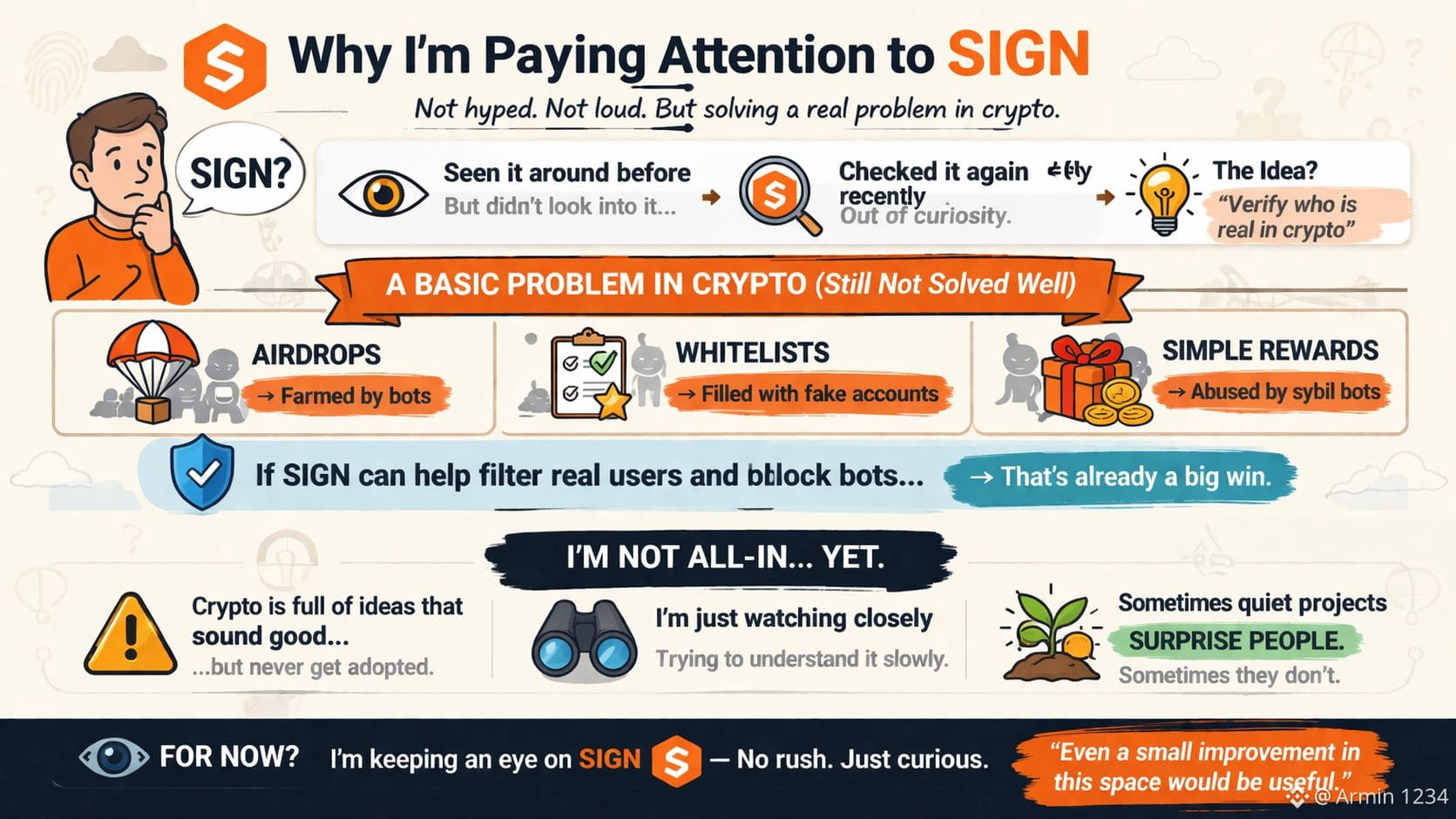
I've noticed the SIGN a few times before.
But I didn't really look into it.
It didn't have the usual hype you see everywhere else.
So I didn't think much about it.
I recently checked this again.
Just out of curiosity.
From what I understand.
He is trying to solve a basic problem in crypto.
To discover who is real and who is not.
It seems simple.
But it's not properly resolved yet.
Things like airdrops.
Things like whitelisted vacancies.
And even simple rewards.
Everything gets messed up because of bots.
If SIGN can help improve this.
Even if it's just a little.
That would already be useful.
I'm still not sure how far this can go.
Crypto has many ideas that seem good.
But they are never actually adopted.
So I'm not jumping to conclusions.
I'm just keeping an eye on it.
And trying to understand better with time.
Sometimes, these quiet projects surprise people.
Sometimes, they don't surprise us..0319
+0.37%