
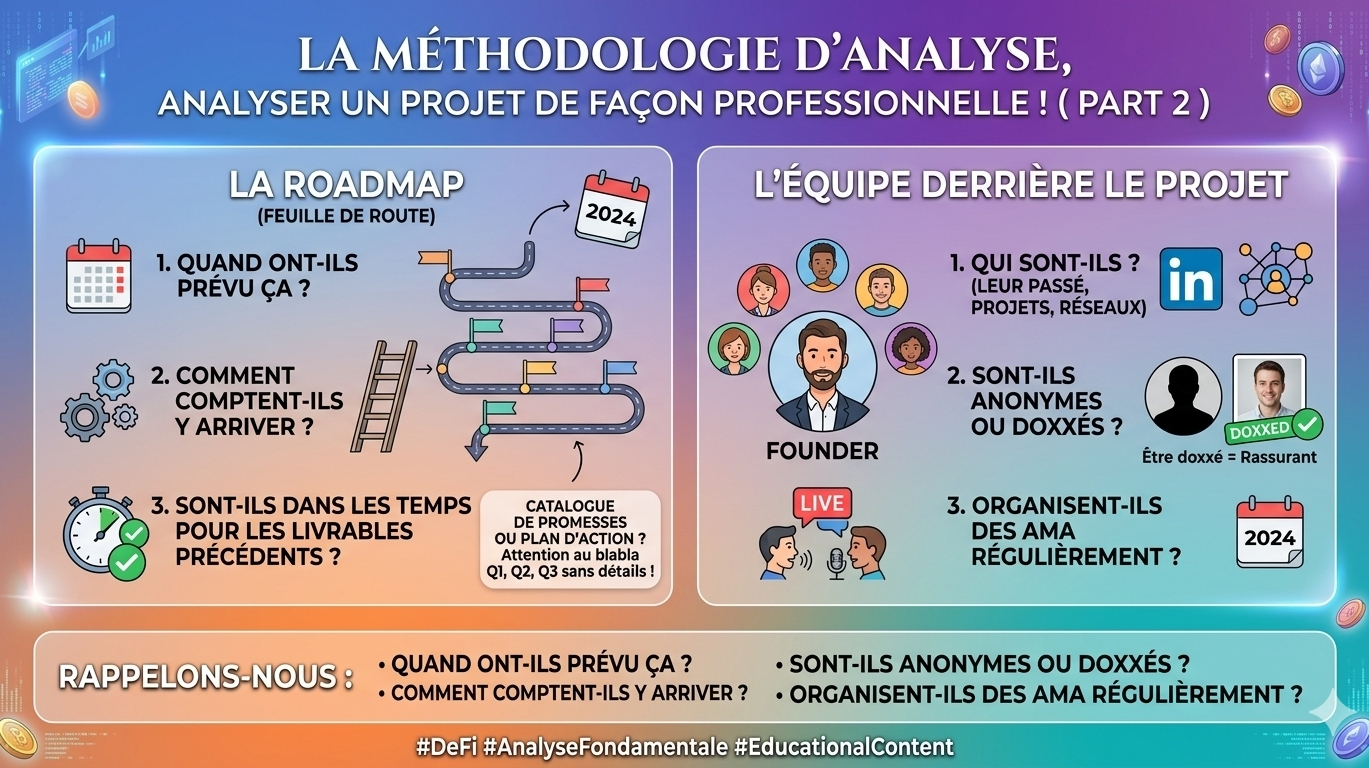
Without delay, let's continue this sequence with the analysis of the Roadmap and the team behind the project.
You need to know how to differentiate between a Roadmap and a catalog of promises.
When you take the Roadmap of a project, you will need to ask yourself a few questions:
×××> When did they plan this?
×××> How do they plan to achieve it?
×××> Are they on track for the previous deliverables?
We have experienced tons of waste projects that sold us dreams in our early days; they establish catalogs of promises without action, just blah blah.
🔶 They say that Q1 (quarter 1), Marketing and launching on PancakesSwap and coinmarketcap and uniswap and gaining 100,000 holders and CEX (often unregulated) and with low trading volume... Okay, it's easy, they can do an airdrop to inflate the numbers, and getting listed on unregulated CEX is not a big deal, be careful.
🔶They say in Q2, they will launch a debit or credit card for payments and a payment platform for freelancers, for example, but in the end, they do not launch the card but just the testnet of the platform at the end of the deadline without details...
🔶In Q3 they say they will make partnerships with companies and other projects without details instead of focusing on the product's Mainet... In the end, they cannot fulfill their partnerships because the product is not ready and they lose investors because they do not meet deadlines and lack coherence...
🔶If you come across a project that was launched 6 months ago, first check if they met their deadlines in previous quarters. If it's unclear, skip them; they are navigating blindly.
A good project respects all the details planned in its Roadmap. Normally, each Segment is structured, with milestones. These milestones allow them to meet deadlines and provide them with the necessary tools to achieve their goals, and communicate with their community transparently.
Remember, it is always said that actions prove sincerity, not promises.
Who is in control?
You guessed it, we are talking here about the team behind the project...
×××> Who are they? (Their past, their projects, their networks)
×××> Are they anonymous or doxxed?
×××> Do they organize AMAs regularly?
You know, they say a dog never changes its way of sitting!
If you research a founder and find that he has a past related to a failed project or an abandoned project, run away immediately; you could well be the next victim.
By the way, take a look at their network, that is to say, the people who follow them on social networks... on X for example, if they are followed by reputable people in the ecosystem, it's reassuring. Because the most influential people in the ecosystem (not influencers) do not follow just anyone haphazardly. They actually connect before they follow.
Are they anonymous or doxxed (public)...
Project leaders should not be anonymous; if that is the case, it's a red flag🚩.
Being doxxed is reassuring for investors. Project managers (team) must show their face without filters; it is akin to confessing their good faith.
The last part, the AMA sessions, are not just lives; they are exchange sessions between the team and the investors during which the investors can see the faces of the project leaders or discuss with them and ask them all possible questions, without filters. It's a very important thing to check to see how they take care of their community; they must do it at least every quarter, it is really important.
Remember:
×××> When did they plan this?
×××> How does he plan to achieve that?
×××> Are they on time for the previous deliverables?
×××> Who are they? (Their past, their projects, their networks)
×××> Are they anonymous or doxxed?
×××> Do they organize AMAs regularly?