
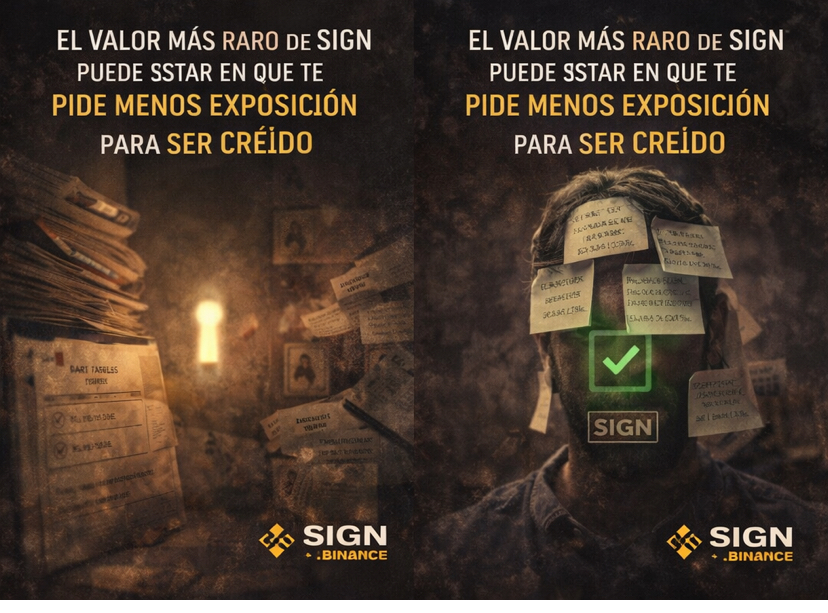
The first time I started to look at SIGN more calmly, it wasn't thinking about identity or reputation, but rather about a feeling that almost no one says out loud: the discomfort of having to show too much to achieve something simple. Once, I had to go through a process where, to prove just one thing, I ended up showing much more than I really thought was necessary. And that's when I understood that in many systems, the problem is not just validation, but the cost of the exposure that comes with it. Sometimes the system is not asking you to be clear; it's asking you to open up more than necessary. And honestly, brooou, that doesn't always feel good.
$SIGN me started to seem strange and interesting precisely for that reason. Because instead of turning validation into a complete showcase of who you are, it tries to make it more compact, more useful, more direct. And that changes quite a bit the user's feeling, because you are no longer entering as if you had to give a complete speech about your life to be taken seriously. You are entering with a proof that the system can read without forcing you to reveal half your existence in the process. In my opinion, that detail is worth more than it seems, because a technology is not just measured by what it confirms, but also by how little it forces you to show to confirm that. ✏️
The craziest thing is that this opens another conversation that almost no one addresses: the relationship between trust and exposure. Because if every time you want to demonstrate something you have to provide too much information, then the real cost is not time, it's vulnerability. And SIGN, at least in theory, aims to lower that cost. It doesn't eliminate it completely, but it does try to ensure that validation is not an excuse for the system to ask you for more than necessary. I find that super relevant because in crypto, many people talk about privacy as if it were hiding, and it’s not. For me, good privacy is also this: being able to demonstrate what is necessary without becoming an open book every time someone looks at you. 🧩
And that’s where $SIGN can have a greater value than it seems at first. Because it not only makes a proof exist, it makes it exist without so much noise around it. Without so much extra weight. Without so much unnecessary exposure. And when a system achieves that, it is no longer just validating users, it is also reducing the human cost of being validated. For me, that is one of the most serious things that such a protocol can offer. Not because it sounds nice, but because it touches on one of the most uncomfortable parts of any network: how much you have to show for them to believe you. What do you think?
@SignOfficial #SignDigitalSovereignInfra $SIGN
