

Morning news:
1.Strategy did not purchase any Bitcoin in the past week;
2. Bitmine increased its holdings by 71,100 ETH last week, currently holding 3.92% of the ETH supply; 3. The Iranian parliament approved a bill to impose tolls on the Strait of Hormuz:
4. US media: Trump is willing to end the war with Iran if the Strait of Hormuz is closed;
5. CFTC will refer to NFL opinions to tighten regulations on prediction market contracts;
6.Robinhood: As of March, the nominal trading volume of cryptocurrencies is 16 billion USD, and the predicted market trading volume is 2.6 billion USD;
7. The US Republican Party has proposed the 'US Mining Act' to promote the expansion of mining and strengthen Bitcoin reserves;
8. Bill Ackman: High-quality companies are trading at very low prices, making it the best time to buy quality assets.
9. Bernstein: Crypto stocks have fallen about 60% from their 2025 peak, currently presenting a "significant discount buying" opportunity.
10. U.S. Senators question SEC leadership changes and the decision to dismiss the Sun Yuchen case.

The so-called spokesperson for the Federal Reserve is actually meaningless to ordinary traders. They essentially only represent the conglomerates and capital groups behind them, responsible for glossing over the situation and stabilizing expectations, and will never reveal the truth on the eve of a financial crisis, nor remind you to hedge and escape in advance. Listening to these capital mouthpieces should be treated as a passing breeze; there's no need to take it seriously. What we really need to do is to dig out real data ourselves, make independent judgments, and make anticipatory arrangements in advance.
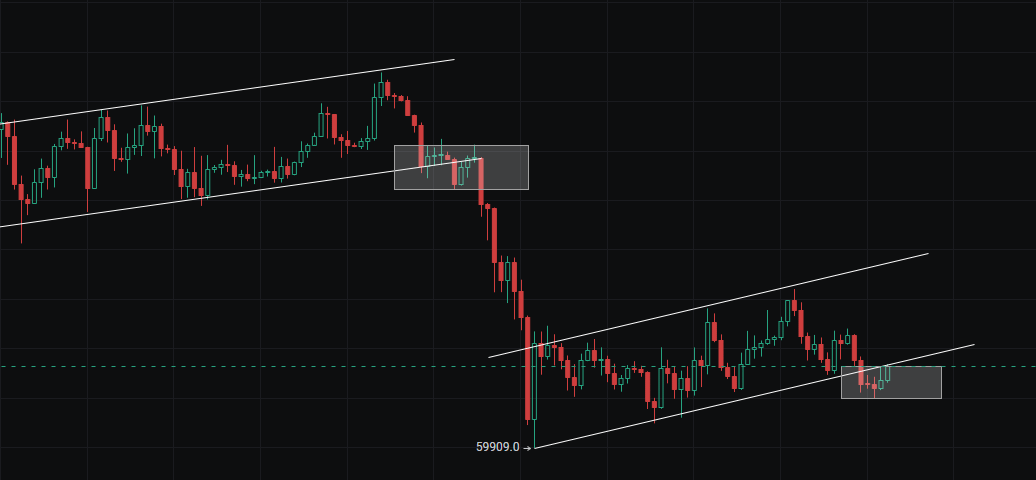
The medium-term downward trend of Bitcoin has quietly begun, and the short-term dead cat bounce fluctuations do not change the downward trend. Around 68,000 is a strong resistance price area, and after the price breaks below the 48-day upward trend line, the price is likely to plummet after a few days of sideways fluctuation.
As shown in the picture, take a close look at the BTC weekly waves 2 and 4, the patterns are highly similar.
1. Fluctuation structure and cycle
Wave 2: Fluctuation for about 60 days, structured as an upward channel.
Wave 4: Fluctuation for about 50 days, also forming an upward channel.
2. After breaking out, the second wave's trend breaks below the channel's lower edge, retests for confirmation, weakly rebounds, and consolidates for 3 days before a significant drop; Wave 4 has now completed the breakout retest and weak rebound, with consolidation lasting for 2 days: Based on this structure, BTC is likely to consolidate for another 2-3 days before a sharp drop occurs, combined with the announcement of multiple core economic data by the U.S. in early April, where market expectations are bearish, which may trigger a substantial decline in BTC. In early April, BTC's trend will become increasingly perilous, and risks will significantly increase.
Want to keep up with structural judgments, key points, and wave ideas in real-time, without falling into the trap of false signals? Welcome to my study group. Daily sharing in the group: technical structure explanation, key position analysis, position risk control, real-time idea reminders, and various trading insights. The market has risks, and trading should be cautious.
The above content is only a personal thought sharing and does not constitute investment advice. Profit and loss from operations based on this are at your own risk.