
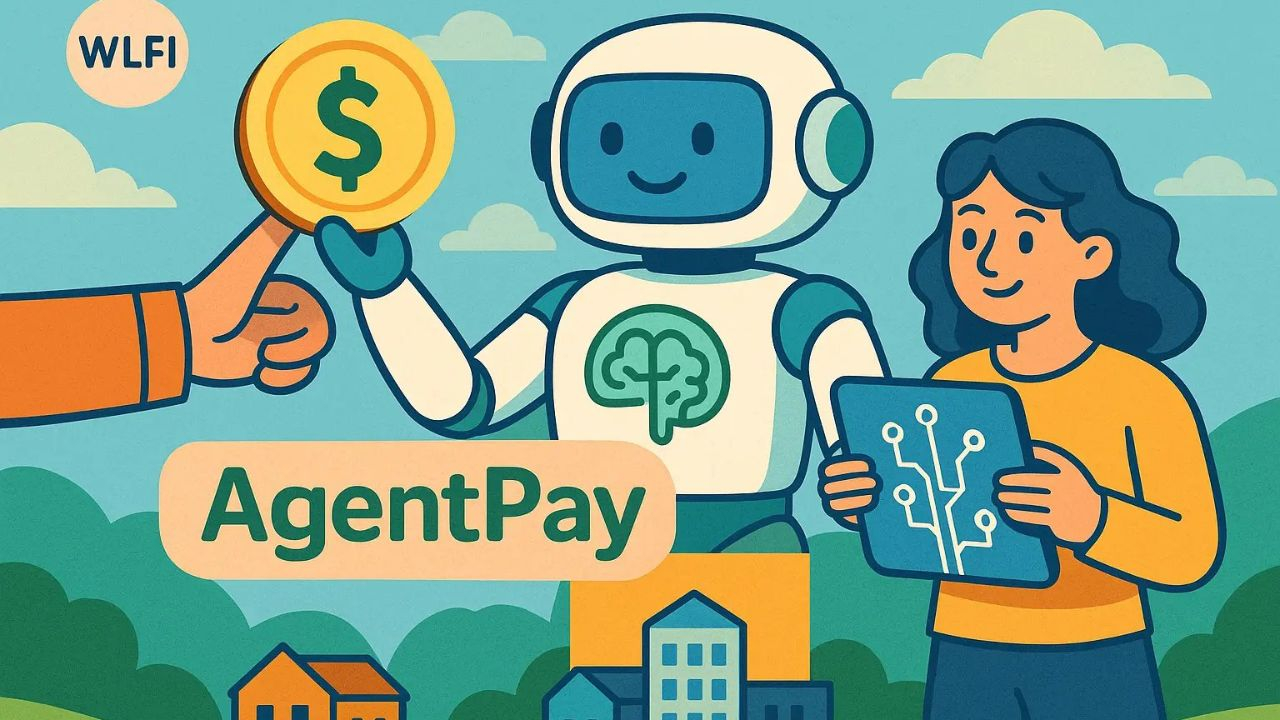
Recently, everyone is focusing on #WLFI's USD1 stablecoin yield, but I dug deep into the newly updated AgentPay SDK v0.2.1 and found that new opportunities in the market are on the way! 🧐
This is not a simple payment component; it adds an autonomous wallet to the AI Agent. In the future, the real competition in the stablecoin market will not be about 'interest rates' but about 'payment capabilities.'
The current pain point is very real: AI is evolving from 'laborers' to 'agents.' It needs to query data, call advanced APIs, and purchase computing power. Once it encounters a paywall (HTTP 402), the Agent crashes immediately because it has no wallet and cannot autonomously make payments. AgentPay is here to fill this gap, allowing #AI to have a controlled spending limit.
This v0.2.1 upgrade has two very solid underlying logics:
One is x402, which can be understood as an 'automatic payment trigger'. An agent requests an interface, and the other party returns 'money needed', along with the price. AgentPay will automatically check the budget you set for it; if it's within the limit, it will sign and pay directly, retrieving the data. The entire process does not require human intervention, equivalent to AI completing a consumption on its own.
Another aspect is micropayments, which connects to the Tempo mainnet, focusing on solving the problem of 'high frequency, small amounts'. Imagine an agent constantly calling APIs, refreshing data, running tasks; if each time it goes through traditional on-chain payments, the gas fees would have already exploded. The significance of micropayments lies in reducing these costs of a few cents or even smaller to a negligible level.
With EIP-3009 signatures, you don't even have to worry about gas; it directly deducts stablecoins. This level of smoothness basically lowers the threshold of Web3 to the level of Web2.
But these technical points are just superficial; what I value are the three core aspects behind them:
First, the safety bottom line, adopting localized self-custody. Private keys never leave the device, and the agent only receives an authorized limit, such as $10 a day. This design is a reassurance for institutions and whale players, ensuring both AI efficiency and absolute control over funds.
Second, the real demand for USD1. Stablecoins fear a lack of scenarios. If in the future, all AI agents default to settle with USD1, this demand is not pushed out by marketing but is used through system calls. This is the true logic of hard currency.
Third, seize the cash register of the 'machine economy'. If in the future, 80% of the requests on the network are initiated by AI, whoever controls the payment interface will be the Visa of the AI era. What #WLFI is doing now is planting a flag in that most critical position.
Of course, it's easy to plant a flag, but the road is difficult. Whether this solution can explode doesn't look at technology but focuses on adoption. Can the Tempo ecosystem support the applications? Are API service providers willing to integrate x402? This requires time to endure and is the biggest variable.
In summary, the previous AgentPay taught AI how to 'transfer money'; the current v0.2.1 teaches AI how to 'consume'. Once AI can autonomously buy computing power and services, AI, payments, and on-chain economy will truly form a closed loop. If this line runs smoothly, #WLFI will no longer just be a stablecoin project but a key settlement protocol stuck at the bottom layer of the AI economy.