
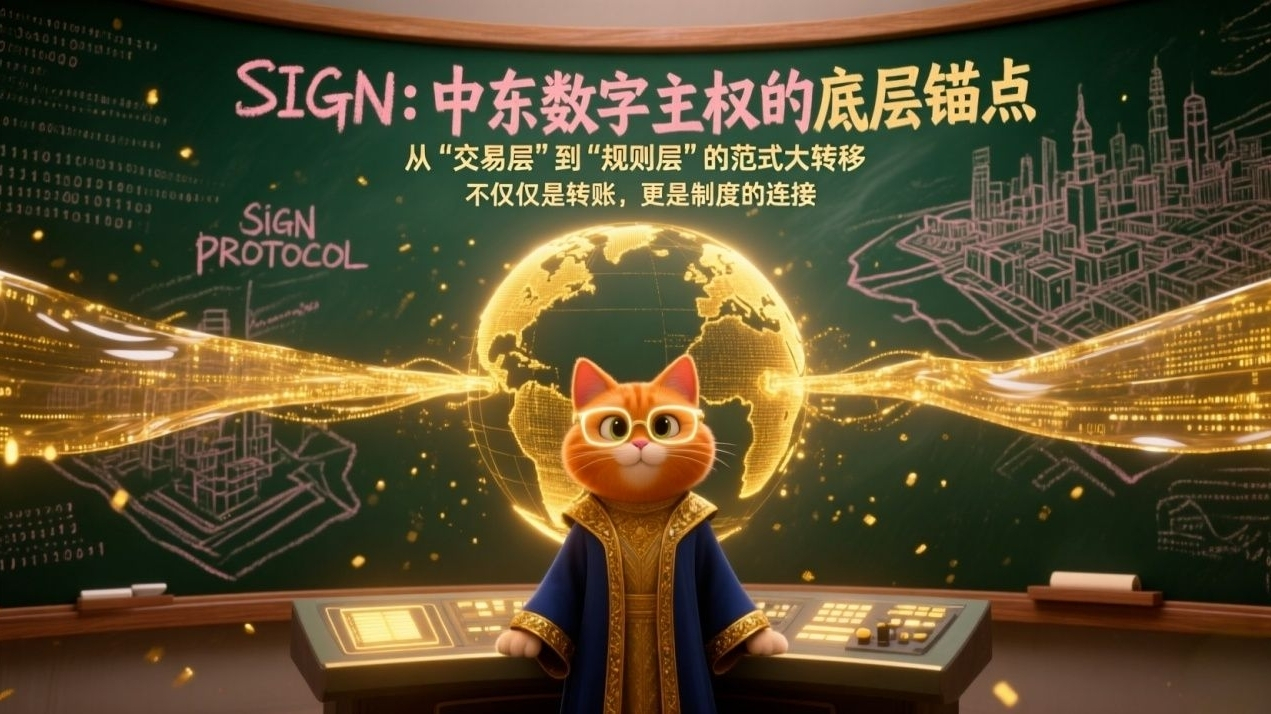
Last month, I helped a friend handle the due diligence for a tokenization of a property in Saudi Arabia, and I was pressed down by compliance for an entire morning. Business licenses, fund penetration, shareholder backgrounds, the same materials submitted to the account opening bank once, and then submitted to the intermediary bank again. Looking at that pile of PDF documents stamped with official seals, I completely understood: the pain point of multinational finance is not in how fast the transfer is, but in the endless 'self-justification'. You are clearly a legitimate company, and the money is also legitimate, but you have to prove it to A, prove it to B, prove it to C, with every intermediary requiring you to lay out your entire background.
Understood@SignOfficial What are you doing? Many people still regard it as a tool for on-chain contract signing, which is a narrow perspective. Its technical architecture is actually a combination of three layers, each solving the ancient problem of 'how to prove oneself.'
The first layer is called Sign Protocol, and its core consists of two elements: Schema and Zero-Knowledge Proof. What is Schema? It defines a universally accepted format for all proofs. Just like when you stay in a hotel in any country, the passport number, name, and date of birth on your passport have a globally standardized format, which customs can easily recognize. Schema does this—sovereign nations register a Schema for 'property certificates,' stipulating what fields must be included. In the future, anywhere in the world, as long as they see this Schema, they will know which country and which institution issued the certificate, and its legal effect follows. Zero-Knowledge Proof allows you to 'provide only the result, not the underlying card.' When you log into your bank account and see a balance of 1 million, you don't need to give your account password to the other party; you only need to generate a cryptographic proof using Sign's protocol to prove 'this account has 1 million.' The other party verifies that this proof is true, but they see nothing of your account number, transaction records, or bank.
The second layer is a dual-chain architecture. One private chain runs on Hyperledger Fabric, allowing the government to fully control the nodes—citizens' identities, land ownership, central bank digital currencies—things that must never be touched by outsiders are locked on this chain, with the government as the sole validating node. The other public chain runs on opBNB, handling cross-border payments and asset transactions that need to be publicly disclosed. A bridge is built between the two chains, where core data never leaves the government's door, but the verification results can be publicly disclosed through the public chain. Abu Dhabi locks property certificates on the private chain, guarding them at home; property verification runs on the public chain, allowing buyers in New York to scan a code to know who truly owns the house. Throughout the entire process, Abu Dhabi's property database has never been opened to anyone.
The third layer is dynamic proof. This is not just an embellishment; it is the key issue of whether sovereign nations dare to move core systems onto the chain. After Abu Dhabi put property certificates on the chain, it was discovered that property rights can change—if you buy a house today and sell it tomorrow, what happens to the original property certificate? If it cannot be modified after being put on the chain, then the proof received by the new buyer coexists with that of the old buyer, wouldn't that create confusion? Dynamic proof solves this problem: at the moment you sell the house, the property certificate in your hand automatically becomes invalid. The central bank digital currency of Kyrgyzstan runs on the chain, and once the sanctions list is updated, the CBDC certificate of the sanctioned account is immediately invalidated, requiring no manual intervention and no waiting for approval.
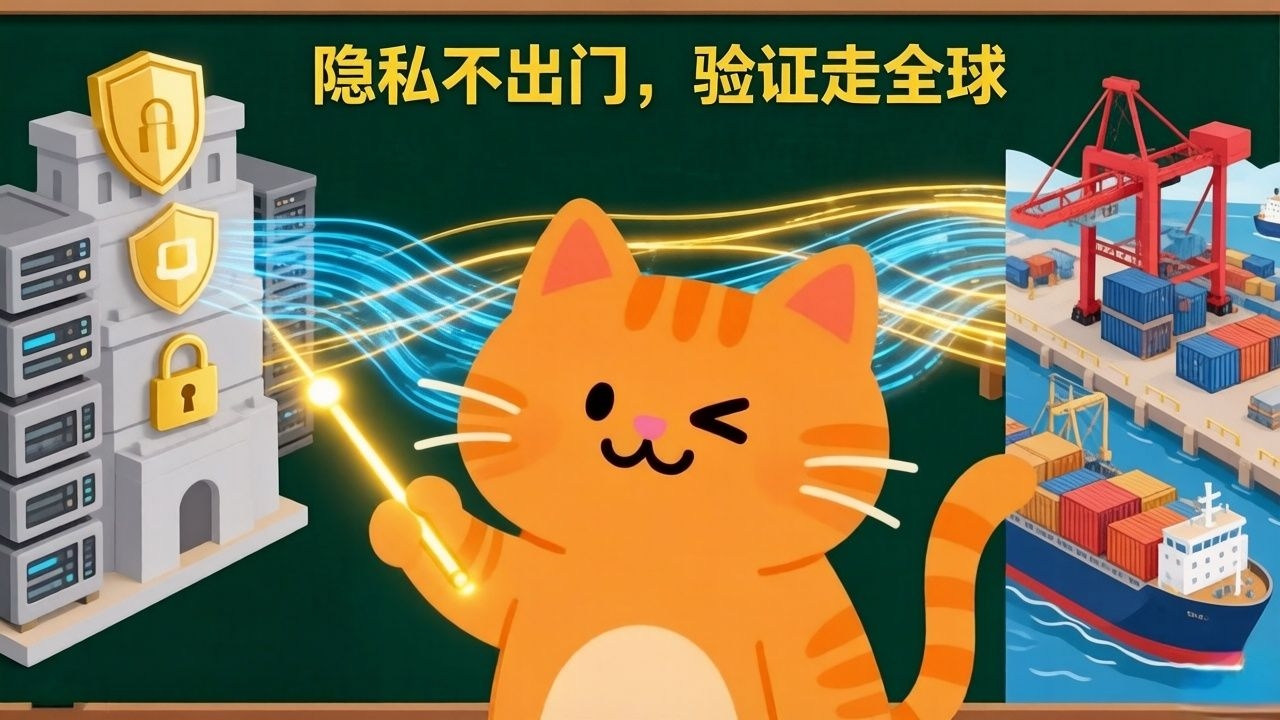
These three layers combined create a complete 'sovereign credit router.' Your original data is locked in your own home, and only de-sensitized proofs run on the chain; you use Schema to fix the format of the proof, allowing sovereign institutions to register standards themselves; when others need to verify you, they only need to confirm 'the result is true' through zero-knowledge proof, but none of your sensitive details are exposed.
Many people only focus on the liquidity at the trading level of projects, which is a narrow perspective. What is truly valuable is always the rule layer that determines whether 'this money is qualified to flow.' Once the Sign underlying standards are embedded in sovereign governance and RWA rights confirmation, that becomes a replacement cost at the level of major surgery. Other competitors shouldn't even think about entering because you cannot replace a country's identity system, property system, or currency system. I don't look at short-term candlesticks; I only focus on one indicator: whether the real verification call volume of multinational institutions has picked up. In the chaotic world of parallel finance, whoever masters the underlying digital notary office truly holds the future's licensing power. SIGN is gradually transforming into that notary office. #sign地缘政治基建 $SIGN