
A few years ago, I followed a childhood friend to a well service team in the Middle East for business and learned that they used an ERP system from a European SaaS company for financial and supply chain collaboration. As a result, one day the company encountered a legal dispute, and to protect their assets, they directly cut off the overseas server's physical network.
That entire week my buddy was going crazy. His company's corporate accounts and inventory lists were all locked in the cloud, watching helplessly as the project came to a halt with no way to resolve it. That time I learned a lesson: in digital systems, whoever holds the underlying control is your true authority.
Now that I've entered the Web3 circle, everyone is shouting about decentralization and code as law. Anyone who has studied logic knows that we must change our perspective in everything we do. That day, I smacked my forehead and thought, if I were to consider it from the perspective of a sovereign country, if I were the governor of the central bank of Kyrgyzstan or the UAE, would I dare to entrust the national fiat currency (CBDC) and the national identity system to a group of strangers? This is simply joking with the financial sovereignty of a nation.
With this victim mentality in the industry, I opened the driest chapter in the @SignOfficial developer documentation: (Governance & Operations).
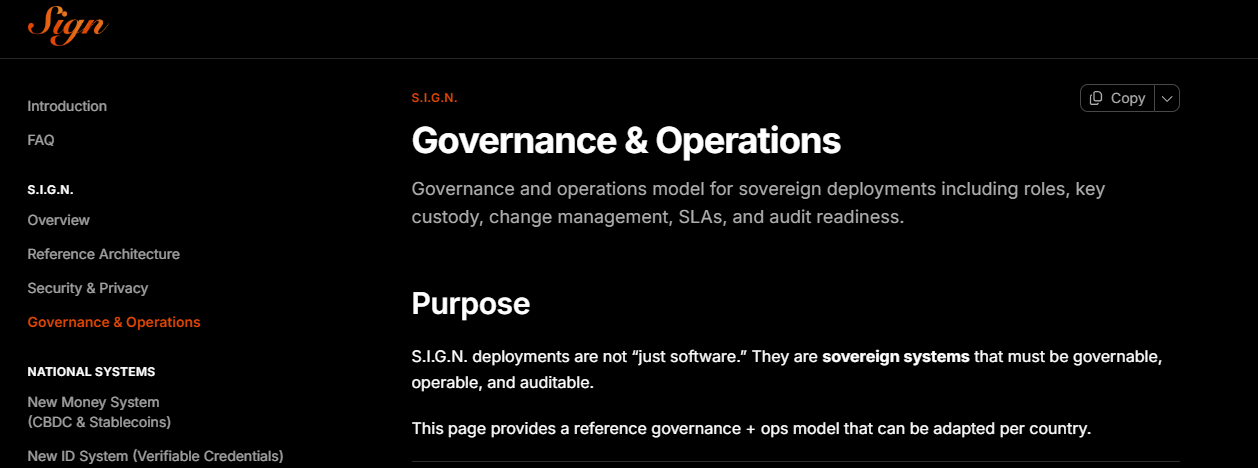
I discovered that they not only understand technology, but they also understand politics (the advantage of a Chinese CEO? Hahaha).
Faced with the sovereign countries' fear of backdoors, Sign did not mention any DAO community voting but instead implemented an extremely cold Separation of Duties mechanism.
In its architecture, the technical party, the issuer, and the regulatory party are completely isolated at the physical and cryptographic levels. The Technical operator, responsible for running nodes and APIs, absolutely cannot access the Issuer keys; while the most critical policy decisions and system upgrades are locked in the Governance keys, controlled by sovereign institutions through a 2-of-3 or 3-of-5 multi-signature mechanism.
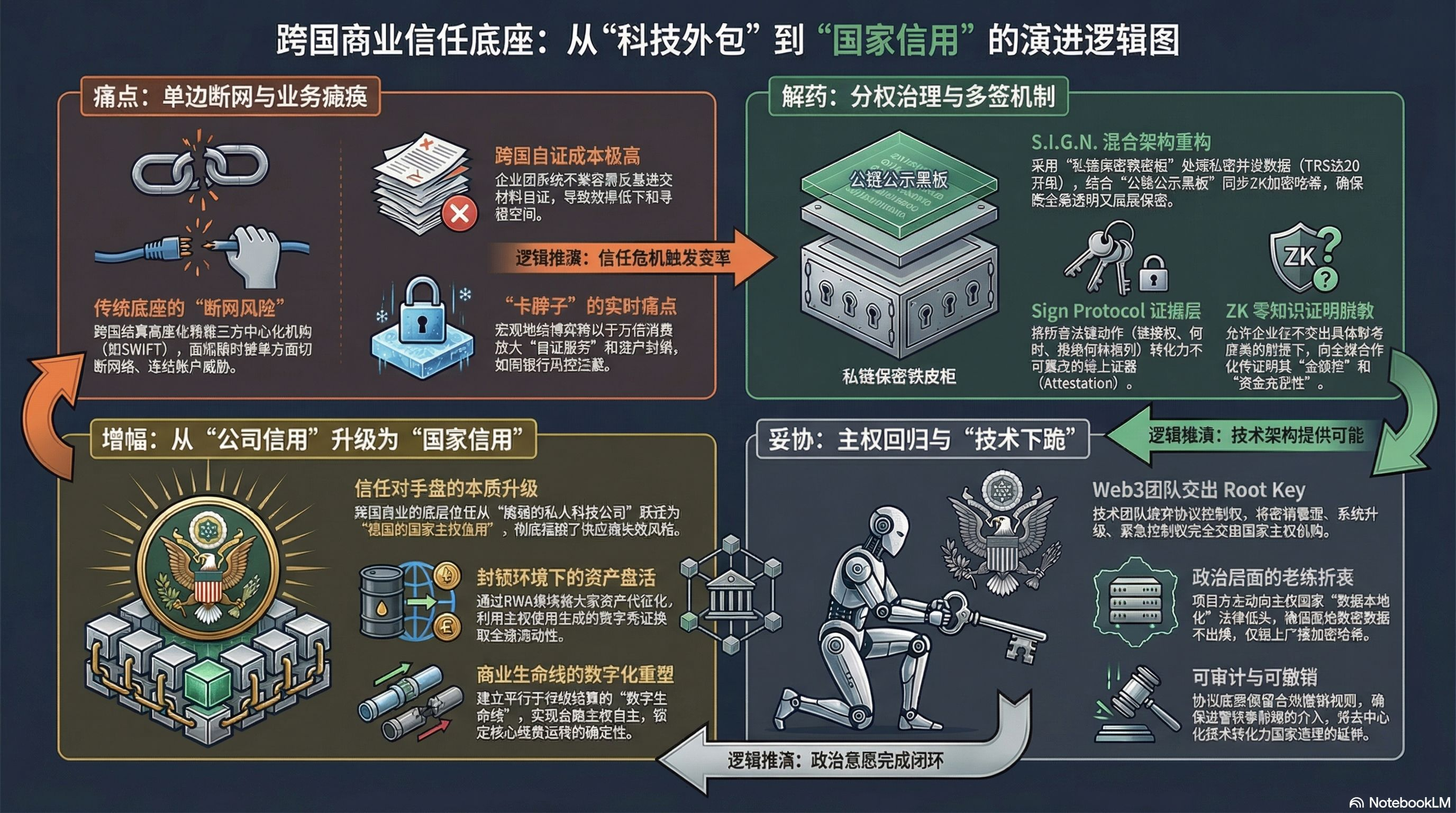
This is their deepest "kneeling compromise" to the real world: the Web3 team is only responsible for building this digital highway, but the keys to the toll booths and the Emergency Pause button, which can close the road with one click, are completely handed over to the state.
However, as someone who has been doing business in high-risk areas for many years, I find myself feeling a chill when I look at this Emergency Pause.
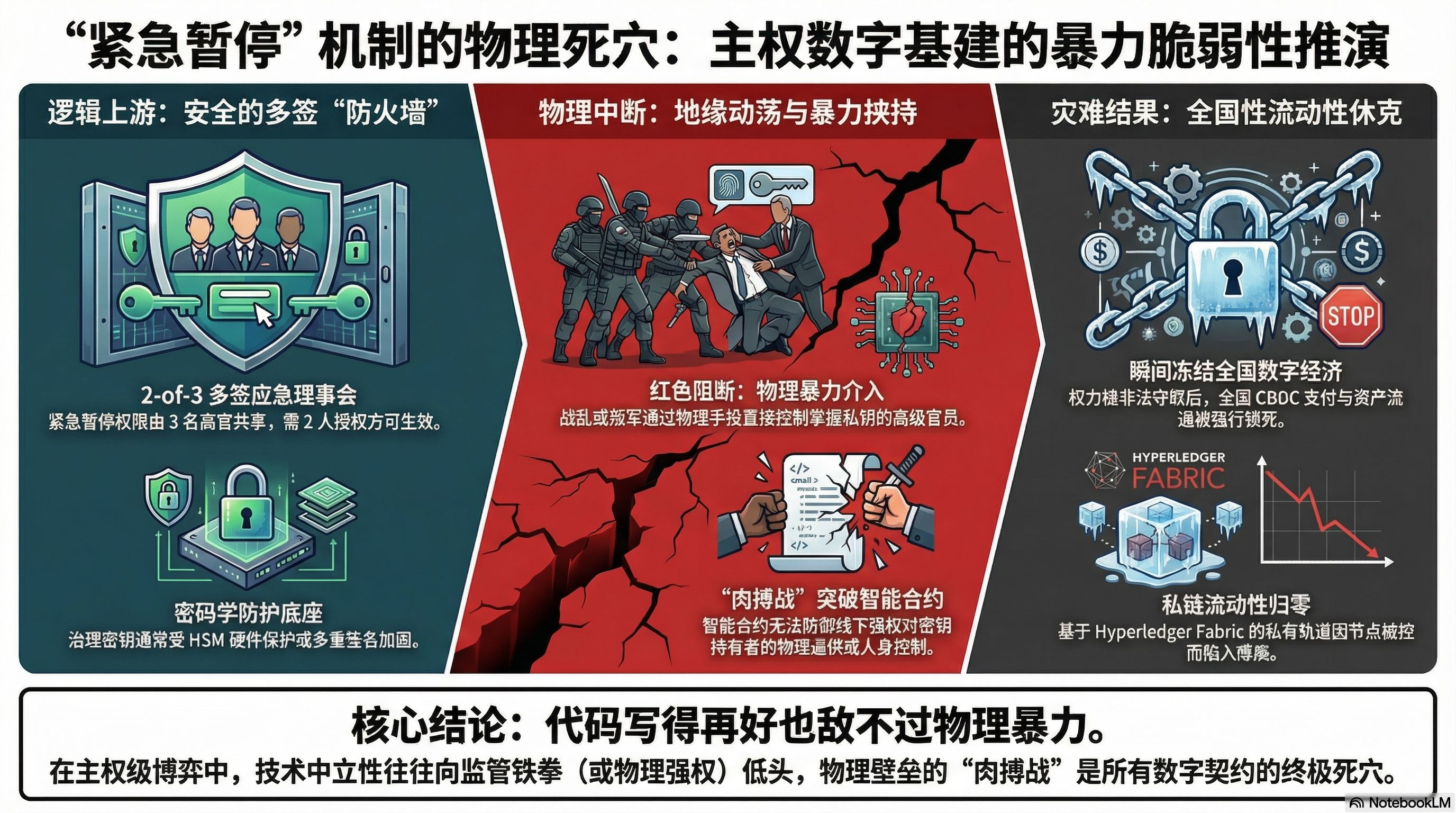
This one-click internet disconnection power, preserved to satisfy sovereign countries' "absolute control," is precisely the most fatal physical vulnerability of the entire system. In peacetime, it serves as the last firewall against hackers. However, in geopolitically fragile regions, any turbulence can turn this into a disaster.
Disrupting this system does not require cracking any smart contracts. The rebels only need to kick open the door of the "Emergency Committee" and use force to hold the few people with the 2-of-3 multi-signature private keys, thus completely freezing the liquidity of the entire private chain and invalidating all cross-chain gateways within seconds. In the face of absolute physical violence, no matter how exquisitely written the governance logic in the code is, it is just a piece of waste paper.
Returning to our business itself. Although there is such an extreme physical vulnerability, if Sign's decentralized mechanism really rolls out in the Middle East, it will be a game-changing benefit for our cross-border traders.
This means that the cross-border settlement and qualification verification systems we rely on for survival will no longer suddenly die due to a tech startup's cash flow breakdown or server payment issues. Our rival positions and infrastructure have officially been entrusted to national credit. In the future, as long as we select politically stable and creditworthy sovereign nodes to deploy capital, we can completely rid ourselves of the fear of being choked by centralized tech bullies.
In a global market filled with distrust, #Sign地缘政治基建 uses a clearing base that won't crash arbitrarily and has clear responsibilities, which is worth more than any flashy model.
