
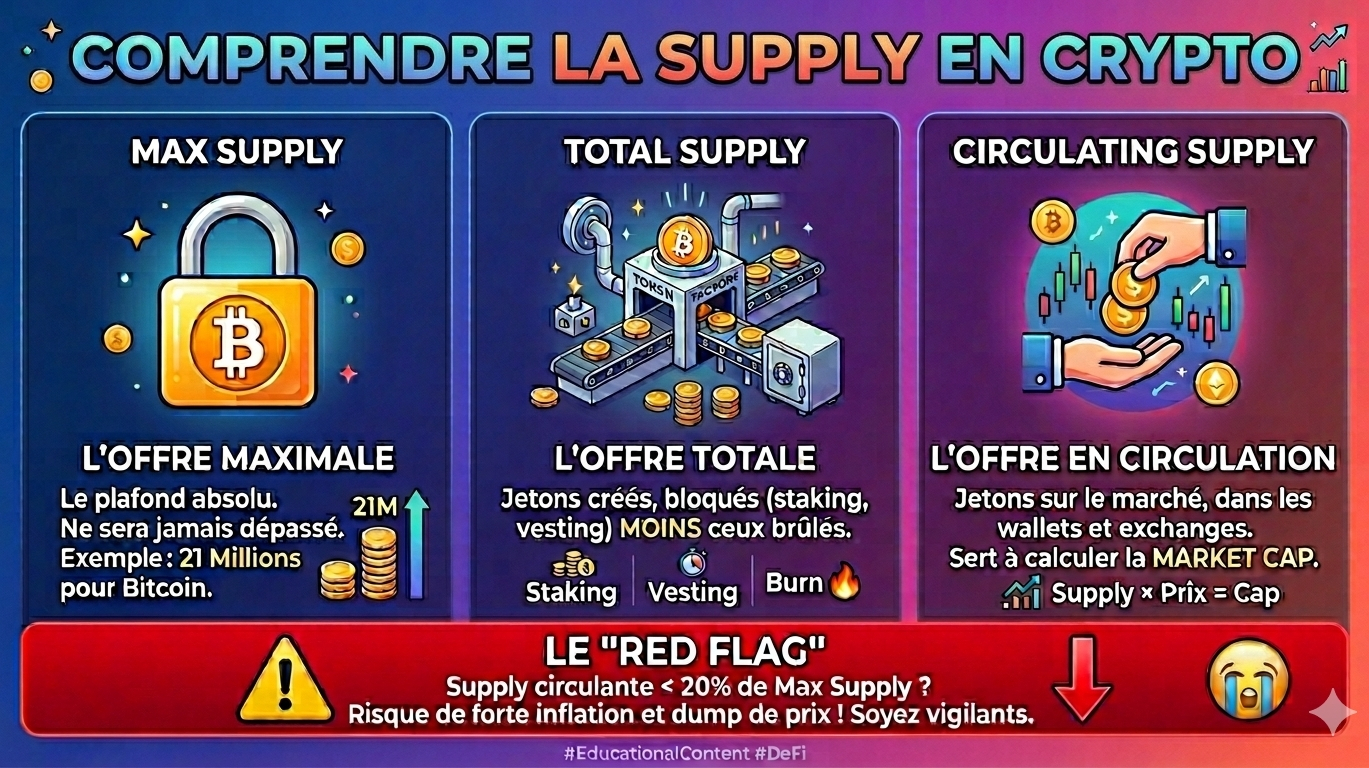
I would like to draw your attention to a subject, the distinction between Total supply, Max supply, and circulating supply.
All these terms talk about the quantity of tokens in a crypto project, but do you know the details they hide?
Max Supply: it is the cap of tokens that will never be exceeded.
For example, the Max supply of Bitcoin is 21 million.
No matter how you mine, or how Microstrategy buys Bitcoins, the day the 21 million are reached, no more Bitcoin will be mined.
Now let's move on to the total supply.
This is where the nuance annoys and causes confusion…
Look a bit: The total supply is the total number of tokens available. That is to say, everything that has been created including (what is locked in staking + what is in the team's vault behind the project and what is reserved for vesting minus the amount that has already been burned.)
Do you see that?
Now the circulating supply: it's the amount that is in circulation, what is in the hands of the users, on the DEX, the CEX, in wallets, in short, what is really circulating.
This is also how we calculate the market capitalization of a crypto.
We calculate the total circulating supply × the current price and find the market capitalization.
Red flag 🚩: If the circulating supply is very low, around 20% compared to the Max Supply, run away! The project risks high inflation and a price dump when they start unlocking the tokens.
So now you know, if a project talks to you about burning zeros in front of its price, or puts ×××$ to the moon with a certain price, you can have an idea of the market capitalization it could reach if that happened and you will directly know that it's myths.