
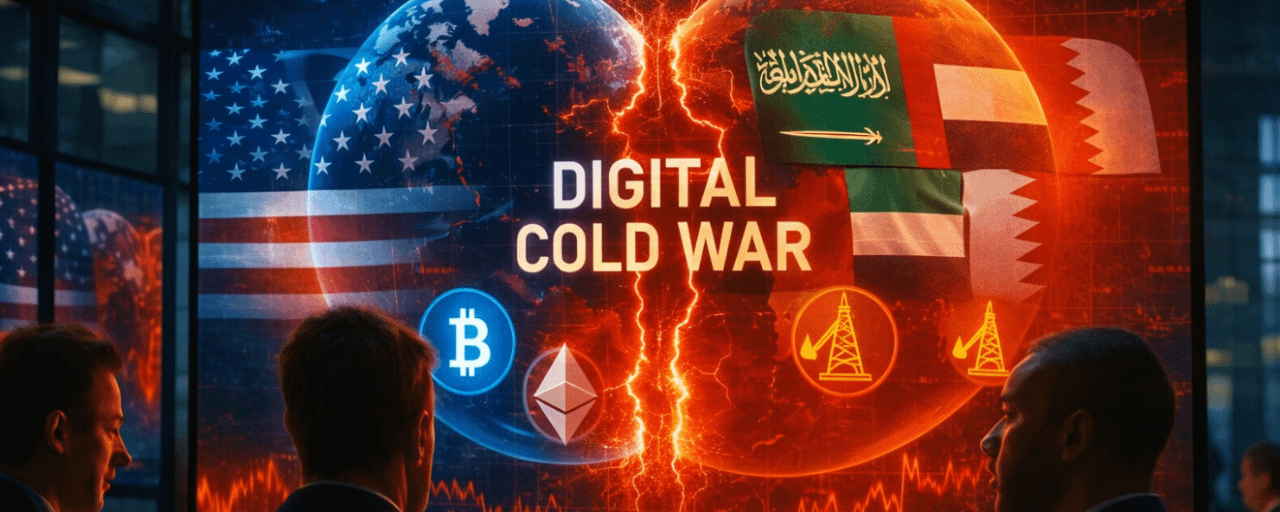

Over the past decade, geopolitical conflicts have increasingly manifested within the financial system:
Cross-border payments are restricted
Assets have been frozen
Capital flows are under scrutiny
The underlying dependence of these behaviors is represented by the global financial infrastructure, epitomized by SWIFT.
But a clear trend is emerging:
The world is transitioning from a 'single system' to a 'multi-system parallel'
This means:
The world may enter a new state—
The 'Digital Cold War'
1. Background: The on-chain world is replicating the camp structure of the real world
In the early days of blockchain, people believed it was 'borderless'.
But reality is changing this assumption:
Different countries promote different regulatory frameworks
Different regions prefer different chains and ecosystems
Data and identity are beginning to be incorporated into sovereign control
According to research by the International Monetary Fund:
More than 130 countries globally are exploring CBDCs and digital financial systems
This means:
The on-chain world is no longer a unified market,
But is gradually forming:
Regional financial networks
Sovereign digital identity systems
Divided liquidity structures
Two, key question: how do different camps 'recognize' each other?
If the world splits into multiple on-chain camps, a core issue will arise:
How do identity, assets, and rules verify across camps?
For example:
On-chain identity issued by a country
Will it be recognized by another country?
An on-chain asset
Can it flow across systems?
If there is no unified verification layer:
The world will enter the 'Era of On-chain Islands'
Three, the potential role of Sign: the 'neutral verification layer' between camps
Under this structure, the value of Sign begins to undergo a qualitative change.
@SignOfficial 's core capability is:
Providing cross-chain and cross-system attestation mechanisms
This means it can:
Verifying identities issued by different countries
Unifying data structures from different systems
Providing auditable cross-system credentials
Functionally, it is more like:
The 'neutral verification layer' of the on-chain world
Similar to the real world:
SWIFT (neutral financial information network)
International clearing systems
But the difference is:
$SIGN is 'on-chain native'
Four, why is 'neutrality' a core competitive advantage?
In a world of camp division, the most scarce resource is not technology, but:
Trust neutrality
If a protocol:
Excessively binding to a particular country
Or serving a single camp
It will lose global applicability.
And Sign's current path is:
Simultaneously laying out in multiple regions such as the Middle East and Central Asia
Providing a verifiable but not fully centralized structure
Supporting multi-chain and multi-system access
This gives it the potential to become a 'neutral layer'
Five, data and market signals
From a market perspective, this narrative is also being priced in:
Liquidity significantly increased after going live on Binance
Upbit (South Korea) trading volume rapidly expanded
In March 2026, prices surged over 100% against the backdrop of geopolitical conflict
These signals indicate:
The market sees it not just as a technology project,
But is:
'Geopolitical risk hedging + infrastructure competition' assets
Six, risks: is neutrality sustainable?
The biggest challenge facing Sign is not technology, but:
Neutrality risk
Specifically includes:
Will it be 'bound' by a certain camp?
Will it be replaced by national systems?
Can it maintain openness under regulatory pressure?
Once neutrality is lost, its value will significantly decrease

Finally, what I want to say is: the true battlefield of Sign is 'between camps'. From a research perspective, Sign's competitors are not just other protocols, but the digital systems constructed by different countries themselves.
Its ultimate value depends on one question: #Sign地缘政治基建
In a divided world, is it still accepted by all parties?
If the answer is 'yes',
Then Sign will be not just a project, but: a key infrastructure connecting different digital camps.