
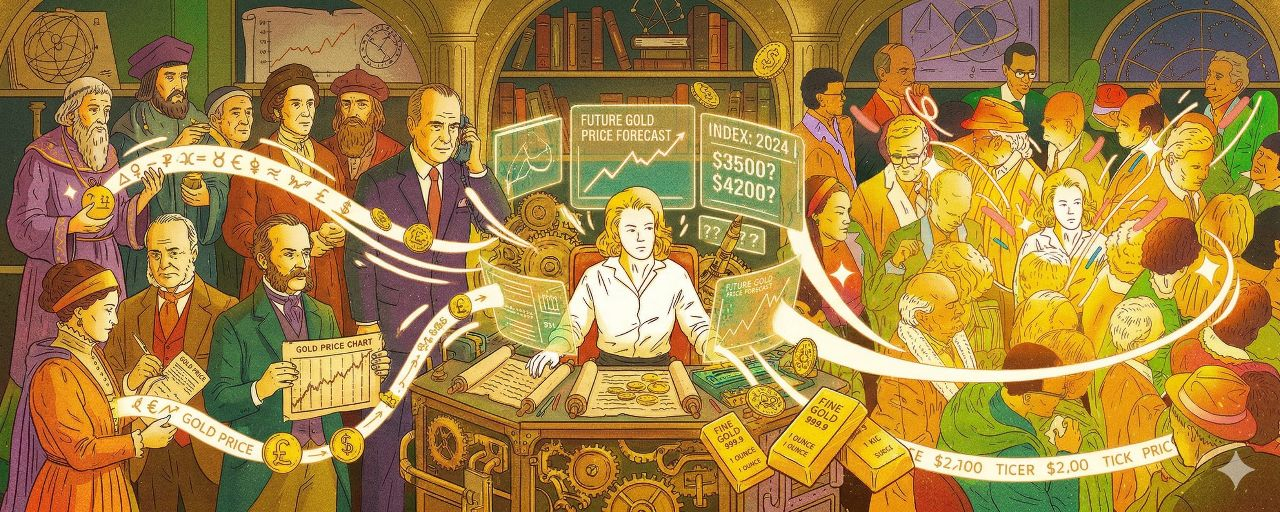
If I were to gather all the most accurate predictions, the most authoritative institutions, and the most renowned analysts throughout history for a financial product—like gold—and compare each of their predictions with the actual results to find "who is the most accurate"... and then examine how these "most accurate people" view the future now—
Does that mean I've grasped the secret to wealth in this financial asset market? 💰
With this in mind, I actually did it. I used gold as a sample and analyzed more than a decade of prediction records.
For this survey, we selected three types of people: top investment banks and industry institutions on Wall Street, influential figures who loudly advocate for the gold market, and "legendary figures" who accurately predicted key reversals.
Let's look at the data one by one.
We've laid out all the forecast data we found.
Wall Street professional institutions:
The LBMA (London Bullion Market Association) invites dozens of top analysts each year to make annual forecasts for gold. In 2025, the average forecast given by 28 analysts was $2,735 per ounce. The most optimistic analyst that year—Keisuke (Bill) Okui of Sumitomo Corporation—gave a forecast of $2,925, winning the "Most Accurate Prediction Award" for being "closest to reality."
What will be the average real price of gold in 2025? $3,431.
In other words, the analyst who was the most bullish in the entire market and ultimately won the award still predicted a 15% lower value than the actual value. The market consensus, on the other hand, underestimated the value by a full 20%.
Goldman Sachs has two notable records in the history of gold prediction. In April 2013, Goldman Sachs issued a report explicitly recommending a short position in gold, with a target of $1,450. Gold subsequently plummeted by 26%, cementing Goldman Sachs' legendary status.
But recently, Goldman Sachs made a mistake. In October 2024, Goldman Sachs predicted a gold price of $2,700 in 2025. What actually happened? Gold prices soared throughout 2025, breaking through $5,600 in early 2026. It was more than half the predicted price.
JPMorgan gave a gold price benchmark of $5,055 for 2026 at the end of 2025. Gold prices subsequently broke through this level ahead of schedule.
Golden Track Influencer:
Kim Do-tae V:
Peter Schiff, the most famous "always bullish" figure in the gold market, has been predicting "$5,000 gold" for over a decade. During the five or six years from 2013 to 2018 when gold prices stagnated, he faced constant criticism and ridicule, being called a "stopped clock." However, gold prices did indeed break through $5,000 in early 2026. His latest statement (March 23rd) calls the recent decline "illogical" and predicts gold prices will surge to $11,400 within three years.
Jim Rickards, another prominent figure who has long advocated for "$10,000 gold," argues that the BRICS countries' de-dollarization will force a reset of the global monetary system. While the direction is correct, the timeline has been repeatedly delayed, and the target price has yet to be achieved.
Robert Kiyosaki (author of Rich Dad Poor Dad) predicted in mid-March that gold would reach $35,000 after the impending "biggest bubble burst in history".
The "god-like" player who accurately predicted the reversal:
Nouriel Roubini ("Dr. Doom"), renowned for his accurate prediction of the 2008 financial crisis, made two particularly insightful predictions regarding gold: In June 2013, with gold prices around $1,400, he wrote that "the gold bubble is bursting," targeting $1,000. This prediction was perfectly validated when gold prices hit a low of $1,050 at the end of 2015. In January 2023, with gold prices hovering around $1,900, he went bullish, predicting a 10% annual increase over five years, targeting $3,000. Gold prices subsequently far exceeded this figure.
Ben McMillan (Chief Investment Officer of IDX Advisors) has recently stood out in the market. In early 2024, when gold was around $2,000, he predicted it would reach $5,000 within five years. The market thought it was "almost insane" at the time. In the end, gold reached that price in just a year and a half.
Ray Dalio (founder of Bridgewater Associates) doesn't provide specific prices, but rather makes qualitative judgments from a macroeconomic cycle perspective. He predicts gold will be called the "second largest currency" in January 2026 and recommends allocating 5-15% of an investment portfolio to it.
After looking at the data, you might think—some people are actually quite accurate?
Hold on. The above are just their "most famous moments." When I pull out their complete record, the picture is different.
Wall Street professionals: Typical lagging forecasts
What is lagging forecasting? It means that they only start raising their target prices after a bull market has already arrived; but the increase is never as large as the actual price increase. When a bear market arrives, they start lowering their targets again, but always too slowly.
The LBMA's 28 analysts are a prime example. Making an annual forecast essentially involves a small extrapolation of "already occurring trends." Gold prices had already reached $2,700 in 2024, yet their median forecast for 2025 was only $2,735—virtually just using last year's closing price as their prediction. The actual average price in 2025 was $3,431, a 20% error.
Goldman Sachs followed the same pattern. At the end of 2024, they only projected $2,700 for 2025, but gold prices later surged past $5,000. JPMorgan Chase gave a benchmark price of $5,055, which gold prices broke through earlier.
What these institutions are doing is more accurately described as **"trend confirmation"**—telling you that what has happened is indeed happening, but always being conservative in their assessment of the magnitude. If you wait for their signals to make decisions, you'll always be a step behind.
Track influencer: Even a broken clock can be accurate twice a day.
Peter Schiff has been predicting $5,000 for gold for over a decade. Jim Rickards has been predicting $10,000. Kiyosaki has been predicting $35,000.
Their strategy is essentially to predict price increases every year. If prices rise, they say, "I told you so," and if prices fall, they say, "It's not time yet."
The more fatal problem is that these kinds of predictions lack time granularity. They don't tell you when to enter or when to exit. If you had listened to Schiff and invested all your money in gold in 2011, you would have had to endure five or six years of sideways trading and losses to get to where you are today. Faith, when you've lost 40%, doesn't stop the bleeding.
Top-tier players: Are they really always accurate?
This type of person is the most deceptive. Because they have indeed made surprisingly accurate judgments at some crucial moment, the market has given them the halo of "prophet." But when I look at their complete record, the picture isn't so perfect.
Roubini was right to be bearish in 2013 and right to be bullish in 2023. He caught both turning points, which is truly impressive.
But do you know what he missed in between? When gold prices broke through $1,000 in 2009, Roubini publicly stated that "it's impossible for it to rise another 20-30%." The result? Gold prices soared to $1,900 in 2011, an increase of nearly 90%. At the end of 2009, when gold prices reached $1,200, he again said, "It looks very much like a bubble," and "Gold has no intrinsic value."
Throughout the gold bull market of 2009-2012, Roubini repeatedly predicted a downtrend, completely missing out on the gains. This period is largely ignored; people only remember his brilliant bearish prediction in 2013 and his bullish reversal in 2023.
Ben McMillan predicted in early 2024 that gold would reach $5,000 within five years, and it did so in just a year and a half. His logic, based on structural changes in central bank gold purchases, was indeed correct. However, the problem is: this is his only widely documented prediction in the gold sector. The sample size is limited to just one instance. Does a single correct prediction demonstrate systemic predictive ability?
Ray Dalio sounds like the most reliable analyst—he doesn't predict prices, only provides investment advice. But look at his macroeconomic forecasting record: In 1981, he firmly believed the US was going to experience a Great Depression, shouting it out in newspapers, on television, and at congressional hearings, only to be completely wrong; Bridgewater Associates nearly collapsed, and he had to borrow $4,000 from his father to pay household bills. In 2015, he predicted a repeat of 1937, which didn't happen. In 2018, he predicted a recession within two years, which also didn't occur. In October 2022, he predicted a "perfect storm"—that month happened to be the bottom of the US stock market.
He predicted a financial crisis almost every two or three years, and the vast majority of them never happened. Ironically, his statement, "You don't need to predict prices, just allocate 5-15%," became the most useful one among all the predictions.
The script from 2011 is being replayed in 2026.
There was a particularly interesting finding in the report.
Before gold prices peaked at $1,923 in 2011, market predictions skyrocketed: at the beginning of the year, everyone predicted $2,000; by mid-year, that had doubled; and near the peak, Jim Sinclair predicted $12,500, while Rob Kirby predicted $15,000. The most extreme predictions appeared just weeks before the actual peak.
Then gold prices plummeted in September. What was the forecasters' reaction? They started by calling it a "healthy correction," then reluctantly lowered their target prices by 20-30% over several months, and finally postponed the timeline indefinitely.
In March 2026, gold prices plummeted 25% from a record high of $5,600 to around $4,200—the largest single-week drop since 1983. What was the reaction of the vast majority of institutions and celebrities? They maintained their original extremely high target prices, even believing the crash to be the "best buying opportunity."
History doesn't simply repeat itself, but the script is remarkably similar.
So how do they see the future now?
Since we've already dug into it, let's list their latest assessments for everyone's reference:
People/Institutions Latest Forecasts Core Logic Roubini Previous target of $3,000 achieved, bullish outlook unchanged Inflation expectations return + long-term structural rise McMillan $10,000 within five years Central bank gold purchases + US debt crisis + BRICS de-dollarization Dalio No price given, suggests allocation of 5-15% Fiat currency credit structural decline Jamie Dimon May reach $10,000 this year Economic concerns + inflation + asset bubble Peter Schiff $11,400 within three years Calls recent decline "illogical" Kiyosaki $35,000 After "the biggest bubble burst in history" JPMorgan Chase $6,300 Believes the plunge is profit-taking Goldman Sachs $5,400 Bull market not over UBS $6,200 Maintain bullish outlook
See that? From $5,400 to $35,000, the highest and lowest differ by nearly seven times. Under the same market conditions and with the same data sources, the answers from these top minds in the world can vary so drastically.
So, have we found the "secret to wealth"?
My conclusion after reviewing everything: Not found.
Institutions are always chasing trends, influential figures are always making pronouncements, and even legendary prediction experts aren't always accurate—they're just right at certain specific moments, and nobody remembers the times they were wrong. Combining the predictions of these three types of people doesn't yield a more accurate answer; instead, it creates more confusion because their predictions often contradict each other at the same point in time.
I used to think that "finding the most accurate person and following them" was a viable approach. However, after conducting this research, I discovered that in the field of gold prediction, there is no such thing as "the most accurate person all the time." There are only people who "happened to be right this time."
In conclusion
A single gold investment completely dispelled my illusions about so-called financial experts.
Whether you can catch ALPHA depends not only on the model and data, but also on your destiny.
Therefore, instead of trying to crack the code to wealth, I decided to learn from Dalio—not to predict specific prices, but to acknowledge uncertainty and manage risk through asset allocation.
I bought gold last year and will continue to buy more this year. My investment timeframe is calculated on a 10-year cycle.