
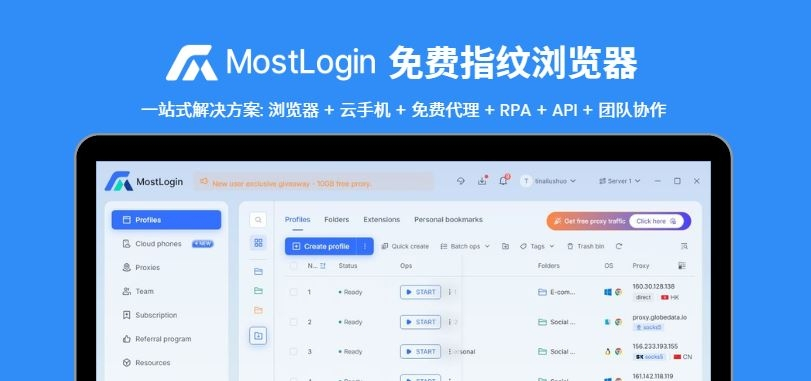
The value of Web3 digital assets continues to rise, but incidents of cryptocurrency theft are frequent, causing irreversible huge economic losses to users. From cache theft, cloud leaks to supply chain tampering and script injection, hacker attacks have formed a chain-like path of crime, making it difficult for users to resist such systemic risks. MostLogin, as a professional fingerprint browser, deeply cultivates the field of terminal security and deploys blocking mechanisms at each key node based on the cryptocurrency theft risk chain, significantly reducing the probability of users' on-chain asset losses with a systematic protection plan.
Six core defense mechanisms to precisely cut off the full chain attack
1. Cache data theft prevention: environmental isolation + secondary encryption, preventing data reuse
Hackers often steal browser Profile cache through Trojans and erroneous file transfers, copying wallet and session extension data for cross-device import, taking over wallets and misappropriating assets. MostLogin's fingerprint browser is specifically designed with triple protection: achieving complete environmental isolation of Profiles, cutting off data circulation channels; performing secondary encryption on extension data to increase cracking difficulty; and binding encrypted data strongly to the environment, making it unusable across environments. Even if data is stolen, hackers cannot reuse it, completely blocking the path of cache theft and asset misappropriation.
2. Cloud data leakage prevention: local first + independent encryption, strictly controlling data export
In response to the risk of bulk leakage from browser cloud synchronization, MostLogin defaults to disabling cloud synchronization, with core data stored only locally to minimize exposure. Even if users actively enable synchronization, the system will generate an independent unique key for each Profile, and the server cannot access the data in an unauthorized state. Even if cloud data is stolen, it cannot be decrypted and exploited in bulk.
3. Program tampering prevention: integrity verification + anomaly fuse, resisting supply chain attacks
In the face of client-side tampering, update package replacement, and other supply chain attacks, MostLogin's anti-detection browser deploys a dual verification mechanism: performing MD5 hash checks before the update package goes live to ensure the installation package has not been tampered with; automatically verifying integrity when the client starts, immediately terminating operation upon detecting anomalies to prevent malicious code execution and reduce attack success rates.
4. Script injection prevention: multi-layer protection + permission restrictions, narrowing the risk range
In response to XSS script injection attacks from malicious web pages and advertisements, MostLogin builds multi-layer anti-injection barriers combined with Profile environmental isolation technology, strictly limiting access permissions to sensitive data. Even if a single environment is invaded, the risk can be locked in a localized area, preventing data theft and wallet operation hijacking, avoiding risk spread.
5. Server-side breakthrough prevention: minimum privilege + multi-factor authentication, converging the attack surface
To prevent server-side interface attacks and unauthorized access, MostLogin's fingerprint browser follows the principle of least privilege to achieve permission separation, strictly controlling core data access permissions; adding 2FA two-factor authentication, IP whitelists, and core service isolation measures to compress hacker attack vectors and reduce the risk of large-scale data leakage, thereby strengthening the backend security defense.
6. Mnemonic risk alert: clarify responsibility boundaries and strengthen user security awareness
The mnemonic is the highest privilege credential for Web3 wallets. Once leaked, it will cause irreversible asset loss, and cannot be remedied through software tools. MostLogin solemnly reminds users: mnemonics must be securely stored offline, strictly prohibited from cloud storage, plaintext retention, or screenshot saving, and never input on unfamiliar pages, guarding the last line of defense for user security.
Multi-layer collaborative protection, constructing a new paradigm of Web3 asset security
Compared to traditional single-point protection tools, MostLogin's fingerprint browser disassembles the Web3 asset theft attack chain layer by layer, with each layer of protection precisely connecting to the attack nodes, forming a closed-loop defense system. Relying on advanced technology, MostLogin minimizes various attack risks to the greatest extent, providing comprehensive protection for users' digital assets. In the future, MostLogin will continue to delve into the field of Web3 terminal security, optimizing protection mechanisms to create a more reliable on-chain asset security environment for users.