
Last year, we competed for an infrastructure bid in North Africa and encountered a very aggressive competitor. They presented a complete set of impeccable 'environmental compliance certificates' and 'multinational credit reports.'
To verify these PDFs stamped with various foreign official seals, we spent two weeks and invested tens of thousands of dollars hiring local due diligence lawyers to dig deep. The result was both laughable and absurd: the institutions issuing those high-end certificates were entirely a fly-by-night shell company operating out of a basement.
In the real multinational business war, the loss of trust is remarkably astonishing. Every day, we are spending enormous costs to verify whether 'the issuing institution is really a legitimate organization.'
Now the circle is constantly shouting to put assets and identities on the blockchain. But I have always held an extremely pessimistic view: if fraudulent agencies in the real world also upload fake degrees and qualifications to the blockchain, won't the blockchain just become an immutable 'cyber garbage dump'?
It wasn't until I dug deep into the underlying architecture of @SignOfficial that I realized these people truly understand the pain points of physical business. Their underlying New ID System not only manages 'issuance' but also 'anti-fraud'.
In the face of sovereign nations and large enterprises, Sign does not believe in so-called 'decentralization without permission' at all. It pragmatically introduced a hardcore component called the Trust Registry.
How does it compromise with reality? In this system, not everyone is qualified to issue on-chain.
Effective credentials. Whether it is a government department in Abu Dhabi or an authoritative auditing agency, they must first be certified by a sovereign authority, entering their public key and identity into this trust registry.
When we verify a supplier's qualifications in international trade, the system first scans the Trust Registry. It not only verifies the authenticity of cryptography but also validates the legitimacy of the issuer. If the endorsement you receive is from an unknown node, even if your zero-knowledge proof (ZK) is perfect, the system will still reject you. This 'sovereignty-threshold trust mechanism' is the underlying reason digital credentials can be mutually recognized between countries.$SIGN

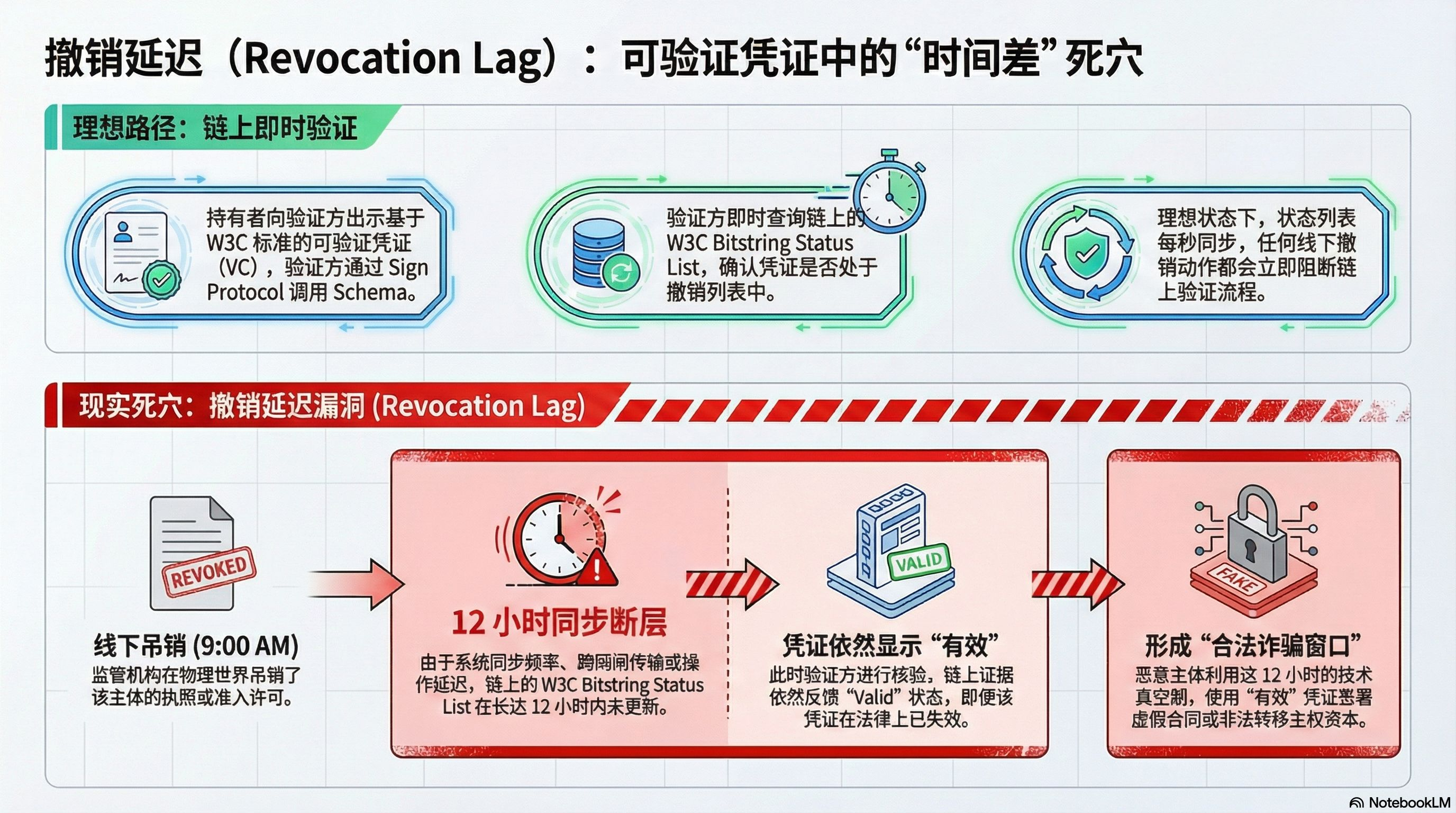
But as a practical veteran, I kept a close eye on the W3C Bitstring Status List responsible for revocation in the system, breaking into a cold sweat.
There is an extremely dangerous physical loophole hidden here: Revocation Lag.
Assume a non-compliant supplier had their business license revoked offline by the local government at 9 AM today. But during the reporting process, the on-chain status list did not achieve second-level broadcasting. Then, in the following 12 hours, this supplier, who should have been dead, can still use mathematically legitimate on-chain credentials to sign contracts and defraud funds without hindrance in the international network. Hackers do not need to crack your smart contracts; they only need to exploit this physical time difference between reality and on-chain status to achieve legal robbery.
Looking back at our business situation. Although there are significant time lags, the expansion of this sovereign-level trust registry remains a nuclear-level enhancement for us as multinational business owners.
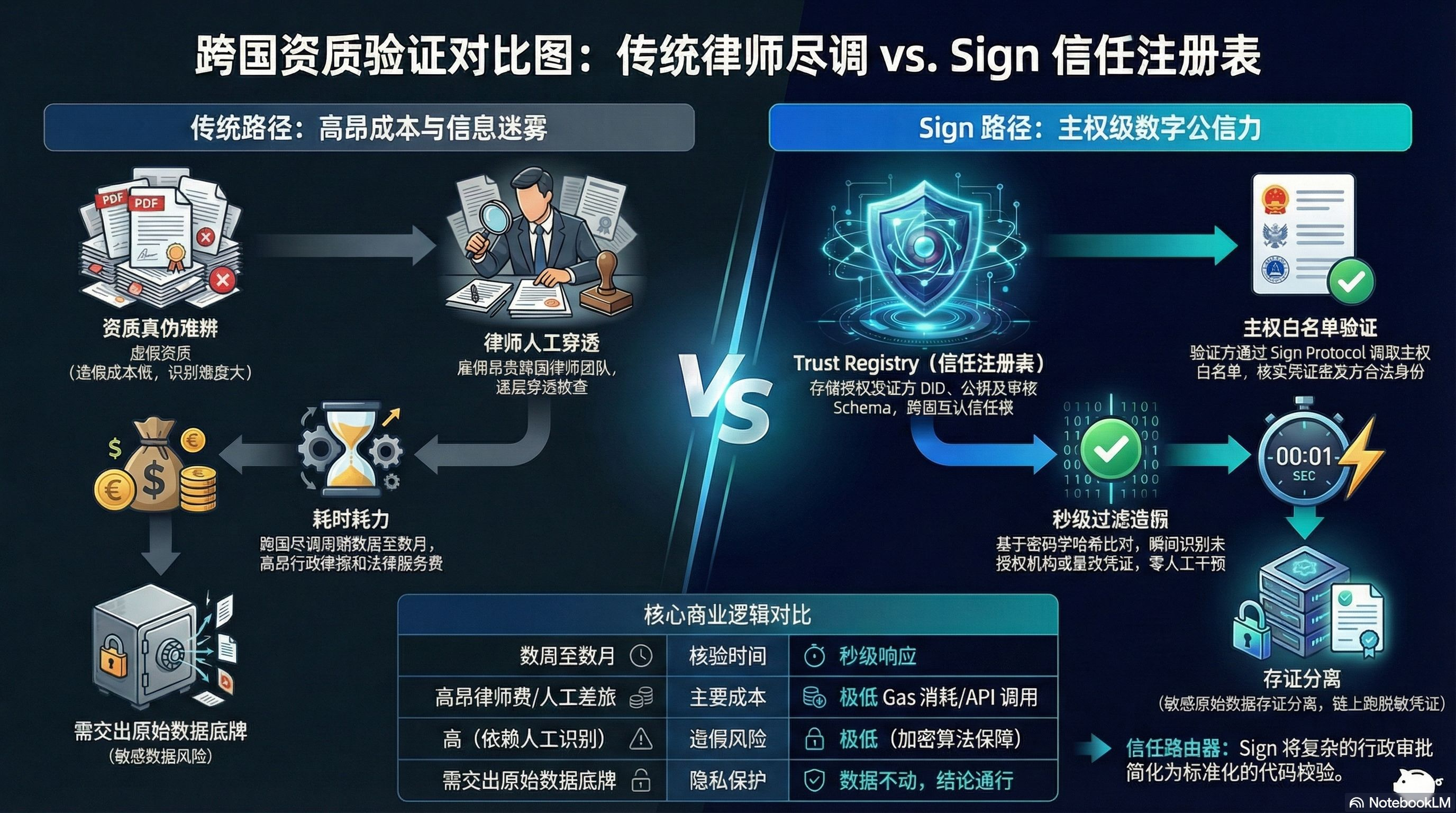
If this system is implemented in the Middle East and Africa, in the future, when I go to cross-border contracts, I will no longer need to spend tens of thousands of dollars and wait two weeks to hire a lawyer to verify the opponent's base documents. With a single API call, I can instantly know whether the other party's credentials are endorsed by a fraudulent agency. When the verification cost approaches zero, whoever controls this trust gateway that filters out cyber garbage will have a grip on the future of international trade.
This account is much clearer than watching the daily fluctuations of a few cents in the market.