
15/10/2025 POLYGON Article # 19
In the world of crypto, it's not just technology, utility, and adoption - macroeconomics and market sentiment also play a significant role in the direction of prices. Today, POL (Polygon) is at a turning point where its emission/inflation model, community sentiment, and price dynamics are in a complex interplay. In this article, we will learn what POL's current inflation model is, how sentiment and on-chain metrics can influence price, and which signals hold strategic importance right now.
POL's Inflation / Emission model (Macro Tokenomics)
Current Emission Model: 2% annually
Polygon has clarified its emission strategy: POL tokens will be emitted at an annual rate of 2%, which can be modified through community governance. polygon.technology+1
1% of this goes towards validator rewards, and the remaining 1% is reserved for community treasury/ecosystem support. polygon.technology+1
The emission rate is controlled by parameters like mintPerSecondCap and EmissionManager in the smart contract, and it can be changed by governance proposal (but not beyond the contract-imposed cap). docs.polygon.technology+1
Proposed Adjustments: Deflationary / Burn Mechanisms
As you mentioned, some proposals have suggested reducing inflation or implementing buyback/burn mechanisms. These ideas could create a positive mental impact on holders as the dilution effect would be reduced. However, no permanent changes have been implemented yet.
Supply Dynamics & Circulating Supply
Circulating supply gradually increases due to emissions. If demand does not increase in the same manner, it can create dilution pressure. Some community observers claim that a 2% annual emission can release approximately 200 million POL tokens, which could dilute holders. Reddit+1
Market Sentiment, Price Correlation, and Data Trends
Sentiment Metrics and Price Correlation
In the crypto market, it is often observed that sentiment (social media mentions, community buzz) and prices influence each other. In the case of POL, sentiment metrics like social volume, bullish vs bearish tweet ratio, etc., often show correlation with price movements. For instance, social stats for POL on Coinbase show that the number of bullish tweets is higher than usual. Coinbase
CoinCodex has stated that the sentiment outlook for POL is neutral - thus, the market's mood is currently stable. CoinCodex
Technical & Price Data Insights
Investing.com’s technical analysis shows that many indicators for POL are pointing towards the sell side (RSI ~36.9, MACD negative) Investing.com
POL's current price is ~$0.237, and the recent rally has challenged some resistance zones. Messari
Some analyses also indicate that POL is still trading below several major resistances, although a positive sentiment bounce has been observed in the past few months. CCN.com
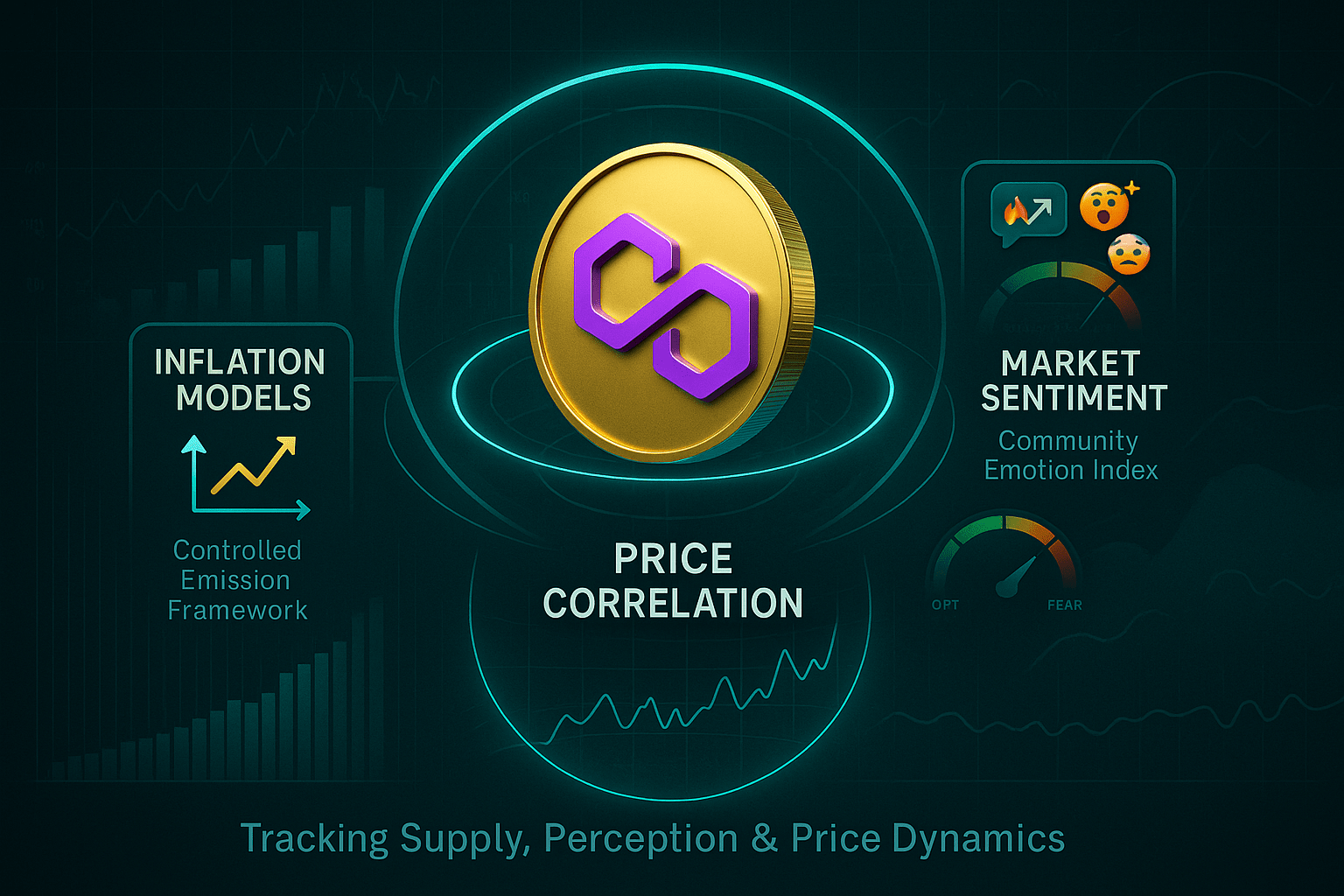
Macro Economy
ics X Price: how do these all work together?
Dilution Pressure vs Demand Generation
Each new emission can dilute the holder base. If demand (staking, usage, adoption) increases sufficiently, it can offset dilution pressure. But if demand does not increase, then emissions can negatively impact.
Sentiment-Triggered Price Moves
New protocol upgrades, migration announcements, grant cycles, partnerships, and other news events can spike sentiment and lead to short-term price jumps. Steps like the POL migration announcement have already increased positive sentiment.
Feedback Loops
Positive sentiment → more buying → price rise → more positive sentiment
Negative sentiment → sell pressure → price fall → and negative sentiment
This loop can amplify the volatility of cryptos, especially those tokens that are not supported by strong fundamentals.
Insights from Sketch
When the inflation rate lowered to ~2% (when the MATIC → POL transition occurred), the market took it as a positive sign, leading to an initial price uplift.
However, macro shocks (like the US inflation surprise) pushed POL into a downtrend, showing that even stable inflation cannot fully shield from external sentiment pressure.
High inflation and speculative cycles in the old MATIC-era led to excessive volatility - thus, the aim of the new lower inflation model is to achieve both dilution/control and sustainable growth.
What to Monitor - Signals That Matter
Emission / Tokenomics Proposals - If there is a proposal to reduce inflation or introduce burn mechanisms, it could be a structural shift.
Staking & Usage Trends - how much supply is staked and how much active usage is occurring.
Sentiment Metrics - social volume, mentions, bullish/bearish ratios, RCI, etc.
Price Correlation with broader crypto - how much POL's movement is linked to broader altcoin/BTC trends.
Catalyst Events - upgrades, partnerships, regulatory news, etc.
Conclusion
The inflation/emission model in POL's macroeconomics is a central pivot - currently, a 2% annual emission is in effect, but the community is reconsidering this. Both sentiment and price dynamics go hand in hand, especially in the short term. If the Polygon team implements inflation and burn mechanics and increases usage/adoption, sustainable upside for POL is possible. But always keep in mind: sentiment bubbles, negative feedback loops, and dilution risk are real threats.

#POLTokenomics #CryptoMacro #SentimentAnalysis @0xPolygon #Polygon $POL