
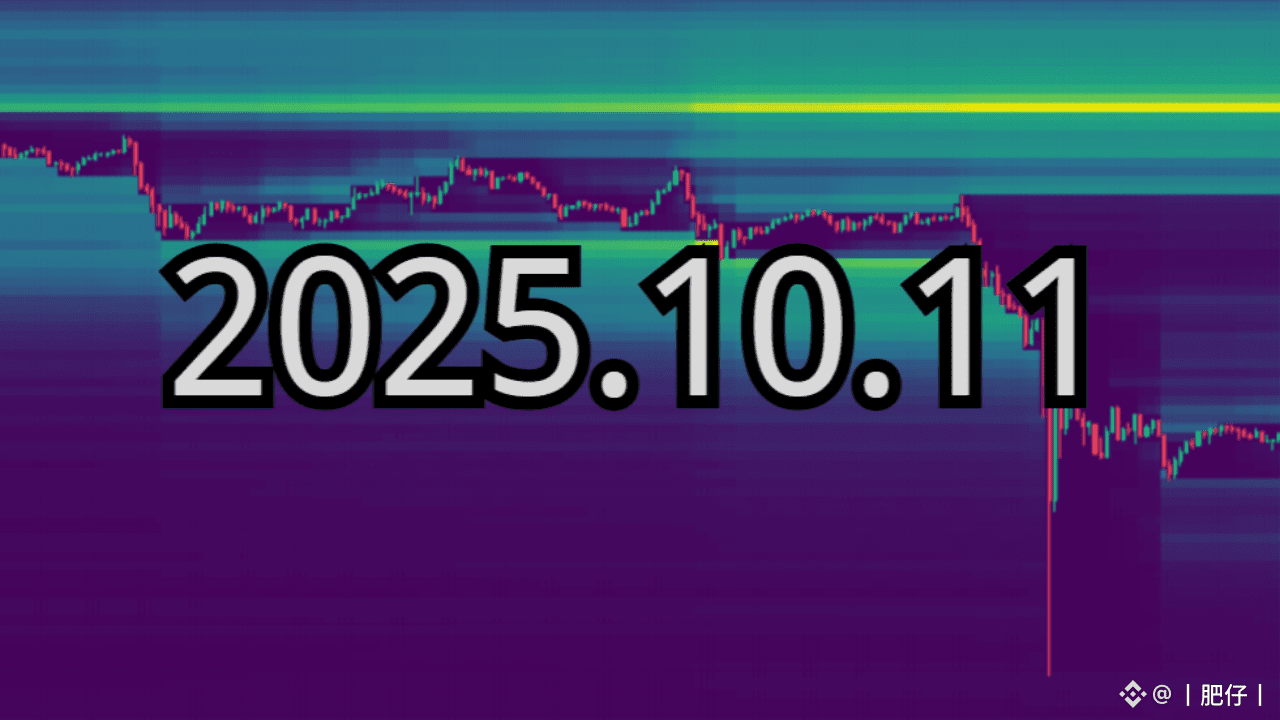
October 11, 2025. On this day, there was no news in the crypto world, only obituaries.
The K-line on the screen is no longer a subject of technical analysis; it has turned into an electrocardiogram, from violently beating to calming down, finally pulling into a straight line. $19 billion in leveraged funds, along with the hopes of 1.6 million families behind them, were wiped out in one fell swoop. The community went from frantic "To the Moon!" to panicked "What happened?", and then to deathly silence in less than three hours.
The trigger for this crash is clear: after Trump announced a new round of high tariffs on China, the US stock market first significantly adjusted, followed by Bitcoin plummeting from a high of $122,000 to below $110,000 in a few hours, hitting a low of $102,000. Ethereum's decline was even more brutal, reaching 16%-22%, while altcoins suffered a complete amputation-style decline.
But these are just appearances. What truly ignited the entire arsenal was the trading system itself, which we use daily and seems so self-evident.
Lightning execution: the liquidity evaporation mechanism of the order book
The order book, this century-old antique inherited from the stock market, is our most familiar friend.
It is like a huge, transparent auction house, with buyers' bids on the left (Bids), sellers' asking prices on the right (Asks), and the most recent transaction price in the middle. Everything is orderly, full of the aesthetic beauty of classical finance.
In a bull market or a stable market, this auction house is bustling with activity. The bids from buyers and sellers are closely linked, forming what we call "depth."
Professional market makers are like diligent bees, constantly placing and withdrawing orders with high-frequency trading bots, ensuring that the bid-ask spread is small enough to make your trades as smooth as silk.
But on October 11, all buyers in the auction house vanished into thin air.
As panic spread like a virus through social media and K-lines, the only direction in the market was "sell." At this point, the fatal weakness of the order book was exposed: its liquidity is based on the illusion of confidence.
The betrayal of market makers:
The first to defect were those market makers. Their algorithmic core is risk control, not charity. When market volatility skyrockets to extremes, and the risk of one-sided declines becomes immeasurable, their first response is to withdraw all buy orders and significantly widen the bid-ask spread. The once impenetrable web of liquidity was torn to shreds by their own hands.
The vacuum of buying pressure:
With market makers gone, what about retail buyers? It’s even less likely they will rush in to catch falling knives at this time. Thus, a huge, desperate vacuum gap appeared on the buy side (Bid Side) of the order book. You might see the price still at $110,000, but the next valid buy order might be at $105,000, or even $100,000. That entire $10,000 range in between is a liquidity cliff.
The chain explosion of stop-loss orders:
The deadliest blow comes from the stop-loss orders we set ourselves. A large number of automatic stop-loss sell orders set at critical support levels are triggered simultaneously when the price breaks down. These stop-loss orders are essentially "market sell" instructions. They act like a string of ignited firecrackers, passively and costlessly smashing into the pitiful buy pressure, instantly piercing through several price levels.
The death of the order book is "execution-style."
It will not give you time to react, nor will it let you be slowly boiled like a frog. It directly pulls away the floor beneath your feet in an instant of collapsing confidence, making you free fall. Your assets will be liquidated in a few minutes in a "price piercing" manner. The support level you thought was there is as thin as a cicada's wing in front of a liquidity cliff.
Blunt knife execution: the bleeding mechanism of AMM's slippage
If the order book is a classic firing squad, then AMM is a precisely designed, emotionless modern execution device.
It was born from the utopian ideals of DeFi, aiming to create an always-online, permissionless, and inexhaustible liquidity pool using code and algorithms.
Its core principle, like X × Y = K, sounds beautiful. You don't need to find a counterparty; you just need to trade with this liquidity pool. The pool will never reject you as long as you are willing to pay the price.
On October 11, we saw just how high that "cost" could be.
Slippage, that blunt knife:
When everyone frantically throws various altcoins and mainstream coins into the pool, just wanting to exchange them for USDT, the AMM algorithm begins to coldly execute its mathematical rules. The risk assets in the pool increase while stablecoins decrease. To maintain the constant of "K", the prices of risk assets are pushed down by the algorithm at a non-linear speed. This is slippage. The larger the quantity you sell, the lower your average transaction price becomes. You feel like you are in a quagmire; the more you struggle, the deeper you sink. Each sale digs a deeper price pit for the next seller. Your assets do not instantly go to zero; instead, they are gradually cut away by this blunt knife called "slippage" in one transaction after another.
LP, the most tragic bag holder:
If you are a liquidity provider (LP), one of the shareholders of this liquidity pool, congratulations, you are sitting in the most painful execution chair in the arena. During market panic sell-offs, you passively absorb all the "toxic assets" thrown by traders (toxic flow). Your asset portfolio increasingly contains altcoins whose prices have plummeted, while the stablecoins you want the most are constantly being withdrawn. Besides the price drop of the assets themselves, you also have to bear huge impermanent losses — the total value of the assets you end up with is far lower than what you initially held. You provided liquidity to the market, and the market returns you an embrace filled with junk coins.
MEV bots taking advantage of the fire:
In the dark forest of DEX, there are also a group of bots called MEV. They are like bloodthirsty sharks, monitoring every pending transaction. When you submit a huge sell order out of panic, they will immediately jump in front of you, selling first with a higher gas fee, pushing the price down, and then buying back at a lower position after your transaction is completed. This back-and-forth artificially amplifies your slippage, while they complete risk-free arbitrage. You are not only being slaughtered by the market but also drained by these code ghosts.
The death of AMM is "lingchi".
It won't cause you to die instantly, but it will ensure that every step you take towards escape costs you dearly. Every operation you perform exacerbates your losses. It replaces the uncertainty of human nature in the order book with the certainty of algorithms, but this machine also shows no mercy.
Death spiral: the amplifying effect of USDe decoupling and collateral liquidation
If the order book and AMM are the executioner's knives, then USDe's decoupling and chain collateral liquidation are the hands holding the knife, together turning an ordinary decline into an unstoppable avalanche.
As an algorithmic stablecoin, USDe's value anchor relies on complex liquidation mechanisms and market confidence. When the market begins to panic sell, the value of USDe's collateral plummets, leading to insufficient collateralization. Once it falls below the liquidation threshold, doubts about its solvency in the market will trigger a run.
In the crash, USDe once fell to $0.65, with a decoupling of up to 38%. This is not just a fluctuation of numbers; it marks a crack in the "stable cornerstone" upon which the entire DeFi ecosystem relies. All protocols and positions priced, collateralized, or settled in USDe are suddenly exposed to additional devaluation risk.
In DeFi lending protocols, users collateralize assets to borrow stablecoins. When the price of the collateral falls to the liquidation line, the protocol will automatically force liquidation to repay the debt.
The death spiral on October 11 triggered the liquidation of the first batch of high-leverage positions as the market fell. Liquidators, aiming for profit, auction off the liquidated collateral at slightly lower than market prices. This amounts to adding new, cost-free sell orders to the market. These auction sell pressures further suppress asset prices, triggering the next batch of slightly lower leverage positions to be liquidated, and so on in a loop. Ultimately, an unstoppable avalanche forms.
System linkage: the perfect performance of three meat grinders
On October 11, these three were not isolated events; they constituted a perfect storm:
● Order book: bore the initial shock and the fastest liquidation. A large number of leveraged positions on centralized exchanges were instantaneously "executed" through the order book mechanism, with severe price piercing phenomena.
● AMM: became the relief valve for panic and the last barrier of liquidity. When CEX channels are blocked or prices distorted, traders flock to DEX, "lingchi" in the huge slippage.
● USDe decoupling and collateral liquidation: act as systemic amplifiers. They transmit the decline of individual assets through leverage and stablecoin systems to the capillaries of the entire crypto economy.
The order book bore the initial shock, AMM became the outlet for emotions, and the decoupling of stablecoins transformed localized crashes into systemic avalanches.
Ultimately, this "grand" performance cost $19 billion in funds and 1.6 million liquidated families.
Fortress and wasteland: the future of CEX and DEX
After this blood sacrifice, the debate about which is better, CEX or DEX, has once again resurfaced.
CEX is a heavily guarded centralized fortress. It is efficient and convenient. Inside the fortress, you feel safe, with high walls, guards (customer service), and a powerful matching engine.
But the cost is that all your assets are stored in the central treasury of the fortress; you do not truly own them. You give up sovereignty for convenience. The collapse of FTX reminds us that even the sturdiest fortress can rot from within.
DEX is a vast, boundless decentralized wasteland. Here, you have absolute freedom and sovereignty, with the private key as your only king. Everything is recorded on the blockchain, transparent and open.
But the cost is that the wasteland is fraught with danger, and there is no remedy for regrets. You need to fight against robbers (hackers and MEV bots) on your own. You have sovereignty, but you must face the dark forest alone.
The outcome of the future will not be a complete victory for one side, but an evolution of mutual "invasion": the fortress will open gates to the wasteland, while civilization outposts will gradually be built up in the wasteland.
● CEX is becoming more "transparent": leading CEXs are continuously publishing proof of reserves, trying to self-validate through technical means and graft the feature of "on-chain transparency" onto themselves.
● DEX is becoming more "user-friendly": technologies like Layer 2 and account abstraction are desperately solving the performance and experience issues of DEX, making the roads in the wasteland smoother.
● The rise of hybrid models: platforms like Hyperliquid and an increasing number of Perp DEXs represent a great experiment in achieving centralized efficiency through decentralized means.
The lesson of blood is not to drive people away from the market but to force us to see the truth of the rules.
Written at the end
The disaster on October 11 is a required course on the microstructure of the market, taught to us survivors at the cost of real money and even our lives.
It tells us not to believe in any single solution.
Before the next crisis arrives, make sure to understand:
You trust the trading platform with your wealth, where is its vital point?
When everyone is fleeing, which path can let you bleed the least?
There are no saviors in the market. The only thing that can protect you is your deep understanding of how this system operates.
Because when judgment day comes again, those who understand the rules can at least choose their own way to die.