
In the cryptocurrency industry, stablecoins have always been important, but for a long time, their importance has been more of an 'infrastructure-type importance.'
Everyone is using it, but very few people really discuss it seriously.
It's a bit like water, electricity, and Wi-Fi. Indispensable, but it’s also hard to evoke emotions.
I just finished listening to a deep interview with Jia Jie and the co-founder and COO @zakfolkman of @worldlibertyfi , and my biggest feeling is: #USD1 seems to want to do more than just create a bigger stablecoin; it wants to redefine what 'the dollar of the digital age' should look like.
This is also why I feel that the significance of USD1 may not just be to capture market share from USDT and USDC, but to attempt to push something more fundamental: changing the form of currency to truly adapt to the upcoming digital economy.
Let me start with a very interesting point.
In the past, when we looked at stablecoins, we assumed they were tools. As long as they are stable, convenient, and widely circulated, they were already considered successful. As for whether users like them or recognize them, that didn't seem to matter.
But from Zack's expression, it is clear that USD1 is not taking this path.
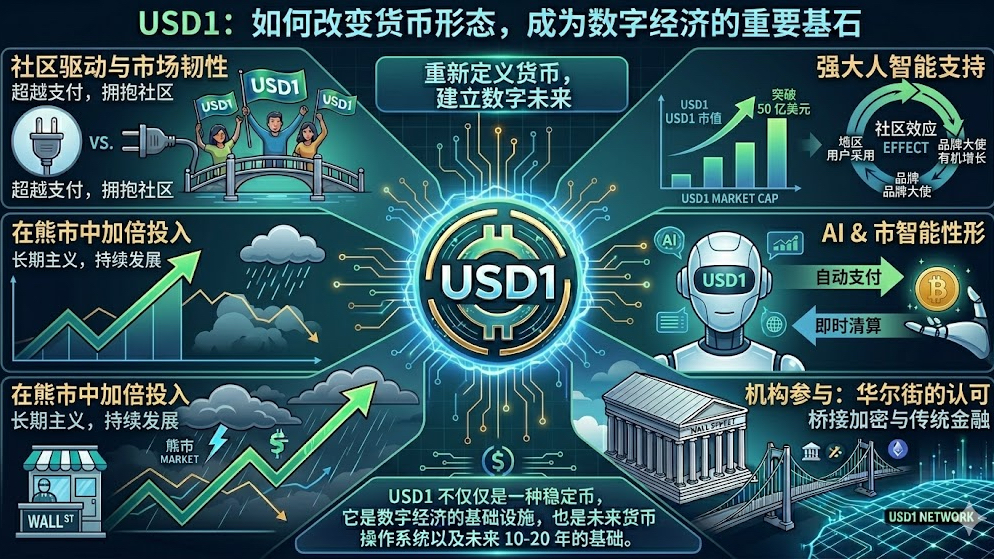
He is not talking about USD1 as a cold payment medium, but as something supported by the community, recognized, and even willing to spread.
This point is actually quite different.
Because no matter how strong USDT and USDC are, they are essentially still 'products that are being used.' People need them but won't be excited for them. However, what USD1 wants to do is something else: not just to have users use it, but to make users willingly stand on its side.
In plain terms, it wants to push stablecoins from 'functional products' to 'community products.'
What’s most worth noting behind this is not the emotions, but the logic.
Once a stablecoin not only has payment attributes but also identity and community attributes, its growth model will change. It will no longer just rely on channel expansion and transaction scene penetration, but will begin to exhibit self-propagation and self-diffusion power.
This is actually a place that very few people discuss seriously.
In the past, stablecoins competed on depth, efficiency, compliance, and circulation, but in the future, it may also compete on one more thing: who can first become a carrier of a certain consensus.
And USD1 is clearly trying to head in this direction.
Another point that left a deep impression on me was their attitude towards bear markets and cycles.
Many projects, when the market is poor, respond by contracting, being conservative, and cutting budgets. This is quite normal, as everyone fears spending money without results.
But Zack mentioned that they are actually more willing to continue investing after seeing effective results, even doubling down.
This statement sounds uncomplicated, but in the current market environment, it's actually quite rare.
Because the projects that can really cross cycles are often not those that shout slogans the loudest, but those who are still willing to continue building products, piling resources, and engaging the community during the coldest times in the market.
It's easy to talk about visions in a bull market, but what's difficult is to be willing to continue working during a bear market.
So from this perspective, what USD1 is trying to compete for now may not just be the current scale, but its sense of position in the stablecoin track in the future.
Looking deeper, I think the most valuable part of this interview is actually their judgment on the relationship between AI and currency.
In the past, discussions about stablecoins were mainly focused on payment, cross-border remittances, and on-chain transactions. But this time, Zack made it very clear: in the future, the true need for stablecoins may not just come from people, but also from AI.
I personally agree with this judgment.
Because if AI Agents really will increasingly participate in work, call services, purchase tools, and handle tasks, then it cannot avoid payments and settlements.
The problem lies here.
The traditional banking system is designed for humans, not for machines.
It has business hours, intermediaries, confirmation processes, and settlement delays. These things can barely be tolerated in human society, but in the world of AI, they would seem particularly cumbersome.
AI cannot wait for banks to open, nor can it wait for humans to confirm every payment initiation.
From this perspective, the value of stablecoins is suddenly magnified.
It's not just a mapping of the dollar chain, but more like a currency layer suitable for the native operation of the digital economy: online 24/7, programmable, callable, embeddable, and capable of automatic settlement.
This is also why I feel that the 'currency upgrade' that USD1 wants to talk about is not entirely just a big term.
Because if there are more and more participants in future economic activities who are programs, robots, or agents, then the currency itself should indeed be upgraded.
With mobile phones evolving to this day, if currency still remains in the logic of paper and bank accounts, it really feels a bit out of touch with the times.
Another point I strongly agree with is their understanding of 'cryptocurrency mainstreaming.'
In recent years, the industry has been talking about mass adoption, but many projects' understanding of mainstreaming essentially still revolves around educating ordinary people to adapt to crypto-native usage.
But the reality is that most ordinary users simply do not want to learn these things.
Mnemonic phrases, wallet signatures, gas, cross-chain, authorization—this set of things has become habitual for insiders, but for outsiders, the threshold is truly too high.
So what truly brings cryptocurrency into the mainstream may not be getting more people to learn about it, but rather making more people feel that they are not using cryptocurrency at all.
I think this is the key.
If in the future, users can transfer, pay, and receive funds using USD1 as naturally as they do today with WeChat Pay, Cash App, or bank cards, then stablecoins can be considered to have truly entered daily life.
It's not about making users understand the underlying structure, but rather letting the technology retreat to the background.
This is how a mature product should look.
From this perspective, looking at USD1, you will find that what it aims to do is no longer just an on-chain settlement tool, but more like a complete payment system aimed at the future.
It needs to connect to Web3, but also wants to integrate Web2; it wants to serve on-chain scenarios while also entering the consumption scenarios of ordinary people; it wants to cater to institutions, but also wants to engage the community.
This path is certainly difficult, but once it is opened, the significance will be completely different.
Because at that time, the competition is no longer about whose market value is higher or whose share is larger, but about who has a better chance of becoming the underlying currency interface in the next phase of the digital economy.
To put it more plainly.
USDT and USDC are more like becoming stronger within the existing stablecoin framework.
What USD1 wants to prove is whether stablecoins can take another step forward, evolving from 'on-chain dollars' to 'a part of the digital economy operating system.'
The difference here is actually quite significant.
The former is still a tool logic, while the latter has already moved to infrastructure logic.
So after listening to the entire interview, my own understanding is:
The most noteworthy aspect of USD1 is not how big it is today, but how it attempts to push stablecoins from 'financial accessories' to 'the foundation of the digital economy.'
What it wants to change is not just market share, but the way currency exists in the new era.
Future currencies may not only be for saving, transferring, and trading.
It also needs to be callable by programs, serve AI, seamlessly integrate into global payments, and run quietly but importantly beneath all systems, like internet protocols.
If that's really the case, then the endgame for stablecoins is indeed not just stablecoins.
What USD1 is doing now, to some extent, is to preemptively occupy this position.
As for whether it can really reach that point, it is still too early to draw conclusions.
But at least from this interview, it can be seen that what they want to talk about is no longer 'to make a better stablecoin,' but something much bigger:
What should the next generation of the dollar look like?
Let’s keep building together and witness the more surprises and possibilities that USD1 will bring us in the future!
