You think it's the Curator matching pools, but in reality, it's writing a term hedging fund.
In these past few days of Qingming, I've been running around, and the customs in each region are really different. We need to wait until after the major cold before we can break ground, but other places can, which is quite nice.
Then I saw TermMaxFi "curators can’t build strategies without rate certainty."
To be honest, many people understand half of this sentence, but the other half is more critical.
1. What the Curator is doing now is actually no longer important.
Now everyone's understanding of curator is probably:
Helping you choose a market.
Help you allocate funds
Help you earn a more stable yield
Sounds fine, but if we stop here, we actually underestimate it. The real issue is not what pool Curator is matching, but what risk it is ultimately managing.
2. If there is no fixed-rate, all strategies are false
This is the key point: without a fixed interest rate and fixed term:
Your strategy today
It will change tomorrow
You think you are building a portfolio, but in fact, you are betting on volatility. Without time certainty, there are no strategies, only reactions.
This is also why the official statement is very important: curators can’t build strategies without rate certainty. Because the premise of a strategy is predictable cash flow.
3. Once interest rates and terms are fixed, the world changes.
When TermMax puts:
Fixed Interest Rate
Fixed Term
Collateral Relationships
After writing into the position, what Curator can do has been directly upgraded to a new dimension—not just distributing funds, but distributing time.
4. This step is the entry point for term hedging
Imagine the simplest structure:
Short-term Assets
Hedging
Long-term Liabilities
Or conversely, short bonds and short long bonds, what is the essence? It’s not about betting on direction, but about managing time mismatches. This is what traditional fixed income funds have been doing, and TermMax has brought this capability on-chain for the first time.
5. Why aggregators can never achieve this step
Yearn can help you find higher yields, Idle can help you optimize the path.
But they cannot break down a fund into different term risk segments because they focus on where to earn, not when to earn.
6. What TermMax is doing is a more fundamental matter
FT is like a debt that matures and pays off.
XT locks in financing costs.
GT writes collateral and debt into one position.
This is not a product; this is a computable, hedgeable, combinable debt receipt. What you receive is no longer a position, but a stream of future cash flows.
7. The ultimate goal of Curator is not yield optimization
I am now more willing to understand Curator = on-chain term hedge fund manager, it can:
Term Distribution
Conduct Cash Flow Matching
Conduct Mismatched Hedging
Conduct Yield Curve Structuring
This is no longer the familiar gameplay of DeFi; this is fixed income.
8. But here I must say a cold truth (this statement is very important)
Term structure is not about reducing risk; it's about reallocating risk. You no longer face interest rate fluctuations, but you begin to face:
Concentration Explosion at Maturity
Liquidity Gap
Curve Mismatch
Risk has not disappeared; it has only shifted from price to time.
9. This is also why this stage is very critical
Current:
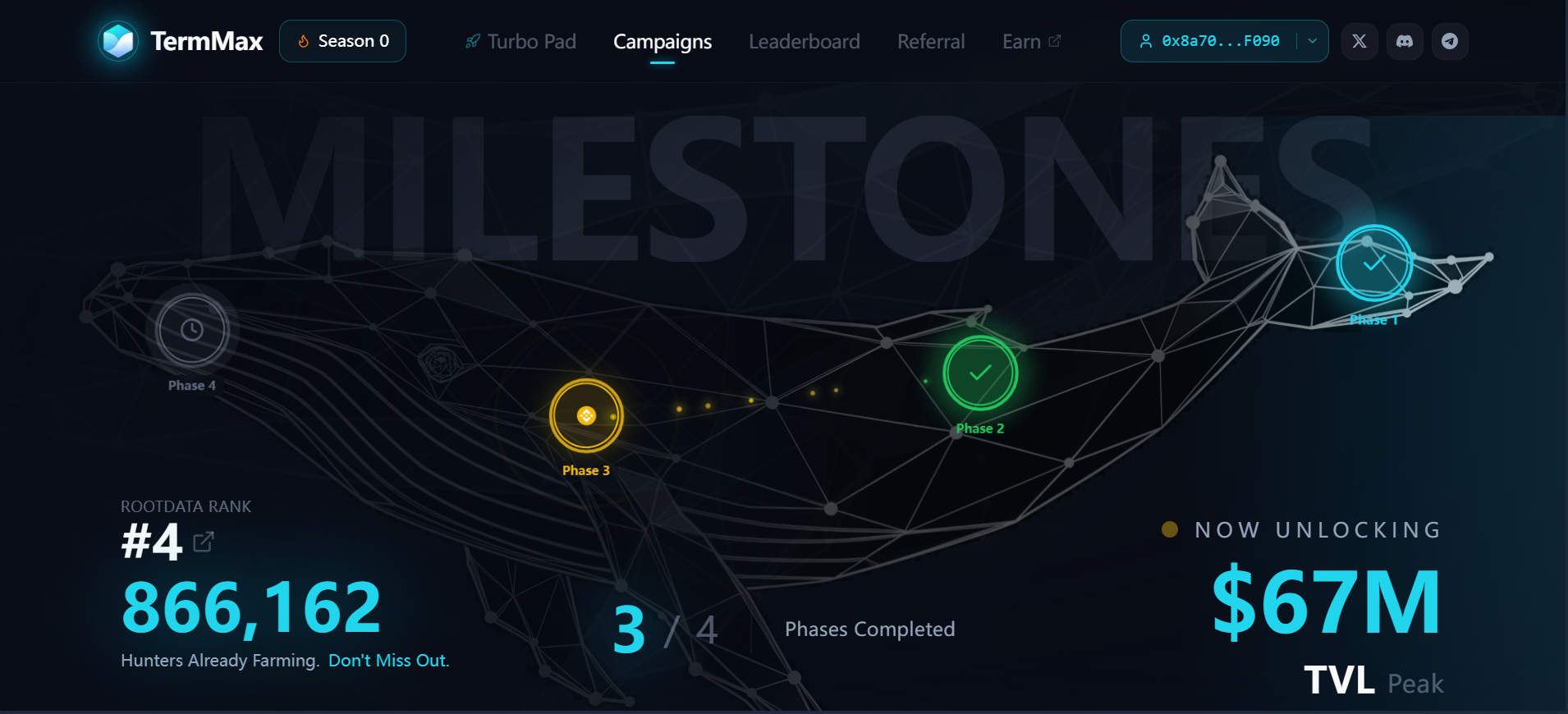
TVL ~ 62000000
Borrowed ~ 13000000000
Costs are still in the early stage
This indicates that the structure has emerged, but the market has not fully understood it yet.
10. So what I care about more is not yield
Rather, this question—when time can be split, combined, and hedged, will DeFi finally see a truly on-chain fixed income fund.
Most protocols aim to make funds more active, while TermMax aims to make time manageable.
If Curator can really create a term hedge fund, what are you more concerned about? Yield? Or who bears the layer of risk from time mismatches?
@TermMaxFi #TermMax #DeFi #FixedIncome #RWA #StructuredFinance #BNBChain