
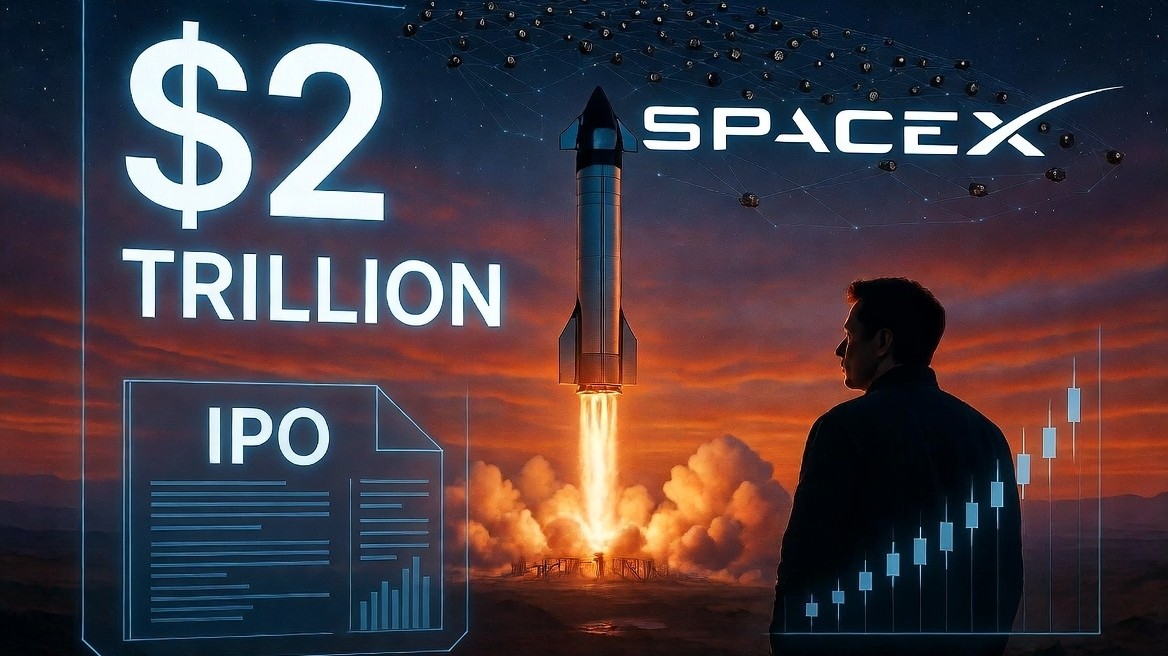
SpaceX is preparing for what could be the largest initial public offering (IPO) in history, with reports indicating a confidential filing to the U.S. Securities and Exchange Commission (SEC) and ambitions for a valuation exceeding $2 trillion as early as June 2026.#AppleRemovesBitchatFromChinaAppStore
This move would eclipse previous records, such as Saudi Aramco's 2019 debut, and position SpaceX among the world's most valuable public companies, potentially ranking it just behind giants like Nvidia, Apple, Microsoft, Alphabet, and Amazon.
Background and Recent Developments
SpaceX, founded by Elon Musk in 2002, has evolved from a rocket manufacturer into a multifaceted aerospace and technology powerhouse.
Its core businesses include reusable orbital launch services (Falcon 9, Falcon Heavy, and the developing Starship) and Starlink, its satellite internet constellation.
In February 2026, SpaceX acquired Musk's AI startup xAI (developer of the Grok chatbot) in a record-setting deal that valued the combined entity at approximately $1.25 trillion — SpaceX at $1 trillion and xAI at $250 billion.
This merger created what Musk described as "the most ambitious, vertically-integrated innovation engine on (and off) Earth," integrating rockets, space-based internet, direct-to-mobile communications, and advanced AI capabilities.
The acquisition fueled a new "Space + AI" narrative, emphasizing potential for orbital data centers to address surging energy demands for AI training and inference, which terrestrial infrastructure may struggle to meet.
SpaceX confidentially filed draft IPO paperwork with the SEC around April 1, 2026, targeting a public listing as soon as June. Initial reports suggested a valuation around $1.75 trillion, but subsequent updates indicated the company and its advisers have floated figures above $2 trillion to prospective investors.
The offering could raise between $50 billion and $75 billion, with up to 30% of shares potentially allocated to retail investors.
Financially, SpaceX showed strong momentum leading into these plans. In 2025, the company reportedly generated roughly $15–16 billion in revenue and about $8 billion in EBITDA (earnings before interest, taxes, depreciation, and amortization), with Starlink accounting for 50–80% of revenue.
Starlink itself had grown to serve over 9 million subscribers across more than 150 countries, with analysts estimating its 2025 revenue contribution at around $10–11 billion at high margins.
Drivers of the Valuation Surge.
The leap in valuation stems primarily from Starlink's explosive growth and the integration of AI ambitions:
Starlink dominance.
With thousands of satellites deployed (estimates exceed 9,500–10,000), Starlink provides broadband to remote, maritime, aviation, and enterprise users. Its direct-to-cell (D2C) capabilities, bolstered by spectrum acquisitions like the $19.6 billion EchoStar deal, expand its addressable market significantly.
Space + AI synergy — Post-xAI merger, SpaceX is positioned to explore space-based computing infrastructure. High electricity demands for AI could drive demand for orbital data centers, leveraging Starlink's low-latency network and Starship's heavy-lift capacity for deployment.
Launch business.
Reusable rockets have slashed costs, securing NASA contracts, commercial payloads, and national security launches. Starship development promises even greater economies for Mars ambitions and large-scale satellite deployments.
Analysts offer mixed views on whether a $2 trillion valuation is justified today. Some sum-of-the-parts models value the core launch and Starlink businesses in the $1.1–1.7 trillion range over a 5–7 year horizon, assuming continued subscriber growth and Starship success. Others note that near-term multiples appear stretched relative to 2025 financials, with long-term upside tied to execution on speculative opportunities like orbital AI infrastructure.
Market Ripple Effects.
The news has already triggered competitive responses and sector-wide enthusiasm.
Amazon is reportedly in advanced talks to acquire satellite operator Globalstar for approximately $9 billion, aiming to accelerate its Project Kuiper (rebranded as Amazon Leo) constellation and close the gap with Starlink.
Amazon's Kuiper has deployed around 200 satellites so far, far behind Starlink's scale.
Space-related stocks have reacted positively, with companies like Rocket Lab and Planet Labs showing heightened market activity. This reflects growing investor belief that the space economy is transitioning from niche government and science projects to a scalable, trillion-dollar commercial industry.
From Science Fiction to Trillion-Dollar Reality.
The space sector's evolution is remarkable. What once seemed like science fiction — reusable rockets landing autonomously, global satellite internet constellations, and AI integrated with orbital infrastructure — is now driving real revenue and market valuations.
SpaceX has played a pivotal role in this shift.
- Reusability reduced launch costs dramatically, democratizing access to orbit.
- Starlink has brought connectivity to underserved regions, supporting disaster response, remote education, and business operations.
Ambitious goals like Mars colonization, while still long-term, inspire technological spillovers in propulsion, materials, and autonomy.
The IPO would mark a milestone, offering public investors direct exposure to this growth while providing SpaceX with capital to scale Starship, expand Starlink, and pursue next-generation projects.
Long-Term Investment Value Amid High Valuations?
Whether the space sector — and SpaceX specifically — holds strong long-term investment value depends on several factors:
Bull case
Massive addressable markets in satellite broadband (projected to grow significantly with global connectivity demands).
Government and defense contracts providing stable revenue.
Technological moats from reusability, vertical integration, and now AI synergies.
Potential for Starship to enable entirely new industries, such as in-space manufacturing or large-scale orbital infrastructure.
Bear case and risks:
Execution challenges with Starship (technical delays, regulatory hurdles).
Intense competition from Amazon, China, and others in satellite internet.
Capital intensity: Massive upfront investments in satellites and launches could pressure cash flows if growth slows.
Valuation risk: At $2 trillion, the stock would need sustained hyper-growth to deliver attractive returns; any misses on timelines or profitability could lead to volatility.
Regulatory and geopolitical factors, including spectrum allocation, orbital debris concerns, and export controls.
Many analysts view the space economy as having durable long-term potential, akin to how the internet or aviation scaled over decades. However, public market scrutiny will be intense, requiring transparent financial reporting and milestone delivery. High valuations bake in significant optimism; investors should weigh them against realistic growth trajectories rather than hype alone.
Musk has occasionally pushed back on specific media reports about the IPO details, reminding observers that not all rumors prove accurate. Details like final valuation, offering size, and timeline could still evolve as the process advances.
SpaceX's potential IPO represents more than a corporate milestone — it symbolizes the maturation of the commercial space industry.
From Falcon 9 landings to Starlink's global reach and now AI-space integration, the company has repeatedly turned ambitious visions into operational realities.
As the sector moves from "science fiction" toward trillion-dollar economics, the coming months will test whether this momentum can withstand public market realities.
For investors, the opportunity is historic but demands careful assessment of risks and rewards in an industry where technological breakthroughs and execution risks coexist at orbital scale.
The space economy's leap is underway; SpaceX's public debut could accelerate it further, drawing more capital, talent, and competition into humanity's expanding frontier beyond Earth.
As SpaceX hurtles toward a historic $2 trillion IPO, Bitcoin continues to demonstrate its resilience and growing relevance in the global financial ecosystem, rising +3.25% in the same period amid the surge in high-growth tech and space narratives.
The cryptocurrency's performance reflects investor optimism not only in traditional risk assets but also in frontier technologies like reusable rocketry, satellite constellations, and AI-space infrastructure — sectors where SpaceX leads.
With Bitcoin increasingly viewed as a digital store of value and a hedge against monetary expansion, its correlation with innovative companies such as SpaceX underscores a broader theme: capital is flowing toward visionary projects that promise to expand humanity’s economic frontier, whether on Earth through decentralized finance or beyond it through orbital economies.
This parallel momentum highlights how both BTC and SpaceX embody the spirit of long-term, high-conviction bets on technological disruption and scarcity one in monetary protocol, the other in physical access to space.
SpaceX Aims for $2 Trillion IPO as Bitcoin Climbs: Is the Space + AI Era the Next Trillion-Dollar Frontier?