
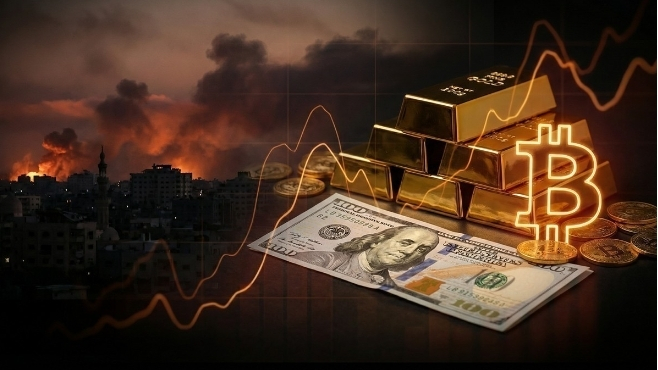
In March, all financial markets were severely turbulent. The military actions in Iran and the resulting twofold increase in oil prices have significantly shaken the global economy. And since the conflict in the Middle East seems far from over, not only investors but also analysts of major companies are currently operating with scenarios rather than forecasts. Often based on the principle: bad, even worse, and it can't get any worse.
Finance
How the war in Iran affects gold, the dollar exchange rate, and Bitcoin. What the investor index showed in March
April 6 at 8:00
Konstantin Korzhevich
In March, all financial markets were quite turbulent. Military actions in Iran and the resulting twofold increase in oil prices significantly shook the global economy. And since the conflict in the Middle East seems far from over, not only investors but also analysts from large companies are currently operating with scenarios rather than forecasts. Often based on the principle: bad, worse, and it can't get any worse.
The dollar grew by 10 kopecks in March
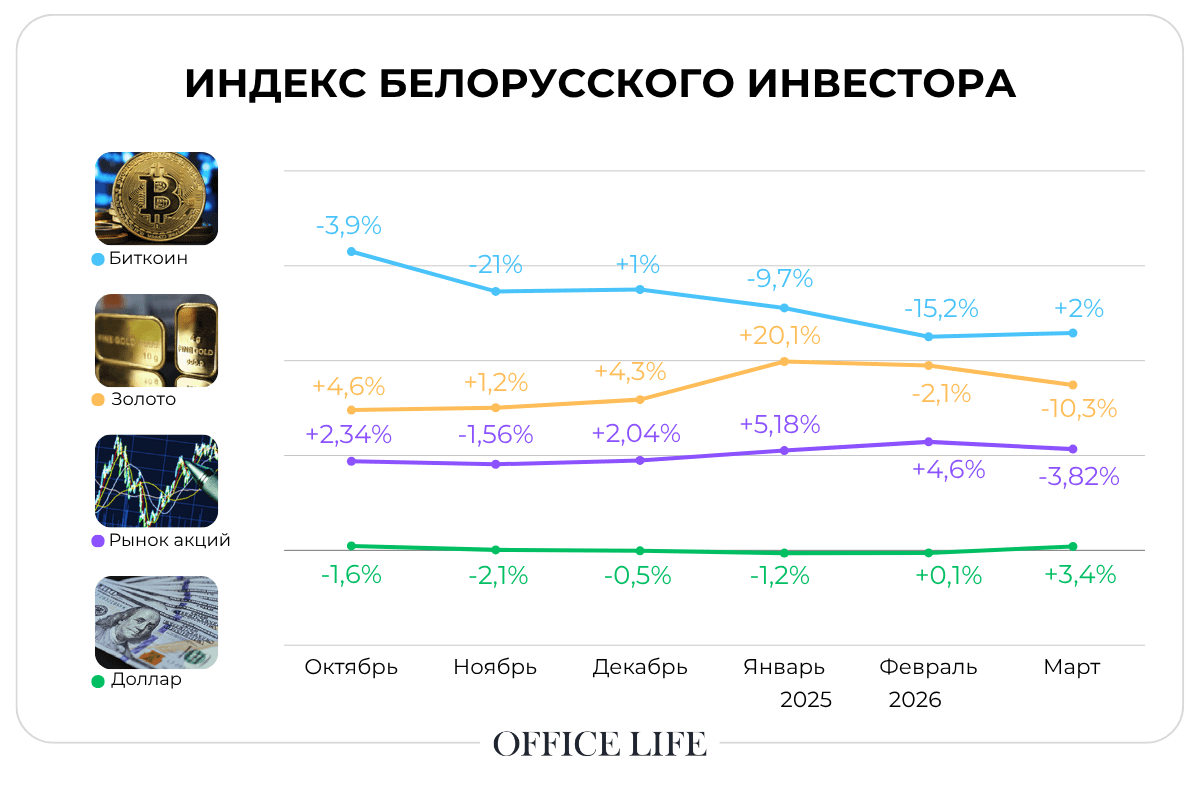
It's hard to believe, but in terms of monthly growth, the dollar in Belarus outperformed all other assets. In March, it gained 10 kopecks (+3.4%) and ended the month at 2.9508 rubles. Moreover, at its peak, the American currency even rose above 3 rubles — to 3.0891. And by the way, its annual yield, which was minus 10%, increased to approximately minus 5.4%. It's already something.
As usual, the reasons for this phenomenon lie beyond the borders of Belarus. First of all — in Russia, where the local ruble, amidst the protracted conflict in Ukraine and a currency shortage in the market, has fallen to more than 82 rubles per dollar. The second reason is the strengthening of the dollar itself, whose index rose to 99.2 (+1.5 percentage points) over the month.
What's next? Most likely, financial regulators in Russia will try to 'calm' their market. For example, through currency interventions. Let's not forget that another tax period is approaching. Therefore, experts believe that the real nearest corridor for the Belarusian ruble is 2.96–3.02 per dollar.
Bitcoin is holding up for now, but risks are increasing
Bitcoin, oddly enough, turned out to be one of the most resilient assets against the backdrop of military actions in the Middle East: it hardly reacted to them at all. Moreover, in March, Bitcoin rose by $1.4 thousand per coin — to $68.2 thousand. This is about 2% more than in February.
Although some experts predicted a decrease in the cryptocurrency rate to $60 thousand and even lower, it is holding up quite well for now. Of course, minus 17.5% for the rolling year is not what investors expected, but it's not the worst option either. The capitalization of the crypto market remains near $2.3 trillion, despite the negative news background.
Experts note that many large holders, primarily corporate ones, have shifted from accumulating Bitcoin to selling it, and the demand for it has decreased (for example, the Coinbase premium index has gone 'negative'). And still, much depends on the war in Iran. For instance, if it drags on and central bank rates rise, cryptocurrency may fall even lower. If the situation resolves sooner, everything could be exactly the opposite. These are the scenarios.