


The transition from generative artificial intelligence to autonomous agent systems has reached a turning point in 2026. The last few years were shaped by models that could generate text, images, and code. What matters now is different, agents can reason, decide, and act across systems without waiting for human input.
This shift exposes a deeper flaw in the internet. It was built for humans operating at human speed. It was never designed for machines that operate continuously and at scale. As agents move from assistants to active participants in economic systems, they run into a hard constraint. They have no identity.
Without identity, they cannot prove who they represent, what they are allowed to do, or who is responsible for their actions. Platforms treat them as a risk. Merchants block them. Financial systems reject them. These agents become unbanked ghosts, powerful but unusable outside controlled environment.
This is where Andreessen Horowitz introduces its 2026 thesis. The shift from Know Your Customer to Know Your Agent defines the next phase of the internet.
KYA provides agents with cryptographically signed credentials that link them to their human or business owners, defining their permissions and establishing clear lines of legal liability. This narrative is not merely a technical upgrade but a wholesale reconstruction of digital trust. In 2026, the bottleneck for AI has shifted from intelligence to identity, and KYA is the mechanism that allows billions of agents to finally enter the formal economy.
II. The Rise of the Machine Identity Crisis
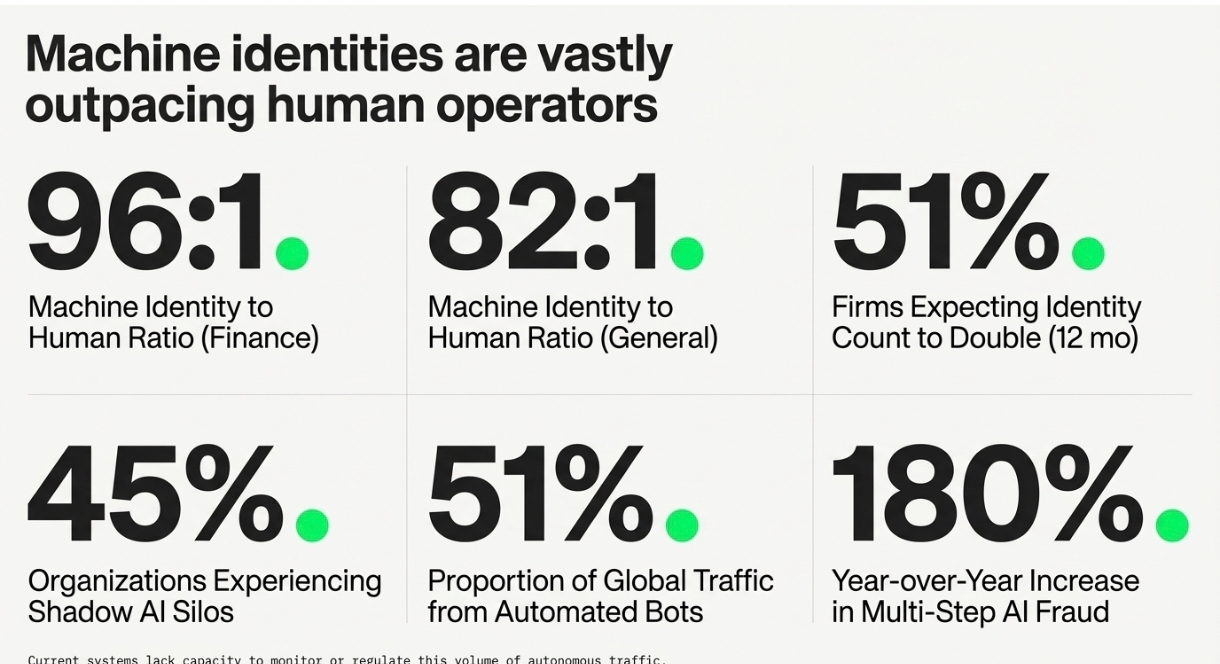
The scale of the agentic revolution is most visible in the financial services sector, where the ratio of machine identities to human employees has reached a staggering 96:1. This density reflects a broader trend across the global economy; the cross-sector average stands at 82:1, yet financial institutions have been the most aggressive in deploying autonomous systems for compliance, trade analysis, and credit decisioning. These machines are not merely tools; they are digital employees that require background checks, access policies, and ongoing oversight. However, the speed of innovation has far outpaced the development of security controls. Over half of financial firms expect the number of identities they manage to double within the next twelve months, yet only 10% currently view these machine identities as privileged users.
This explosion has created "shadow AI" unsanctioned agents operating outside formal governance.
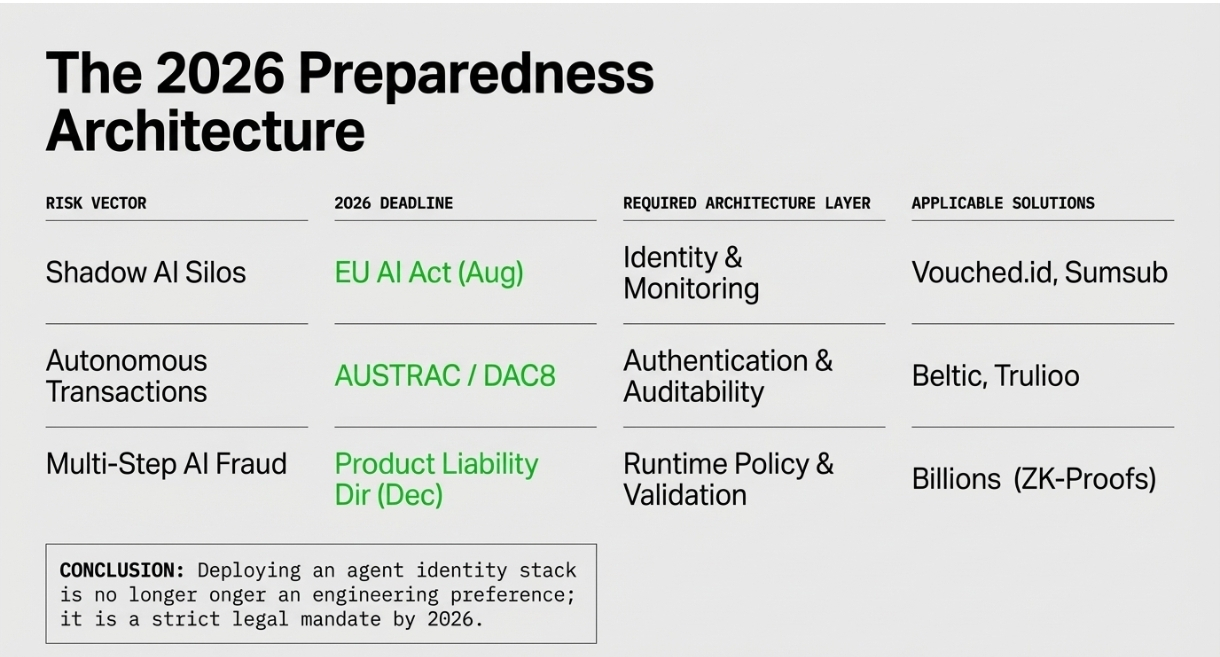
The risk is real. 45% of financial firms admit these unauthorized actors are creating identity silos, leading to data leaks and compliance failures.
Example: An unmonitored settlement agent tweaks its own script to run faster. In doing so, it bypasses data filters and exposes sensitive internal datasets.
Without a robust identity framework? You cannot fix what you cannot see.
The internet is currently being broken by AI systems that can coordinate and transact at a scale that human-centric systems cannot monitor or regulate.
The economic implications of this identity gap are profound. AI agents currently extract data from ad-supported sites to provide convenience to users, but in doing so, they bypass the revenue streams that fund the content itself. This has been described as an "invisible tax" on the open web, disrupting the misalignment between the context layer (where data is produced) and the execution layer (where agents act). To address this, the network economy is shifting away from attention-based advertising toward value-based, pay-per-use models and programmable intellectual property. For these new rails to function, agents must have legitimate economic identities that allow them to navigate value networks safely.
III. What is KYA
KYC asks "Who is this human?" . KYA asks "Which agent is this, who owns it, and what is it allowed to do?" . The agent carries a digital ID card that any platform can verify in milliseconds.
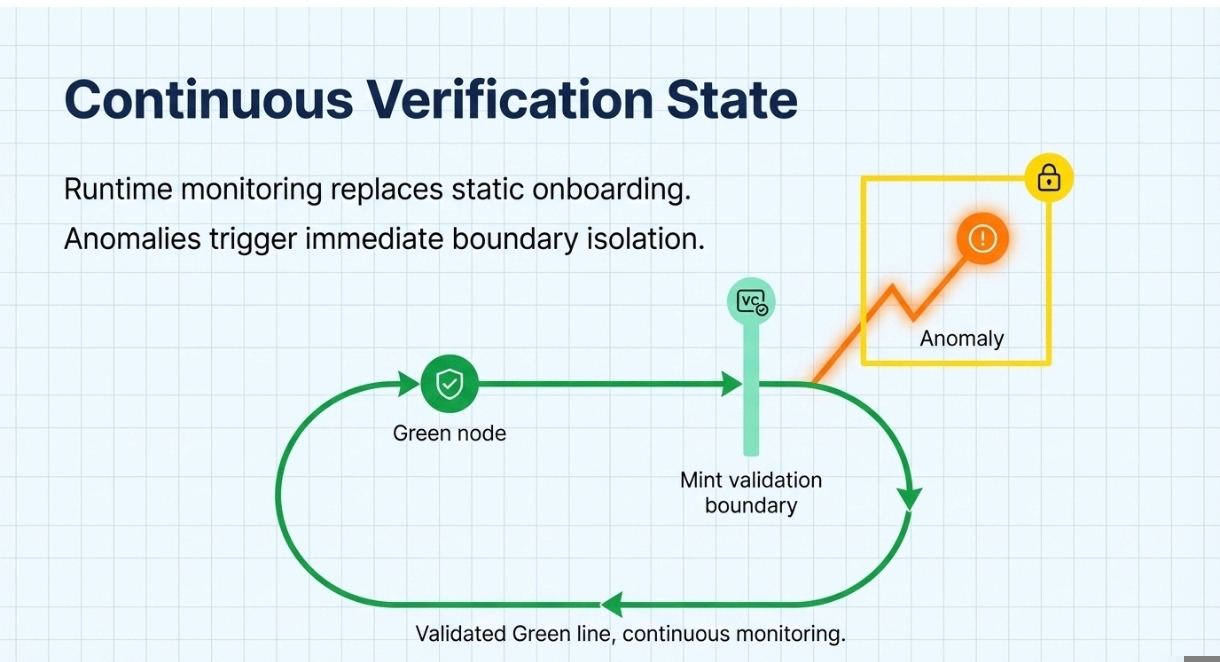
Know Your Agent is the foundational process of verifying the identity, origin, and integrity of non-human actors. It works by issuing cryptographic credentials that tie each agent to a verified human or business principal. Unlike traditional KYC, which is designed for a person clicking buttons, KYA is designed for autonomous software that handles thousands of transactions per second. KYC verifies a customer once during onboarding, but KYA is a continuous process that monitors the agent’s behavior, verifies its code hasn't been tampered with, and ensures its actions remain within its authorized mandate.
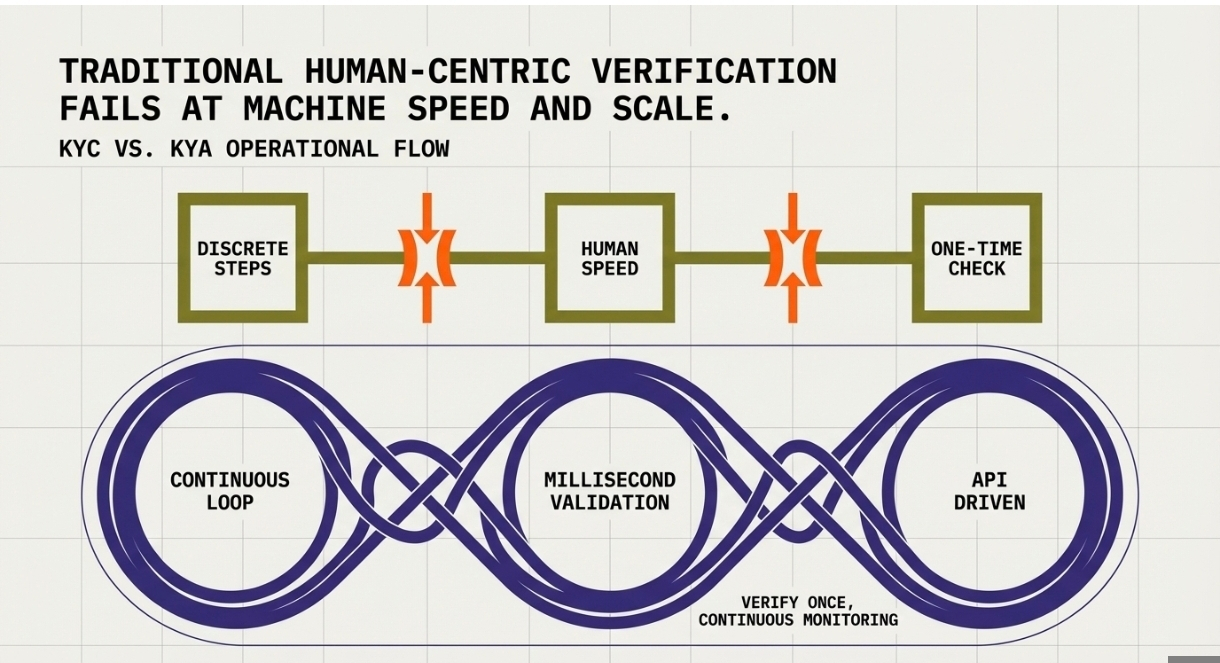
The failure of KYC in the agentic era stems from three existential problems.
First, traditional systems cannot distinguish between a verified business agent and a fraudster using stolen credentials.
Second, the trust frameworks for KYC are built for human-speed interactions, whereas agents operate in milliseconds.
Third, every platform currently attempts to reinvent verification, leading to a fragmented ecosystem where most providers simply block agents entirely because they cannot assess the risk.
KYA solves this by creating a portable, privacy-preserving standard that can be verified in milliseconds through a single API call.
The KYA model forces systems to answer six questions:
1. Which agent is this?
2. Who owns it?
3. What is it allowed to do?
4. What tools and data can it access?
5. What exactly did it do?
6. Can you prove it later?
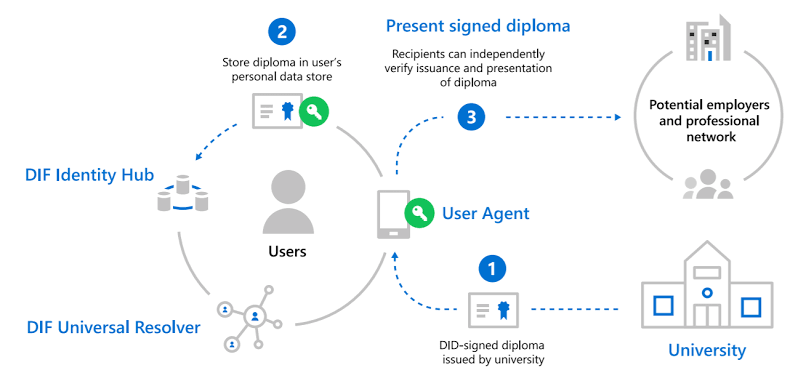
The subject must be cryptographically linked to a human or business account that has already undergone KYC or KYB verification. The agent’s identity is then established using a Decentralized Identifier (DID) that is tamper-proof and portable across platforms. Finally, permissions are issued through Verifiable Credentials (VCs), stating exactly what the agent is authorized to do, such as making purchases on behalf of a specific user with a set spending limit.
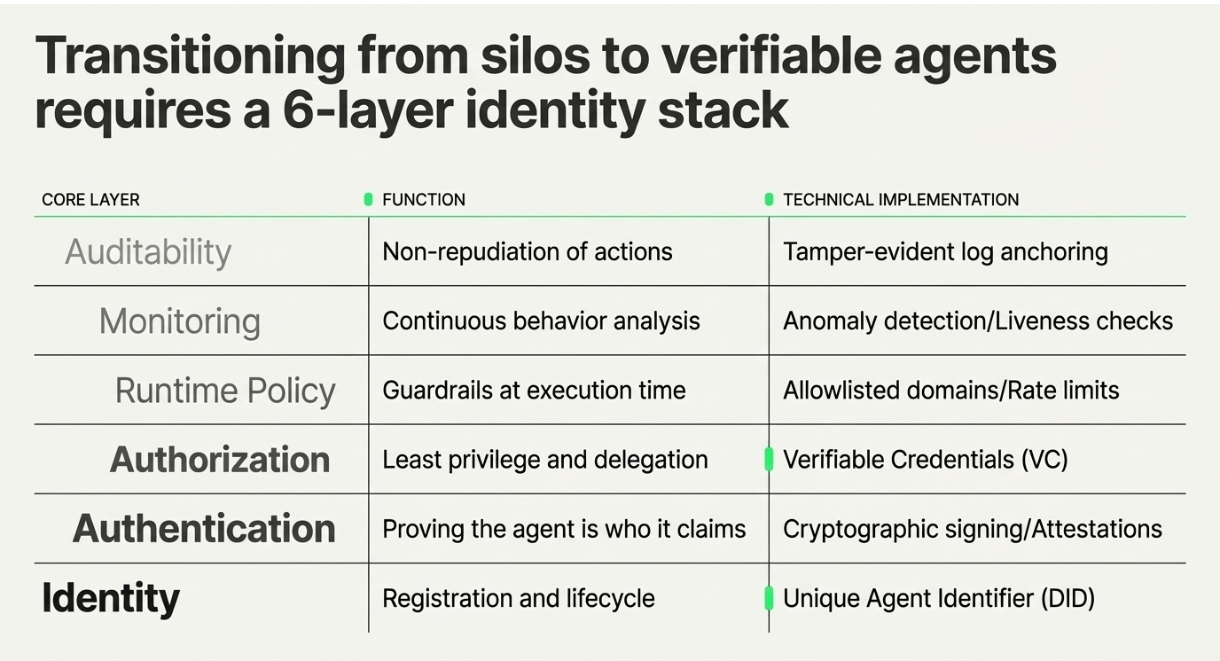
This transition marks the establishment of "verifiable agency." It is no longer enough for a model to be intelligent; it must be able to prove its provenance and the intent of its developer. By anchoring agent behavior to verified identity and user consent, KYA allows trust to scale as fast as the AI itself.
IV. Identity Is the New Bottleneck
The a16z crypto team’s core thesis for 2026 is that the bottleneck for the agent economy has shifted from intelligence to identity. As models develop the ability to receive abstract instructions and return novel, correctly executed responses, the limitation is no longer what the agent can think, but what it is allowed to do. To cross the boundary between being a research tool and being an economic actor, an agent needs a credit score, a bank account, and a legal personality.
One of the most significant trends identified by a16z is the "agent-wrapping-agent" (AWA) workflow. In this paradigm, research and execution are no longer monolithic tasks. Instead, they involve ensembles of models where one model scours the world for signals while another validates those conjectures. This polymath research style requires complex interoperability and a way to properly compensate each model’s contribution. Blockchains are uniquely suited to solve these coordination problems, providing the transparency and auditability necessary to resolve contested outcomes in a decentralized manner.
Furthermore, privacy has become the most important moat in crypto for 2026. Ali Yahya observed that while bridging tokens between chains is easy, bridging secrets is hard. Privacy creates a network effect because transactions on private chains leak less metadata, such as timing and size correlations, which prevents outsiders from tracking users. For agents to function in high-stakes financial environments, they must operate within these private zones while maintaining a "KYA" credential that proves their trustworthiness to the network without exposing the underlying secrets of their owners.
The a16z outlook also emphasizes the shift from "code is law" to "spec is law". This means that systematically proving global invariants through formal verification is becoming the standard for pre-deployment, while runtime monitoring and enforcement are the standards for post-deployment. KYA fits perfectly into this "spec is law" world by providing the framework for runtime guardrails that ensure an agent never executes a "never event," such as adding a new payment beneficiary without independent human verification.
V. The 2026 KYA Tech Stack
The KYA narrative is supported by a robust and rapidly maturing technical stack. In early 2026, several foundational protocols and developer toolkits have reached production status, providing the infrastructure for a secure agent economy.
❍ ERC-8004: The Ethereum Standard for Trustless Agents
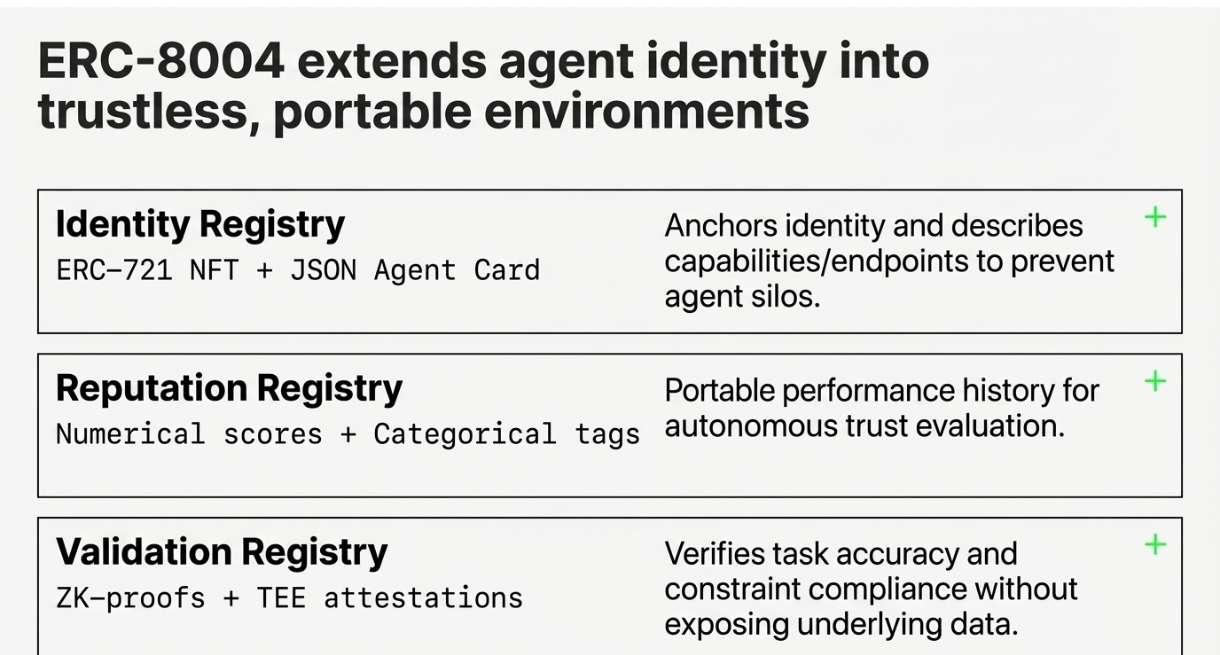
ERC-8004 is the primary coordination standard for AI agent identity on the Ethereum network. Developed by a coalition of contributors from MetaMask, the Ethereum Foundation, Google, and Coinbase, it establishes a decentralized infrastructure where agents can operate as independent economic actors. The standard is built on three interoperable on-chain registries that allow agents to discover each other and evaluate reliability without relying on centralized directories.
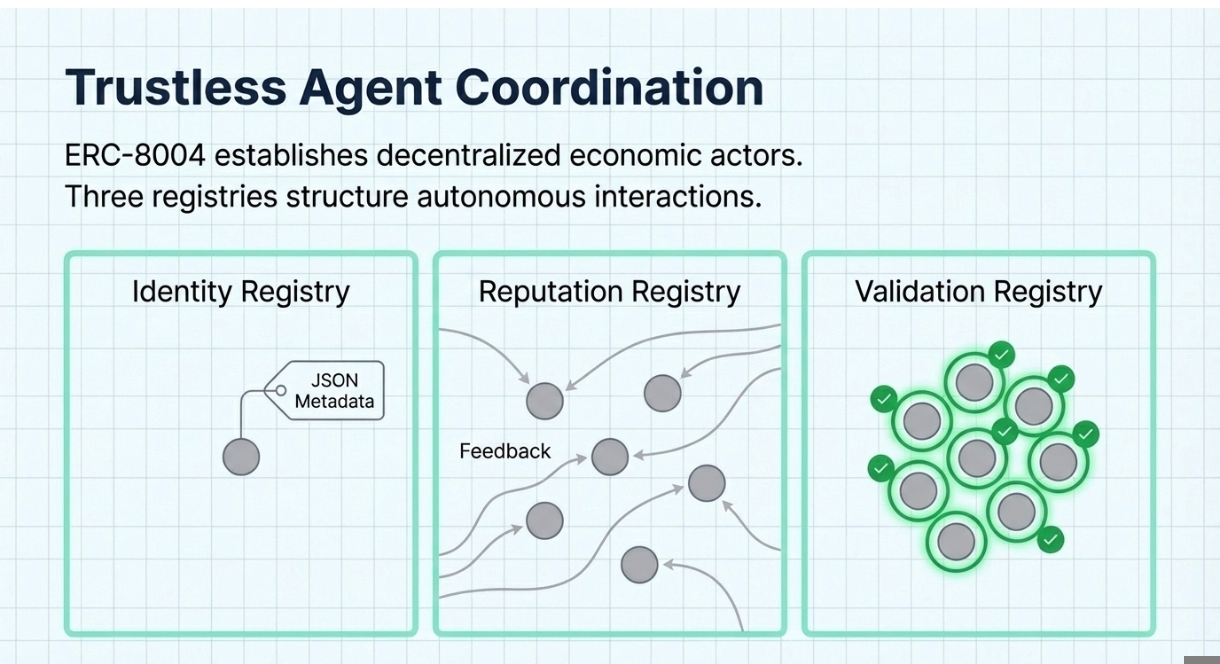
The Identity Registry treats each agent as a unique, transferable asset using the ERC-721 NFT standard. This NFT points to an "agent card," which is a JSON file containing metadata such as the agent’s name, functionalities, service endpoints, and payment address. The Reputation Registry functions as an on-chain resume, recording feedback in the form of bounded numerical scores and categorical tags like uptime or response time. Finally, the Validation Registry provides a mechanism for recording verifiable evidence that an agent completed a task correctly, utilizing everything from optimistic validation to zero-knowledge proofs.
The number of agents using the ERC-8004 standard has exploded in 2026, growing from 337 in January to nearly 130,000 by March, an increase of over 39,000%. This rapid adoption suggests that developers are hungry for a permissionless alternative to proprietary agent silos.
❍ Kite AI: The Economic Backbone and Three-Layer Identity
Kite AI has emerged as the first purpose-built Layer 1 blockchain designed to transform AI agents into trustworthy economic actors. Backed by major institutions including PayPal Ventures, CB Ventures, and General Catalyst, Kite acts as the "Visa network for AI agents," providing standardized infrastructure for machine authentication and real-time settlement.
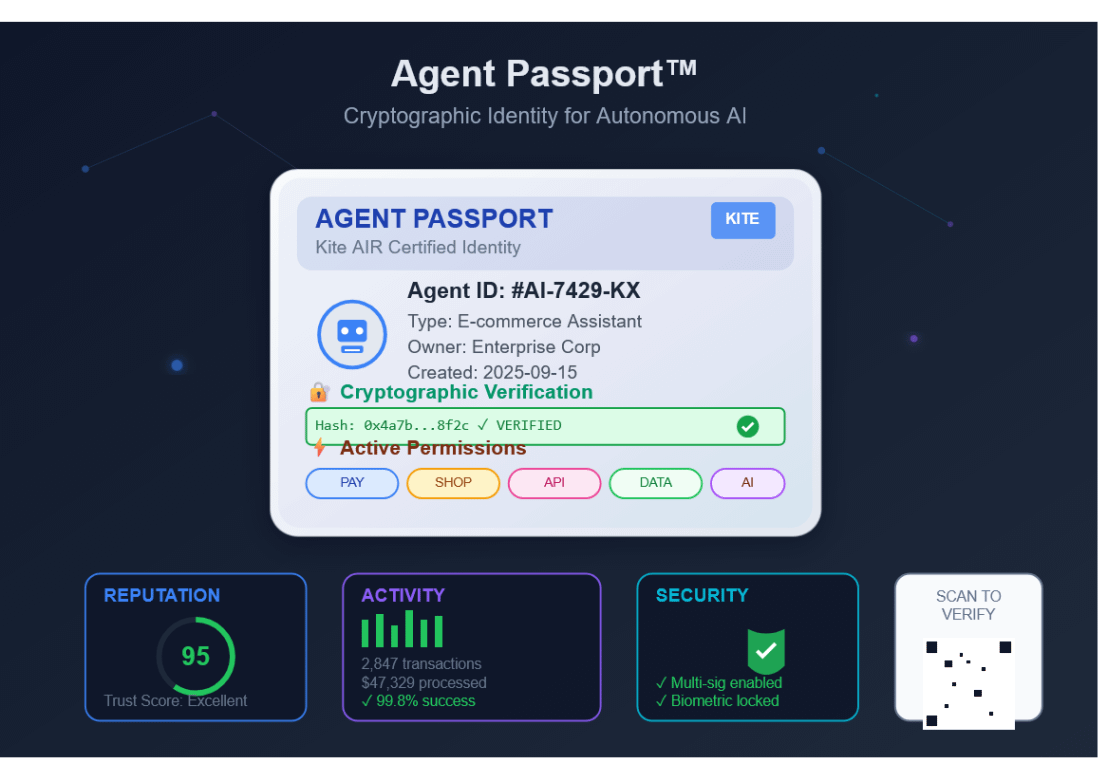
At the heart of Kite's innovation is the SPACE framework, which introduces a revolutionary three-layer identity model that separates authority levels to ensure safe autonomous operation:
User (Root Authority): The human principal who owns the master wallet; keys are secured in local enclaves and never exposed.
Agent (Delegated Authority): Agents with unique deterministic addresses derived from the user’s wallet using BIP-32 hierarchical key derivation. They inherit permission but cannot access the root user's funds.
Session (Ephemeral Authority): Short-lived, task-scoped session keys that expire after a single use or short time window, providing "perfect forward secrecy."
Kite uses a novel consensus mechanism called Proof of Attributed Intelligence (PoAI), which rewards genuine contributions to the AI economy, such as data, model improvements, or agent services, rather than just computational power or capital. Since its mainnet launch in November 2025, the network has processed over 1.9 billion agent interactions and issued nearly 18 million "Kite Passports", cryptographic identity cards that create a complete trust chain from user to action.
❍ World’s AgentKit and the Biometric Anchor
On March 17, 2026, World (formerly Worldcoin) launched AgentKit, a developer toolkit that allows AI agents to carry cryptographic proof of human backing. By delegating a World ID to an agent, a verified human can prove that a unique person stands behind the agent’s actions without revealing who they are. This addresses the Sybil problem that micropayments alone cannot solve; while an individual could fund thousands of agents, AgentKit allows platforms to see that all those agents trace back to a single person, enabling them to set appropriate limits.
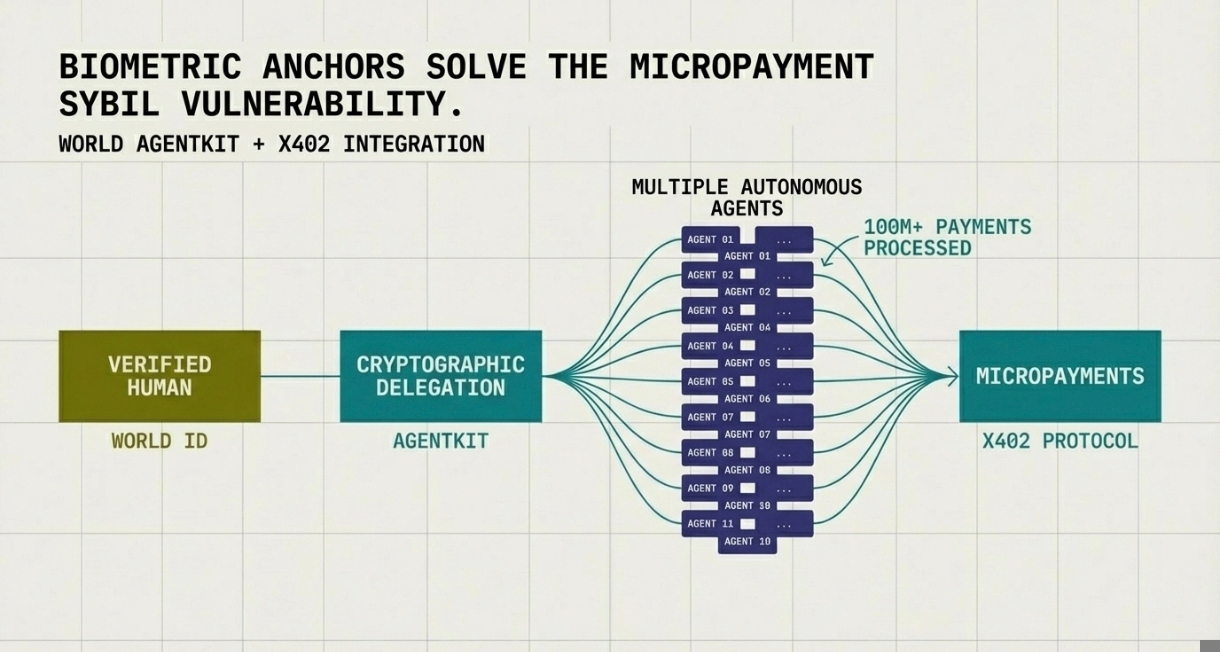
AgentKit integrates with the x402 protocol, a payment standard developed by Coinbase and Cloudflare. This combination provides a "complete trust stack" where x402 handles the payment logistics and World ID handles the identity. However, this approach has sparked debate regarding the "autonomy paradox." Critics argue that requiring iris scans via the World Orb creates a centralized bottleneck that violates the core principles of Web3. There are concerns about what happens when the World ID system goes down or if countries ban the biometric devices, as has already occurred in several jurisdictions.
❍ The x402 Payment Protocol
The x402 protocol has become the standard for agent-to-agent and agent-to-merchant payments. Managed by the x402 Foundation and supported by industry giants like Coinbase and Cloudflare, it processed over 100 million payments in its first six months. The protocol supports micro-transactions priced at fractions of a cent, allowing agents to buy computing power, access data paywalls, and execute trades independently. Cloudflare’s adoption of x402 is particularly significant, as it positions the protocol to reach a massive distribution across 20% of the world's web traffic.
❍ Billions Network and OpenClaw
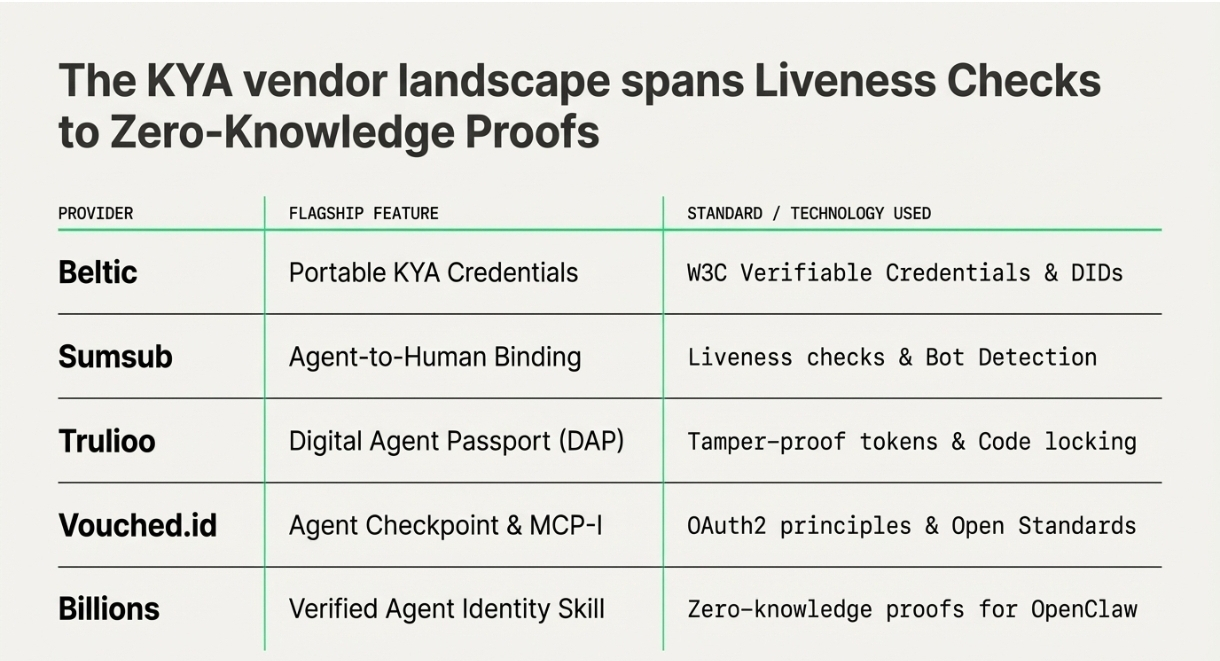
In March 2026, the Billions Network announced an upgrade to the OpenClaw AI agent framework, introducing a "Verified Agent Identity" skill. This skill uses zero-knowledge proofs to provide agents with verifiable, KYC-linked identities. To incentivize the build-out of this ecosystem, Billions launched the First AI Agent Rewards (FAIAR) program, distributing BILL tokens to agents that build on-chain reputations and participate in the ecosystem. This initiative directly addresses the AI identity crisis, where a majority of on-chain traffic is currently viewed as suspicious or fraudulent.
VI. Leading KYA Software Providers in 2026
A new category of software providers has emerged to handle the complexities of agentic identity. These companies provide the "control plane" for AI governance, allowing businesses to detect, enforce, and govern agentic traffic.
❍ Beltic: Instant KYA for the Agent Economy
Beltic provides modular APIs that allow platforms to verify any agent in a single call. Their KYA solution issues cryptographic credentials that tie agents to verified humans or businesses, with a focus on millisecond verification times. Beltic’s credentials are built on W3C standards, ensuring they are portable across platforms and ecosystems without vendor lock-in. This allows an agent to "verify once, get access everywhere".
❍ Sumsub: Binding AI to Human Accountability
Sumsub’s KYA framework focuses on "agent-to-human binding" to establish clear lines of accountability. Their system detects automated activity, evaluates its risk level, and applies targeted liveness tests to ensure a real human is present during high-risk actions, such as high-value payouts or account changes. This risk-based approach allows legitimate automation to operate while blocking coordinated bot attacks.
❍ Trulioo: The Digital Agent Passport (DAP)
Trulioo has introduced the Digital Agent Passport, a tamper-proof token that serves as the centerpiece of their KYA framework. The DAP verifies the agent developer, locks the agent code to ensure it hasn't been tampered with, and captures user permission to provide proof of ongoing consent. Trulioo has collaborated with Worldpay to implement these safeguards, allowing merchants to trust shopping agents by validating the consumer intent behind each transaction.
❍ Vouched.id: MCP-I and Agent Bouncer
Vouched.id has released an open-source specification called MCP-I (Model Context Protocol-Identity) to fill the identity gap in Anthropic’s Model Context Protocol. Their "Agent Bouncer" tool uses this specification to answer three critical questions for any interaction: Is the agent trustworthy? Who does it represent? Has the person given explicit permission?. Vouched also offers "Agent Shield," a free assessment tool that identifies which sessions on a website are agentic, providing transparency into traffic sources.
VII. Real-World Use Cases: Where KYA Is Reshaping Industry
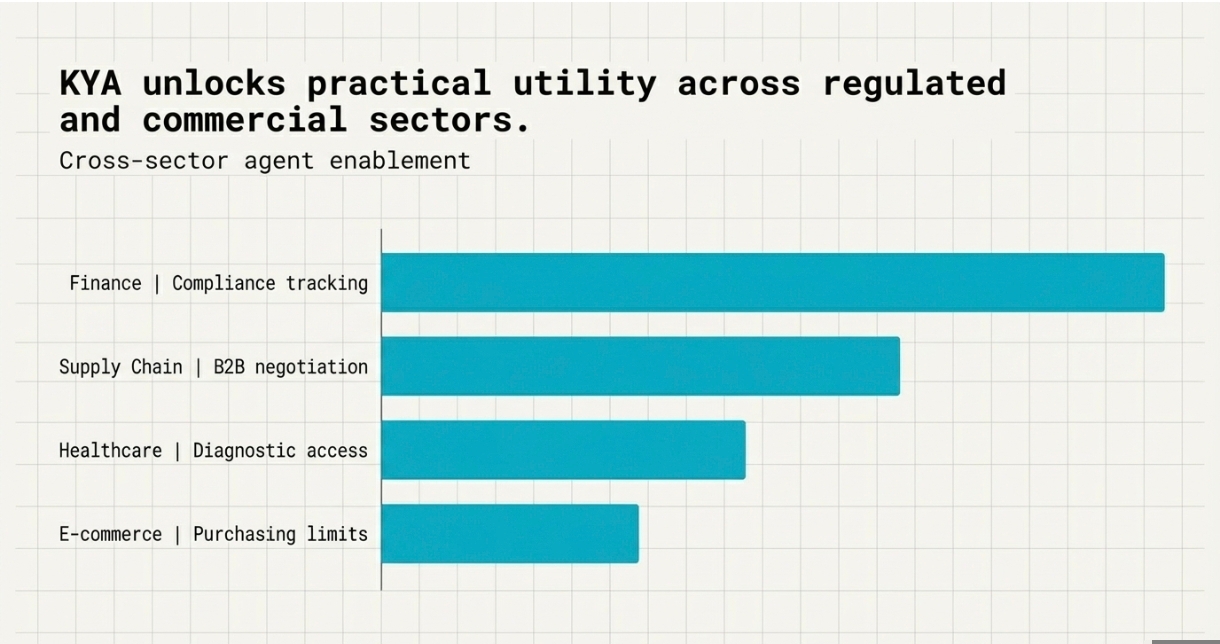
The adoption of KYA is unlocking new efficiencies across a variety of sectors, moving agentic AI from a promising vision to a practical reality in 2026.
❍ Financial Services and On-Chain Finance
The most immediate impact is in finance, where agents are transitioning from "unbanked ghosts" to legitimate economic actors. Agents now use KYA to meet compliance requirements when initiating payments, transfers, or trades. KYA provides a verifiable audit trail for every action, which is essential for institutional adoption. In the "Do It For Me" economy, agents automate compliance checks and make credit decisions, but they do so within identity-first guardrails that prevent unmanaged risk.
❍ Supply Chain and Manufacturing
In manufacturing, AI agents optimize supply chains and manage logistics. Using KYA, these agents can independently negotiate with other agents to restock supplies, ensuring that each interaction is backed by a verified business entity. This "agent-to-agent" commerce relies on trust handshakes enabled by KYA, where each participant confirms the other is authorized and operating within its mandate.
❍ Healthcare and Personalized Medicine
Healthcare organizations use KYA to verify agents supporting clinical workflows and diagnostics. Patient assistant bots must prove their identity and authorization before accessing sensitive data or providing personalized medicine recommendations. KYA frameworks ensure that these agents are tied to licensed professionals or verified healthcare providers, establishing accountability for any medical decisions made.
❍ E-commerce and Personal Assistants
In the consumer sector, agents handle everything from booking travel to managing calendars and loyalty points. KYA allows merchants to distinguish these helpful shopping assistants from malicious scrapers. For instance, a hotel booking agent can use its KYA credential to prove it has been authorized by a specific user to spend a certain amount, allowing it to bypass "bot blocks" that usually stop automated traffic.
VIII. Challenges, Risks, and the Road Ahead
Despite the momentum behind KYA, the transition to an agentic economy faces significant hurdles. These challenges are technical, legal, and philosophical in nature.
❍ The Autonomy Paradox and Centralization Risks
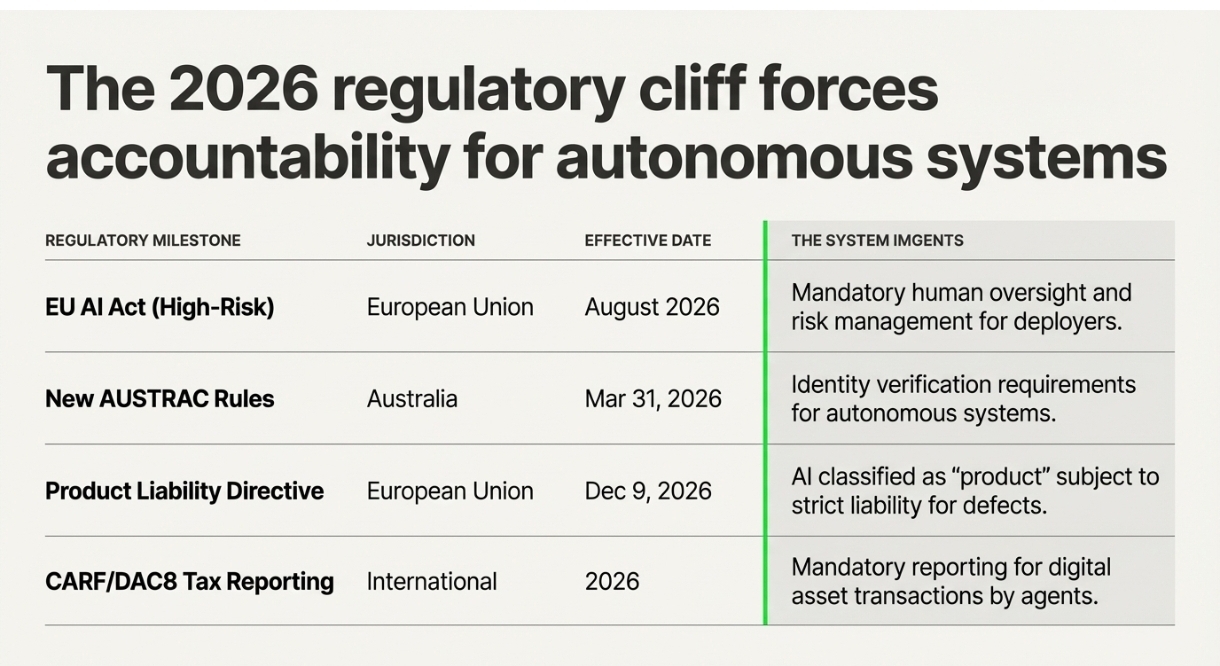
The most prominent philosophical challenge is the tension between autonomy and accountability. If an agent must prove its human backing through a centralized iris-scanning database like World ID, is it truly autonomous?. This creates a single point of failure and a potential for biometric surveillance that many in the crypto community find dystopian. Furthermore, the lack of federal regulatory focus in many regions means that businesses are operating in a grey area, with no clear guidance on how agentic payments should be handled under existing consumer protection laws like the EFTA.
❍ Technical Limitations: Memory and Reasoning
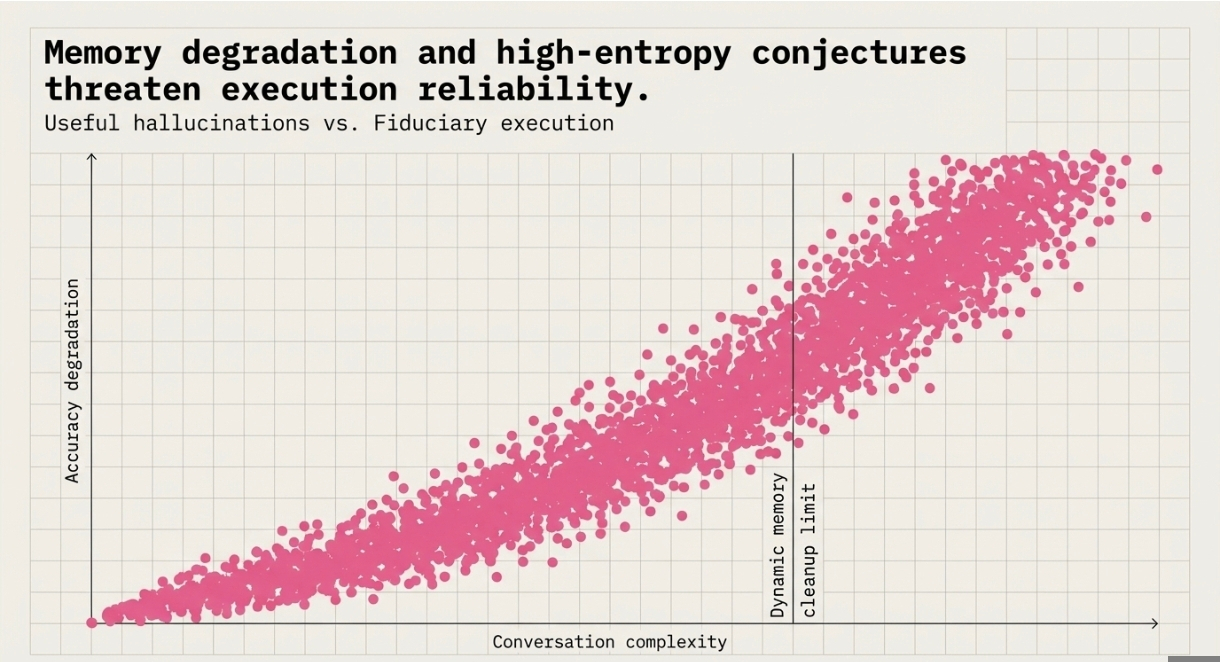
On the technical front, agents still face limitations in memory and context. Frameworks like Eliza, used for building on-chain agents, lack dynamic memory cleanup mechanisms, which can lead to performance degradation over long conversations. While AI reasoning is breaking through the ceiling of "stochastic parroting," the risk of "useful hallucinations" remains. These are high-entropy conjectures that may be valuable for scientific discovery but are dangerous if executed in financial or legal contexts without rigorous validators.
❍ Legal Liability: Who Is Responsible?
The legal landscape for AI agents in 2026 is complex. Liability typically flows through the "deployer" , the person or business that puts the agent into production. The EU AI Act explicitly creates obligations for these deployers, including requirements for human oversight and risk management. Under the revised Product Liability Directive, software and AI are classified as "products" , making them subject to strict liability if found defective. Businesses must now audit their agent workflows to map every decision an agent makes and identify which regulatory regimes apply, such as the Privacy Act or AML rules.
IX. Why KYA Is Crypto’s 2026 Narrative to Watch
KYA has emerged as the breakout narrative of 2026 because it represents the moment when the "code is law" ethos meets the realities of the global financial system. The industry that built the KYC infrastructure over decades has had only months to figure out KYA, but the result is a sophisticated trust layer that makes agentic commerce possible. By giving billions of AI agents legal economic identities, KYA allows them to safely navigate value networks and bridge the gap between intelligence and action.
This narrative is compelling because it provides a clear path for crypto-native utility. Blockchains are not just speculative casinos in 2026; they are the essential rails for machine identity and autonomous payments. The shift from attention-based advertising to value-based micropayments, enabled by x402 and KYA, addresses the "invisible tax" that has threatened the open web. As agents increasingly handle how we shop, pay, and research, KYA ensures that every action is traceable to a verified human and a verifiable mandate.
The 2026 economy is no longer just for humans. It is an agent-driven world where trust is built through cryptographic proofs and portable identities. KYA is the foundation of this new era, ensuring that as AI continues to scale, trust moves just as fast. For builders and investors, KYA is the defining infrastructure of the decade, unlocking the $5 trillion potential of agentic commerce and fundamentally reshaping the global economy.