
First, the signal is not a technology, but a "pricing power infrastructure".
The essence of "Project Samara" is not a blockchain experiment, but a systemic verification of putting sovereign-level assets on the blockchain:
* Issuer: Government Credit (Export Development Agency)
* Participating Institutions: Toronto-Dominion Bank, Royal Bank of Canada
* Underlying technology: Hyperledger Fabric
* Coverage Process: Issuance → Bidding → Coupon → Redemption → Secondary Trading (Full Lifecycle)
what does that mean?
👉 The path from "cash flow assets → programmable securities → tradable shares" has been established.
Once this path holds true, the first assets to be revalued will not be financial assets, but rather—
Energy assets possess stable cash flow, low cost, and strong cyclical characteristics.
II. Why Canada? A triple closed loop of energy, credit, and institutions.
Canada possesses one of the very few "perfect RWA bases" in the world:
1) Low-cost energy (determines the underlying IRR)
* Oil extraction cost: ≈ $30/barrel
* Cost of natural gas power generation: ≈ $0.015/kWh
* Power stability: North American power grid + resource redundancy
👉 Conclusion: One of the world's best "cash flow underlying assets"
2) Sovereign credit backing (determines the anchor for asset pricing)
* Government bonds have completed on-chain issuance verification.
* The banking system (TD + RBC) participates in the actual flow of funds.
* Regulatory attitude: Cautious but not negative (key point)
👉 Conclusion: This is not unchecked growth, but rather "regulated financialization".
3) Energy → Electricity → Computing Power (determines the demand growth curve)
The underlying logic of the AI era has shifted:
The issue isn't "who has the model," but rather "who has the electricity."
Canada is taking shape:
Oil → Natural Gas → Power Generation → AI Computing Power → Stable Cash Flow
👉 RWA's ideal asset model:
Strong cash flow + strong demand growth + standardization
III. Core Model: Energy RWA IRR Decomposition
Let's get straight to what investors care about most: the return structure.
1) Asset-level IRR (underlying project)
Taking the "oil and gas well + gas-electricity integrated project" as an example:
* Single-well IRR: 18% – 28%
* Natural gas power generation IRR: 12% – 20%
* Overall IRR (after synergy): 20% – 30%
Key areas for improvement:
* Self-generated electricity reduces energy costs
* Secure long-term power purchase agreements/hashrate contracts.
* Hedging against oil and gas price fluctuations
2) RWA Structure Premium (Financial Layer)
"Secondary benefits" generated after being uploaded to the blockchain:
* Liquidity premium: +3% – 5%
* Fractionalization: +2% – 4%
* Global funding access (non-local capital): +3% – 6%
👉 Overall IRR after RWA: 25% – 40%
3) Fund-level IRR (LP perspective)
The structural design is as follows:
* GP: Energy Operator + Asset Manager
* LP: USD/Stablecoin Funds
* Investment period: 3–5 years
* Dividends: Quarterly cash flow distribution
Typical structure:
* Priority Partners (LPs): 8% – 12% Fixed Income
* Profit sharing: 70% LP / 30% GP
👉 LP target IRR: 18% – 25% (high visibility)
IV. Fund Structure Design
Architecture 1: SPV + RWA Token
Oil and gas assets → Project Company (SPV)
↓
Package of beneficial rights
↓
On-chain token issuance
↓
Investors subscribe
Features:
* Legal assets are held off-chain (secure).
* The right to the proceeds is on-chain (flowing).
* Compliant with existing regulatory framework
Architecture 2: Bond-type RWA (refer to Samara)
A direct analogy to this pilot program:
* Issuance of "Energy Revenue Bonds"
* Fixed term (3 months / 1 year / 3 years)
* On-chain coupon payment
👉 Benchmarking:
Government bonds → Energy cash flow bonds
Architecture 3: Equity + Token Two-Tier Structure
* Equity: Locking in long-term control (GP layer)
* Token: Releases liquidity (LP layer)
👉 Solve the core problem:
"Traditional energy is illiquid vs. crypto assets have no underlying asset"
V. Exit Path
Exit Path 1: On-Chain Secondary Market
* Token Trading
* Liquidity pool
Market maker intervention
👉 Similar to a "bond trading market"
Exit Path Two: Traditional Finance
* Bank/insurance funds purchase
* ESG Fund allocates to energy assets
👉 Essence: On-chain pricing → Off-chain exit
Exit Path Three: Mergers & Acquisitions/Asset Sales
Sold to a large energy company
* Sold to infrastructure funds
👉 Exit multiplier: 1.5x – 3x
Exit Path Four: Cash Flow Recovery (Most Stable)
* Quarterly dividends
Payback period: 3–5 years
👉 Suitable for conservative LPs
VI. Why "now": The window of opportunity is extremely short.
Three variables are happening simultaneously:
1) Increased geopolitical risks in the Middle East (supply uncertainty)
* Risks in the Strait of Hormuz
* Periodicity of political conflict
👉 High-cost and unstable energy sources
2) Explosive growth in AI computing power (demand confirmed)
Data center electricity consumption is growing exponentially.
* Electricity becomes the new "oil"
3) Financial infrastructure has just been opened
* Project Samara validates "on-chain bonds"
* The banking system has begun to connect.
👉 Window of opportunity assessment: 1–3 years
VII. Core Conclusions (LP Decision-Making)
To summarize in one sentence:
This is an opportunity to "rebuild pricing power for traditional energy cash flow assets using Web3".
Canada is currently the only country that possesses both of the following characteristics:
* Low-cost energy
Sovereign credit endorsement
* Financial system participation
* Policy does not ban
The market.
VIII. The Last Sentence
Not all RWAs are worth voting for.
But after "government bonds have been put on the blockchain"—
The next step will definitely not be NFTs, nor MEMEs.
Instead:
The full financialization of oil, natural gas, and electricity—these "real, high-profit cash flow assets."
And this time,
Those who acquire assets first have the power to set prices.
Previous Readings:
ECOCHAIN (Canada): An eco-friendly investment group rooted in North America and connecting the world.
Christian Yuan, Chairman of ECOCHAIN (Canada)
Jiang Tai, CEO of ECOCHAIN (Canada)
Electricity as computing power: Canadian natural gas power generation is becoming an undervalued "money-printing machine" for Bitcoin mining.
The perfect fusion of energy and BTC: Chainlink Group's "Gas-Power Coin" project empowers the natural gas and biogas power generation market!
In-depth analysis of Canada's computing and co-working industry: From "natural gas power generation" to "computing assets," the birth of a trillion-dollar new infrastructure.
Canada Clean Power Industry Investment Analysis Report (2026): Natural Gas Power Generation + Agricultural Distributed Power Generation + Biogas Power Generation
Canadian Chain Group: Energy industry – oil and gas well development, natural gas power generation, waste recycling and data center construction and operation.
"Oil extraction cost of $30/barrel, natural gas power generation cost of $0.015, PE ratio of 40: The Alchemy of Valuation Manipulation for Canadian 'Energy Computing Stocks' IPOs (Part 1)"
15% of Bitcoin mining machines worldwide are starting to lose money: Low-cost Canadian energy is reshaping the Bitcoin hashrate landscape!
Big winners amid soaring oil prices! Canadian oil production is poised for explosive growth by 2026, with production guidance revised upwards across the board. Benefits from the TMX boom and soaring Asian exports further fuel the surge.
Middle Eastern production capacity is "irreversibly damaged": the certain cash flow of low-cost energy belongs only to Canada!
Canada: Low-cost, secure, and stable energy → electricity → computing power → AI output tokens = a new era of "money printing machine"
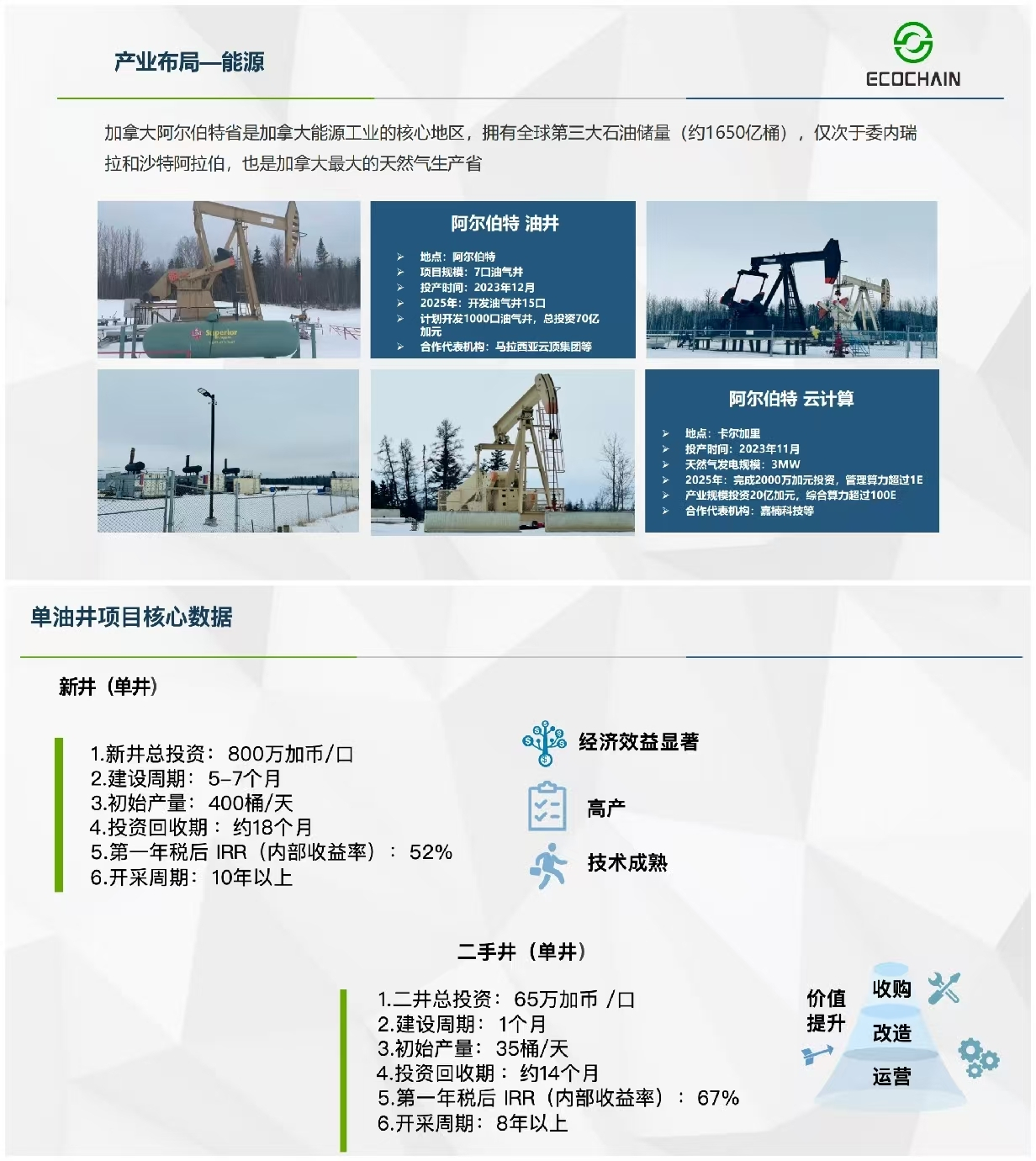
The following are the cooperative business opportunities in Canadian oil exploration:
Add WeChat VCBLO1 (please include your name and collaboration needs in your message).