

📝 Hello everyone, I am 𝟏𝟎. Recently, the popularity of AI has surged to new heights, with terms like OpenClaw, Claude Code, Agent, and MCP trending one after another. Everyone is discussing how AI can change the world.
But ultimately, what truly turns AI into a business is solving a very practical problem: if AI really provides services, schedules tools, buys data, and even completes transactions automatically in the future, how should it charge in a reliable manner.
👇👇👇
1. Solving payment issues: the core goal of x402
This is the core issue that x402 aims to solve. Its goal is actually quite simple: to make transactions between machines and AI no longer a complex process, but rather direct and natural, charging for each service rendered, with all payments automatically completed without cumbersome steps.
x402 is not a new concept, but its real value lies in its progress from empty talk to a verifiable product stage. It has begun providing infrastructure for practical applications, making payments as simple as using an API.
2. From concept to practice: the initial implementation of x402
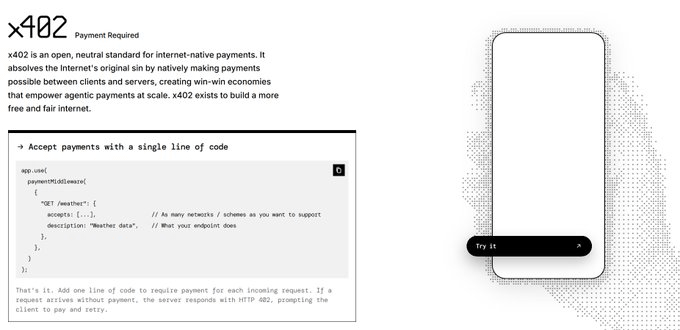
The initial idea of x402 is actually quite simple: in the past, API charging often required developers to open accounts, bind cards, subscribe to packages, and generate API Keys one by one, which was a cumbersome process. The idea of x402 is: why not simplify all these steps and complete the payment directly through a single API call, eliminating those complex processes and allowing payment and usage to occur simultaneously.
While this is a simple idea, it is not easy to implement technically. Fortunately, x402 has begun to break through the concept stage that only existed in PPTs, slowly moving towards engineering implementation. Now, x402 is gradually solving issues related to payment initiation, identity verification, and compatibility of payment methods. Moreover, it is not just Coinbase that is driving this; some external companies and developers have also started to connect.
3. The ecosystem is beginning to form, with continuous support from third parties
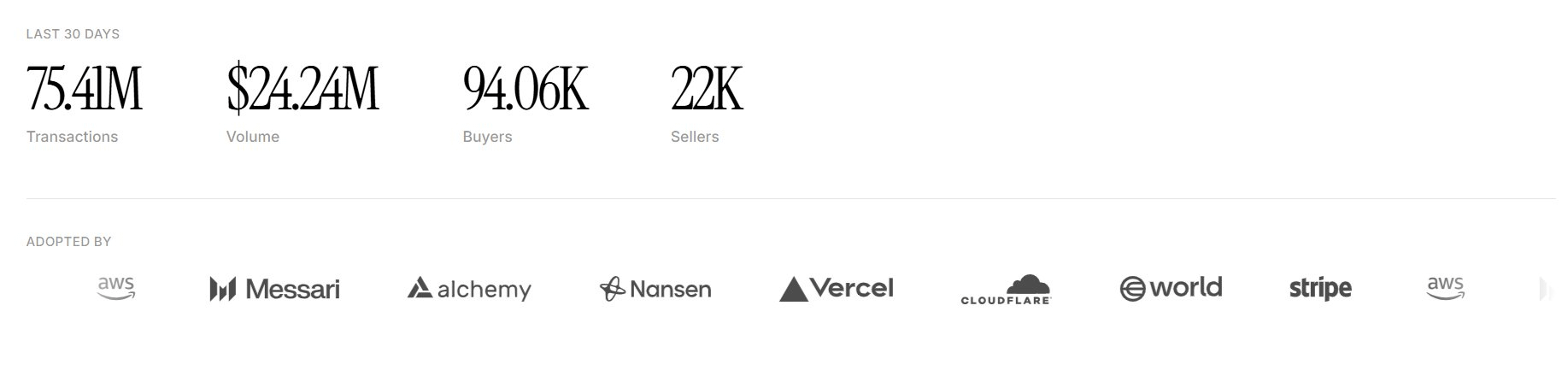
The most important point is that x402 is no longer just an internal project of Coinbase; more and more companies are starting to develop applications around it. Some use it for API charging, some use it to process payments for AI tools, and some are even trying to allow AI agents to directly purchase services, data, or other functionalities. x402 is gradually evolving from a protocol into a complete payment infrastructure.
Moreover, x402 is not a closed system like some technical protocols. Although it was initially launched by Coinbase, there are now third-party tools, payment intermediaries, and compatible services being built around it. This openness is a key factor in whether x402 can continue to grow and attract more developers.
4. The entry of major companies: Cloudflare and Google are also paying attention
One important reason why x402 is worth attention is that major companies like Cloudflare and Google have also begun to incorporate it into their development frameworks. Although they have not directly endorsed x402, including AI automatic payments as part of future products indicates that this demand is not baseless. In other words, x402 has moved from being a technical experiment in a small circle to the vision of major platforms, becoming an important infrastructure for the future between AI and services.
Google's focus may be more on the framework for AI agent payments, while Coinbase aims to provide specific solutions for the payment process. Although their paths are different, they are both trying to answer the same question: how can payments be naturally completed between AI and AI, or between AI and various online services in the future.
5. Responsibility and authorization: the legal challenges behind automatic payments
From a legal perspective, the emergence of x402 has also triggered some new thoughts. In the past, payments were always closely related to human user behavior; we manually authorize and confirm payments, and the entire process is clear. However, with AI agents automatically initiating payments, many traditional payment rules no longer apply.
This brings a new challenge: who is responsible for the payment of AI, the AI developer, the user, or the AI itself? With the popularization of automatic payment, future issues of payment responsibility and authorization will become more complex.
Thus, x402 is not just solving a technical problem; it is also driving a transformation in the payment field. It seeks to provide a specification and framework for future machine transactions, while also offering new directions for thought in the legal and business communities.
6. Summary: The future of x402 is still on the way
Overall, x402 has already moved beyond its initial form and proven itself not to be an empty concept. Its current applications are mainly focused on developer tools, AI services, and scenarios of small automatic payments. Although these still belong to the needs of the tech circle and startups, they lay the foundation for broader application scenarios.
However, it is still a bit early to say that it has become mainstream. x402 is like a new road that has just been paved; although some vehicles have started to drive on it, there is still a distance to go before it becomes a mainstream highway. In the future, whether x402 can be widely used will depend on whether more AI scenarios that require automatic payment can emerge.
Therefore, the significance of x402 lies in the fact that it is not only a technical breakthrough but also a new starting point in business and law. If this machine payment path can be successful, it will undoubtedly become an indispensable part of the commercialization process of AI, and this is precisely where we need to focus.