
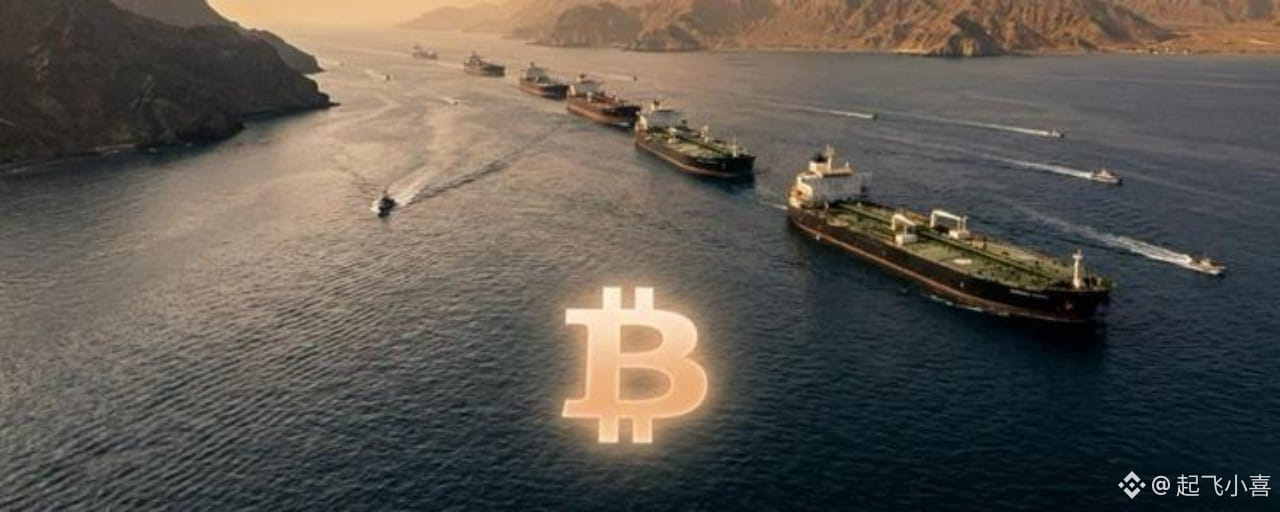
According to several foreign media reports, Iran has officially launched a disruptive rule: all oil tankers passing through the Strait of Hormuz must pay a toll of approximately 1 dollar for each barrel of crude oil loaded, with the payment method specified as Bitcoin or other censorship-resistant cryptocurrencies. Iranian military sources have confirmed that this rule has begun to be implemented under the latest two-week ceasefire agreement.
This is a sovereign country that has officially established Bitcoin, a decentralized digital asset, as the 'toll' for a national strategic channel for the first time.
Why must it be Bitcoin?
Why does Iran go to such lengths? Isn't it simpler to use other currencies directly? Even with cryptocurrencies, isn't it more stable and convenient to use USDT or USDC, which are pegged to the dollar?
The reason Iran bypasses all centralized options is that they cannot escape the same 'tightening spell'—American control. The issuers of USDT and USDC are both under U.S. jurisdiction, and accounts can be frozen at any time, turning funds into nothing in an instant.
For a long time, the narrative that 'Bitcoin is digital gold' has been controversial on Wall Street and in academic circles. Critics argue that its volatility and lack of physical backing make it merely a playground for speculators. However, Iran has provided an answer through state action. On the balance of national sovereignty and economic security, Bitcoin's 'censorship resistance' and 'decentralization' demonstrate a hard currency value akin to gold. It is not controlled by any single government or institution, and once a transaction is on the blockchain, it is immutable, making it the only reliable value transfer network in the geopolitical cracks.
I personally feel that the value construction and manifestation of assets like Bitcoin that are resistant to censorship need significant historical events to solidify them. The reason gold has the historical weight it has today is also due to countless wars, conflicts, and changes in sovereignty, which have repeatedly verified its hedging and value-preserving properties, right? Bitcoin is on the same path.
From retail speculation to sovereign settlement
During normal times, the daily oil transport volume through the Strait of Hormuz reaches about 20 million barrels. Calculating at $1 BTC per barrel means approximately $20 million in daily stable buy orders for Bitcoin, amounting to over $7 billion a year.
It is a rigid, sustained settlement demand based on national trade. The emergence of this demand signifies the evolution of Bitcoin's value logic from serving as a speculative asset for individual investors to becoming a settlement tool for sovereign nations.
The next question naturally is: Will Russia follow suit? In the protracted conflict and sanctions, Russia also faces the challenge of receiving payments for energy exports.
In the past, we discussed whether Bitcoin could become an asset allocation option for institutions. Today, we must begin to consider what terrifying level of demand and value support will be reached when national-level energy trade begins to settle in Bitcoin.
Has Polymarket already placed its bets?
Just hours before Trump announced the facilitation of a ceasefire agreement and the Strait was set to reopen, on the decentralized prediction market Polymarket, a contract regarding whether 'the Strait of Hormuz will reopen before April 10' saw its odds for the 'will reopen' option experience an abnormal and rapid surge, quickly turning the winning probability positive.
This is hard not to raise suspicions. Polymarket, as a platform that allows users to bet on future events, has long been questioned as a hotbed for insider information due to its anonymity and global reach. In the past, from corporate earnings reports to military conflicts, the platform has repeatedly seen mysterious accounts placing precise bets and profiting before official news was released.