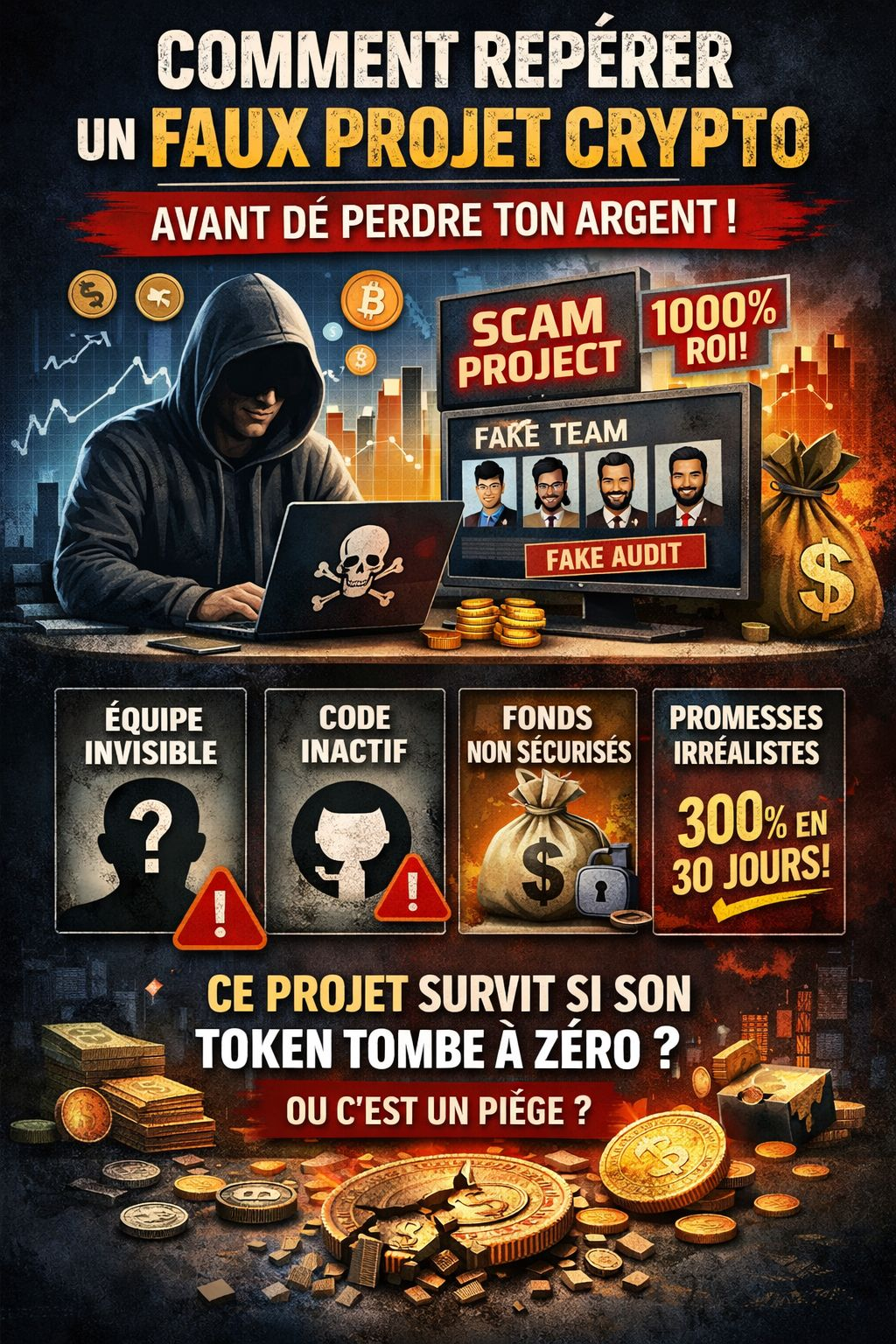
A friend sent me a link one day saying, "Dude, this project is going x10 in three months. I've already put in 500 dollars." I looked at the site. Nice design, ambitious roadmap, team with professional LinkedIn photos. Everything seemed serious.
Three weeks later, the founders had disappeared with the money of 4,000 investors.
This was not an isolated case. It's the daily reality of the crypto market.
The problem is that scammers are getting better.
In 2017, a fake project was easily spotted: poorly made site, copied-pasted whitepaper, no online presence. Today, they have websites worthy of large companies, Twitter accounts with 50,000 bought followers, and invented partnerships with well-known names.
They have learned to imitate legitimacy. And many people still don't know what to look for.
What you need to check before investing a single penny
Is the team verifiable?
This is the first question to ask. If the founders don't have a real LinkedIn profile, no history in the industry, no faces behind the names — run away. An anonymous team is not automatically suspicious, but they should at least have a verifiable history of past projects.
Is the code public?
Every serious project has an active GitHub repository. Not just created, but active — with regular updates, developers contributing, real technical activity. If the repository is empty or has not been touched in six months, it’s a red flag.
Who audits the smart contract?
An audit conducted by a recognized company like CertiK or Hacken does not guarantee anything at 100%, but it shows that the team at least wanted to verify their code. A project without an audit on a token launched yesterday is a huge risk.
Where does the liquidity come from?
On DeFi projects, ask yourself if the liquidity is locked. If the founders can withdraw all the funds from the pool at any time, you are exposed to what is called a rug pull — they empty the funds and disappear. Tools like Token Sniffer or DEXTools allow you to check this for free.
Is the promise realistic?
300% guaranteed in 30 days. No legitimate project promises that. No one can guarantee a return in such a volatile market. When a promise seems too good, it’s because it is.
All these checks take time. And that's exactly what scammers count on you not doing. They rely on impatience, on the fear of missing out on an opportunity, on market euphoria. Slowing down is already protecting yourself.
But beyond all these technical points, there is one question that summarizes everything
🎯 The only question that matters
Before every investment, I always ask myself this question:
Would this project still exist if its token dropped to zero?
If the answer is no, then it’s not a project.
It's just a game of musical chairs.
And in this game, the last always pay for the first.#HODLStrategy $BTC

BTC
64,019.99
+2.75%